

How Can You Use MLA Citation Style In Academic Writing?
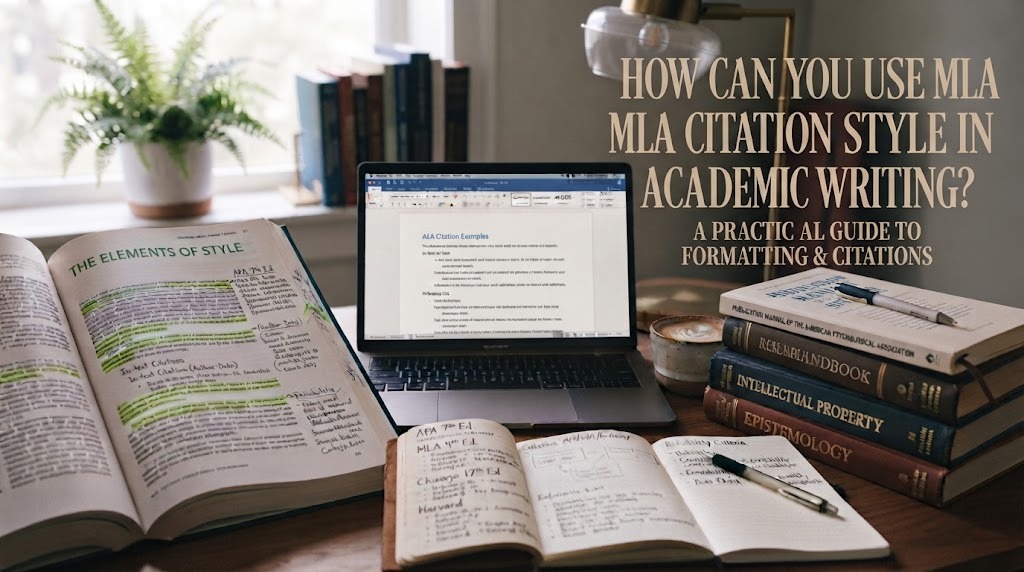
MLA citation style is one of the most commonly used citation systems in academic writing, especially in subjects related to literature, language, humanities, and cultural studies. It helps writers give proper credit to the sources they use while making their arguments more credible. By using MLA correctly, readers can easily identify where information, ideas, or quotations come from. Understanding MLA citation is therefore an important skill for students and researchers.
UNDERSTANDING MLA CITATION STYLE
MLA citation style was developed by the Modern Language Association and is widely used in academic writing within the humanities. The style provides rules for citing books, journal articles, websites, and other sources. MLA generally uses an author page format for citations within the text. For example, a paraphrased idea from a book can be followed by a citation such as (Smith 25).
MLA also requires writers to provide complete source information in a Works Cited section at the end of the paper. This allows readers to locate the original sources used by the writer. The in-text citation and Works Cited entry work together to create a clear system of source documentation. Following these rules consistently can make an academic paper more organized and trustworthy.
HOW TO USE MLA IN TEXT CITATIONS
An MLA in-text citation is normally placed directly after the information or quotation taken from a source. The citation usually includes the author’s last name and the page number, without a comma between them. For example, a quotation from a book might be followed by (Johnson 42). If the author's name is already mentioned in the sentence, only the page number needs to appear in parentheses.
When a source does not have page numbers, such as some online articles, the writer generally does not need to create a page number. The citation can use the author's name or another appropriate identifying element. Writers should make sure that every in-text citation corresponds to an entry in the Works Cited list. This connection helps readers quickly identify and check the original source.
HOW TO CITE DIRECT QUOTATIONS
When using a direct quotation, writers must reproduce the source's words accurately and provide an appropriate MLA citation. Short quotations can normally be included within the paragraph using quotation marks. The citation should be placed after the quoted material and before the final punctuation when appropriate. For example, a sentence may include a quotation followed by (Brown 18).
Longer quotations may require a block quotation format. In MLA style, a block quotation is set apart from the main paragraph and follows specific formatting rules. Writers should use block quotations only when the exact wording of the source is especially useful to their argument. After presenting a quotation, it is also helpful to explain its meaning and relevance rather than leaving the quotation without context.
HOW TO PARAPHRASE AND SUMMARIZE SOURCES
Paraphrasing means expressing information from a source in your own words while keeping the original meaning. A paraphrase still requires an MLA citation because the idea belongs to another source. Simply changing a few words from the original text is not considered effective paraphrasing. A good paraphrase demonstrates that the writer understands the source and can communicate its ideas independently.
Summarizing involves presenting the main ideas of a source in a shorter form. Like paraphrasing, a summary must include a citation when it is based on another person's ideas or research. Writers should avoid copying the structure or wording of the original source too closely. Proper citation helps distinguish the writer's own analysis from information obtained from other sources.
HOW TO CREATE A WORKS CITED PAGE
The Works Cited page appears at the end of an MLA academic paper and contains the sources cited in the text. Each entry provides information that helps readers find the original source. Depending on the source type, an entry may include the author, title, publication information, date, and location or URL. The exact information required depends on the source and the available publication details.
Works Cited entries are generally arranged in alphabetical order by the authors' last names. The page should also follow MLA formatting rules, including appropriate indentation and spacing. Writers should check that every source cited in the paper appears in the Works Cited list. Similarly, sources listed in Works Cited should normally be cited somewhere in the academic paper.
HOW TO CITE DIFFERENT TYPES OF SOURCES
MLA provides guidelines for citing many different types of sources, including books, journal articles, websites, newspapers, videos, and online publications. Each source requires slightly different information in the Works Cited entry. For example, a book citation may include the author's name, book title, publisher, and publication year. An online source may also require information such as the website name, publication date, and URL.
Writers should identify the type of source before creating its citation. It is also important to use the most reliable information available and avoid adding details that cannot be verified. When a source has multiple authors or no named author, MLA provides specific approaches for creating the citation. Checking the current MLA guidelines can help writers handle unusual or complicated sources correctly.
COMMON MLA CITATION MISTAKES TO AVOID
One common mistake is forgetting to cite borrowed ideas. Some students believe that only direct quotations require citations, but paraphrased and summarized information from sources also needs documentation. Another mistake is creating an incomplete Works Cited entry that makes the source difficult to locate. Inconsistent formatting can also reduce the clarity and professionalism of an academic paper.
Writers should also avoid relying too heavily on citation generators without checking the results. Automatic tools can sometimes produce incorrect or incomplete information, especially when source details are missing. It is better to verify every citation against the actual source and the relevant MLA guidelines. Careful checking can prevent citation errors and help reduce the risk of accidental plagiarism.
TIPS FOR USING MLA CITATION EFFECTIVELY
To use MLA effectively, start by recording source information while researching instead of waiting until the paper is finished. Keep track of authors, titles, publication dates, page numbers, publishers, and other relevant details. This habit makes it easier to create accurate citations later. It also reduces the possibility of forgetting where a particular idea came from.
Writers should also maintain consistent formatting throughout the entire paper. Before submitting an assignment, review every in-text citation and compare it with the Works Cited page. Make sure quotations, paraphrases, and summaries are properly documented. Most importantly, use citations to support your own argument rather than allowing sources to replace your own analysis.
CONCLUSION
MLA citation style provides a clear and organized way to document sources in academic writing. By learning how to create in-text citations, direct quotations, paraphrases, summaries, and Works Cited entries, students can use sources responsibly and effectively. Correct MLA formatting also makes academic writing easier for readers to understand and verify.
Using MLA successfully requires more than simply adding citations to a paper. Writers should understand the relationship between in-text citations and Works Cited entries, check source information carefully, and maintain consistent formatting. With regular practice and careful verification, MLA citation can become a useful part of producing clear, credible, and academically responsible writing.
Recent Posts

Bagaimana Sistem SKS pada Program Kuliah... 22.11.2026/40 View

How Does Technology Make Daily Evaluation... 21.11.2026/71 View

Apa Strategi Menghadapi Kesenjangan antara Kompetensi... 21.11.2026/73 View

Mengapa Inventaris Aset Penting bagi Kelancaran... 21.11.2026/69 View

When Should Musicians Join a Record... 21.11.2026/73 View
