

How Did Brain Development Influence Human Evolution?
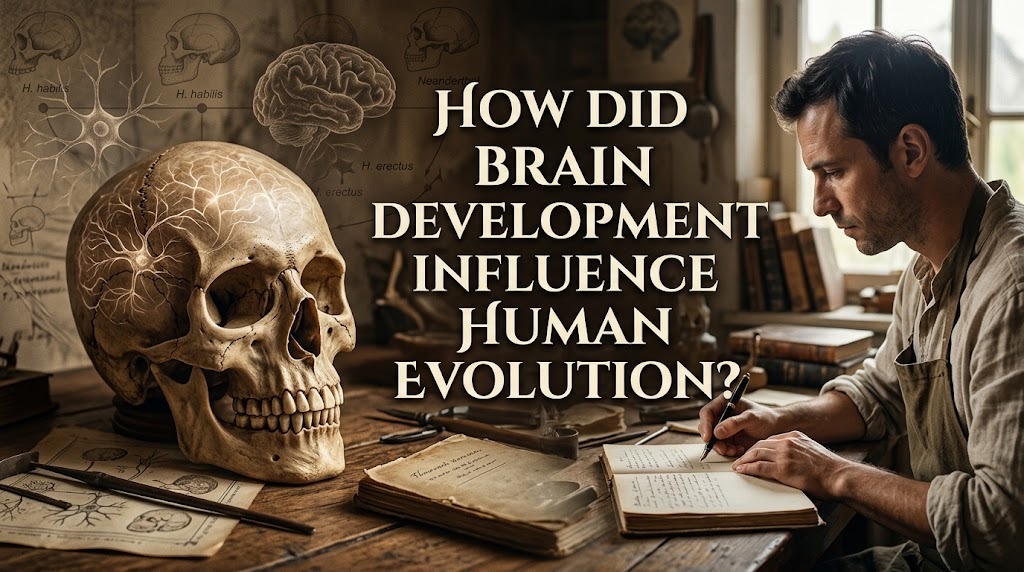
Brain development played a major role in human evolution by improving the ability to learn, solve problems, communicate, and adapt to changing environments. Over millions of years, changes in brain size, structure, and function helped human ancestors develop more complex behaviors and social relationships. These developments contributed to the growth of toolmaking, language, cooperation, and cultural traditions.
However, human intelligence did not develop through brain size alone. Changes in neural connections, learning abilities, social interaction, and energy use also influenced cognitive development. Understanding how the brain evolved helps explain why modern humans can create advanced technologies, share knowledge, and adapt to many different environments.
THE GROWTH OF THE HUMAN BRAIN
Throughout human evolutionary history, several species in the human lineage developed larger brains than earlier ancestors. This trend was not continuous, and brain size varied among different species. Early human relatives already showed some important adaptations before the appearance of modern humans, while later members of the genus Homo developed additional cognitive abilities.
The brain of Homo sapiens supports complex thinking, memory, planning, and communication. However, a larger brain does not automatically mean greater intelligence because brain organization and connections between neurons are also important. The development of these abilities helped humans respond to challenges, learn from experience, and develop increasingly sophisticated ways of living.
HOW BRAIN DEVELOPMENT IMPROVED PROBLEM SOLVING
Brain development improved the ability of human ancestors to recognize patterns, evaluate situations, and find solutions to everyday problems. These abilities helped them locate food, avoid danger, and respond to changes in their surroundings. Better memory also allowed individuals to remember useful locations, recognize threats, and learn from previous experiences.
Over time, these cognitive skills supported more advanced planning and decision-making. Humans could prepare tools for specific tasks, anticipate possible difficulties, and develop new methods of obtaining resources. The ability to learn and adjust behavior increased flexibility, allowing human populations to survive under different environmental conditions.
THE CONNECTION BETWEEN BRAIN DEVELOPMENT AND TOOLMAKING
Toolmaking was an important part of human evolution because it required coordination, learning, and an understanding of how objects could be used. Early human relatives produced simple stone tools, while later populations developed increasingly varied and specialized technologies. Creating effective tools often required selecting suitable materials, controlling hand movements, and understanding the relationship between actions and results.
Brain development supported these abilities by improving motor coordination, memory, and the capacity to learn complex sequences of actions. Individuals could observe skilled toolmakers and gradually improve their own techniques. Knowledge about tool production could also be passed between generations, allowing communities to build on previous discoveries. This combination of cognitive abilities and social learning contributed to technological progress throughout human history.
HOW BRAIN DEVELOPMENT CONTRIBUTED TO LANGUAGE
Language is one of the most important abilities associated with modern human cognition. Human brains contain interconnected networks that support speech, language comprehension, memory, and the interpretation of meaning. The evolution of these abilities likely involved many gradual changes in brain organization, vocal control, social behavior, and communication.
Language allowed humans to share information beyond what could be communicated through gestures or simple signals. People could explain where to find resources, coordinate group activities, teach practical skills, and communicate experiences. More effective communication also helped preserve knowledge across generations. Although the exact origins of language remain uncertain, its development was closely connected to the growing complexity of human social life.
THE ROLE OF SOCIAL INTERACTION IN BRAIN EVOLUTION
Human ancestors lived in social groups where cooperation could improve access to food, protection, and other resources. Maintaining relationships within these groups required recognizing individuals, remembering social interactions, and responding to the behavior of others. These demands may have contributed to the evolution of cognitive abilities related to social understanding and cooperation.
Social interaction also created opportunities for learning. Young individuals could observe adults, imitate useful behaviors, and acquire knowledge about their environment. Cooperative activities encouraged communication, planning, and the sharing of responsibilities. These interactions helped connect brain development with cultural learning, allowing human communities to preserve and expand their collective knowledge.
WHY THE HUMAN BRAIN REQUIRES SO MUCH ENERGY
The human brain is an energy-demanding organ, even though it represents only a small proportion of total body weight. It requires a steady supply of oxygen and nutrients, particularly glucose, to support communication between neurons and maintain normal function. The evolution of a relatively large and active brain therefore created important energy demands for human ancestors.
Access to nutritious food likely helped support this development. Changes in diet, food processing, and food-sharing practices may have contributed to the ability of some human ancestors to meet these demands. However, the relationship between diet and brain evolution is complex, and scientists continue to investigate the importance of different factors. Brain development involved trade-offs because energy invested in one biological function must be balanced with the needs of other bodily systems.
HOW BRAIN DEVELOPMENT SHAPED CULTURE AND TECHNOLOGY
The ability to learn, remember, and communicate allowed humans to develop increasingly complex cultural practices. People could preserve knowledge about hunting, gathering, shelter construction, and environmental conditions without each generation having to discover everything independently. This process of cultural transmission helped useful information spread through communities.
Over thousands of years, accumulated knowledge contributed to agriculture, writing, scientific research, and advanced technology. Modern humans can also organize large groups, develop formal education, and cooperate across geographical distances. These achievements depend not only on individual brain abilities but also on social institutions and the knowledge inherited from previous generations. Cultural evolution can occur much faster than genetic evolution, making it a powerful part of human adaptation.
THE DIFFERENCE BETWEEN BRAIN SIZE AND INTELLIGENCE
Brain size is one feature of brain evolution, but it cannot fully explain intelligence. Cognitive abilities depend on multiple factors, including neural organization, communication between brain regions, development, learning, and environmental experiences. Some animals have relatively large brains or demonstrate impressive problem-solving skills, showing that intelligence has evolved in different forms across species.
In humans, complex cognition results from the interaction of biological and environmental influences. Education, social relationships, nutrition, and experience can affect how cognitive abilities develop throughout life. Human intelligence should therefore not be measured by brain size alone. Understanding brain evolution requires examining how the brain functions and how cognitive abilities interact with the environment.
CONCLUSION
Brain development significantly influenced human evolution by supporting problem-solving, toolmaking, language, social cooperation, and cultural learning. Changes in brain size and organization helped human ancestors develop flexible behaviors and respond to a wide range of environmental challenges. These abilities also allowed communities to preserve knowledge and improve their technologies over generations.
However, human intelligence did not emerge from a single evolutionary change. It developed through the interaction of biological adaptations, social relationships, environmental conditions, and cultural practices. By studying brain development, scientists can better understand how modern humans acquired their distinctive cognitive abilities and how these abilities continue to shape human life.
Recent Posts

Bagaimana Sistem SKS pada Program Kuliah... 22.11.2026/51 View

How Does Technology Make Daily Evaluation... 21.11.2026/81 View

Apa Strategi Menghadapi Kesenjangan antara Kompetensi... 21.11.2026/81 View

Mengapa Inventaris Aset Penting bagi Kelancaran... 21.11.2026/77 View

When Should Musicians Join a Record... 21.11.2026/82 View
