

How Did Early Humans Begin Walking on Two Legs?
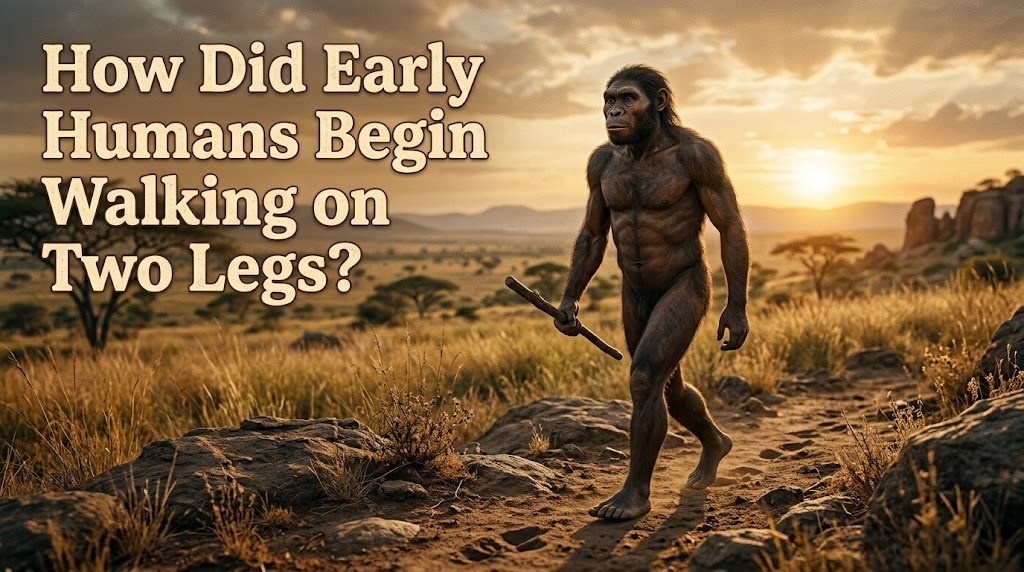
Walking on two legs, also known as bipedalism, is one of the most important developments in human evolution. Unlike most other primates, modern humans usually stand and move upright on two legs, allowing their hands to perform other activities. However, this ability did not appear suddenly. It developed gradually over millions of years as ancient human ancestors adapted to changing environments in Africa.
Scientists study fossil bones, footprints, and other archaeological evidence to understand how early humans began walking upright. These discoveries suggest that bipedalism evolved before modern human brains became large and before advanced stone tools became common. Understanding this process helps explain how human ancestors moved, found food, and survived in different habitats.
WHAT IS BIPEDALISM IN HUMAN EVOLUTION
Bipedalism is the ability to stand and move using two legs as the primary means of walking. Modern humans are highly adapted to this form of movement, with features such as an S-shaped spine, a relatively short and broad pelvis, angled thigh bones, and feet with arches. These structures help support body weight, maintain balance, and make walking more energy efficient. Bipedalism distinguishes humans from most other primates, which generally use all four limbs when moving on the ground.
However, early human ancestors did not develop all these features at once. Different anatomical changes appeared at different times throughout human evolution. Some ancient species could walk upright while still retaining characteristics useful for climbing trees. This suggests that early bipedalism was not identical to the efficient walking pattern seen in modern humans. Scientists therefore view upright walking as a gradual evolutionary development rather than a single event.
WHEN DID EARLY HUMANS BEGIN WALKING ON TWO LEGS
The earliest evidence of bipedalism in the human evolutionary lineage dates back millions of years. Fossils attributed to Sahelanthropus tchadensis, which lived approximately seven million years ago, have features that some researchers interpret as evidence of upright walking, although the interpretation remains debated. Other early hominins, including Orrorin tugenensis, which lived around six million years ago, also show anatomical features that may indicate bipedal movement. These discoveries suggest that adaptations for walking upright began relatively early after the human lineage separated from the lineage leading to modern chimpanzees.
More convincing evidence comes from Australopithecus afarensis, a species that lived approximately 3.9 to 2.9 million years ago. Fossils of this species show several adaptations for habitual upright walking, even though its members retained some features associated with climbing. The famous fossil known as Lucy belongs to this species and provides important information about early human anatomy. Footprints discovered at Laetoli in Tanzania, dating to approximately 3.6 million years ago, also provide strong evidence that ancient hominins walked on two legs. Together, these findings show that bipedalism developed long before the appearance of modern humans.
WHY DID EARLY HUMANS START WALKING UPRIGHT
Scientists have proposed several explanations for why bipedalism evolved. One possibility is that walking upright helped early hominins move efficiently between scattered food sources in changing African environments. As landscapes became more varied, some ancestors may have benefited from moving between woodland areas and more open habitats. However, early bipedalism probably did not develop for just one reason. Different advantages may have influenced its evolution over many generations.
Another explanation is that upright posture made certain activities easier, such as carrying food, transporting objects, or reaching for resources. Standing on two legs may also have helped early hominins see over vegetation in some environments. Some researchers have suggested that bipedalism offered benefits for regulating body temperature by reducing direct exposure to the midday sun, although the importance of this factor remains debated. No single theory explains every aspect of the transition. The most likely explanation is that several ecological and behavioral pressures contributed to the development of upright walking.
HOW CHANGES IN THE BODY MADE WALKING POSSIBLE
Walking on two legs required important changes in the skeleton. The position of the foramen magnum, the opening at the base of the skull where the spinal cord passes, can provide clues about whether an animal held its head upright. In habitual bipeds, the pelvis is generally shorter and broader than in many quadrupedal primates, helping support the body's weight during walking. The thigh bones also angle inward toward the knees, positioning the feet closer to the body's center of gravity. These adaptations help maintain balance while moving on two legs.
The feet also changed as bipedalism became more established. Modern human feet have arches that help absorb impact and store energy during walking, while the big toe is aligned with the other toes rather than being widely separated for grasping. Early hominins displayed different combinations of these features, indicating that foot anatomy evolved gradually. Changes in the spine, hips, knees, and ankles also improved stability and movement. Together, these adaptations made upright walking more practical and efficient over long distances.
HOW BIPEDALISM HELPED EARLY HUMANS SURVIVE
Walking upright may have provided several survival advantages to early human ancestors. Moving on two legs could help them travel between food sources while keeping their hands available for carrying gathered plants, food, or other objects. These benefits may have become increasingly important as some populations adapted to environments where resources were spread across larger areas. However, the earliest forms of bipedalism were not necessarily as efficient as modern human walking, and some early hominins probably continued to climb trees.
Bipedalism also influenced how early human ancestors interacted with their surroundings. As walking became more established, changes in the hands and upper body could support activities involving carrying, manipulating objects, and eventually making tools. Nevertheless, upright walking did not immediately lead to advanced technology or large brains. These developments occurred at different stages of human evolution. Bipedalism was one important adaptation among many that helped shape the human lineage.
DID CLIMATE CHANGE INFLUENCE THE EVOLUTION OF BIPEDALISM
Climate change may have influenced the environments in which early hominins lived. During the late Miocene and early Pliocene, African landscapes experienced environmental changes, including shifts in vegetation and rainfall in different regions. These changes created a variety of habitats, from woodlands to more open areas. Early hominins may have faced new challenges in finding food and moving between suitable environments. Such pressures could have contributed to the development of new movement strategies, including upright walking.
However, scientists do not believe that climate change alone explains the origin of bipedalism. Fossil evidence indicates that some early hominins lived in environments that included woodland and other forms of vegetation rather than exclusively open grasslands. This challenges the older idea that humans began walking upright simply because forests disappeared and grasslands expanded. Different species may have developed bipedal adaptations under different ecological conditions. Researchers continue to investigate how climate, food availability, habitat structure, and other factors interacted during human evolution.
HOW SCIENTISTS DISCOVER THE ORIGINS OF UPRIGHT WALKING
Scientists use fossil evidence to reconstruct how bipedalism developed. Bones from the pelvis, legs, feet, and skull can reveal important details about posture and movement. By comparing ancient fossils with the skeletons of modern humans and other primates, researchers can identify similarities and differences that suggest how early hominins moved. These comparisons are essential because no single fossil usually provides a complete picture of an ancient species.
Footprints offer another valuable source of evidence. The Laetoli footprints preserve impressions of ancient feet and show that their makers walked upright across a surface that later hardened. Researchers examine the shape, spacing, and depth of the prints to investigate walking patterns, although footprints cannot reveal every detail about the individuals who made them. Scientists also use geological dating methods to estimate the age of fossils and trackways. By combining anatomical, archaeological, and geological evidence, researchers can build a clearer picture of when and how bipedalism emerged.
CONCLUSION
Early humans began walking on two legs through a gradual evolutionary process that started millions of years before modern humans appeared. Fossils and ancient footprints show that several early hominin species developed adaptations for upright walking, although the timing and abilities of the earliest bipeds remain subjects of scientific debate. Changes in the pelvis, spine, legs, and feet gradually made walking on two legs more stable and efficient.
The reasons for the evolution of bipedalism were probably complex, involving environmental changes, movement between food sources, and other possible survival advantages. Climate change may have played a role, but it was not the only factor. By studying fossils, footprints, and anatomical evidence, scientists continue to discover how upright walking shaped human evolution. This remarkable adaptation became a defining characteristic of the human lineage and helped establish the foundation for later developments in human behavior and culture.
Recent Posts

Bagaimana Sistem SKS pada Program Kuliah... 22.11.2026/51 View

How Does Technology Make Daily Evaluation... 21.11.2026/81 View

Apa Strategi Menghadapi Kesenjangan antara Kompetensi... 21.11.2026/81 View

Mengapa Inventaris Aset Penting bagi Kelancaran... 21.11.2026/77 View

When Should Musicians Join a Record... 21.11.2026/82 View
