

How Did Human Evolution Influence Culture and Social Behavior?
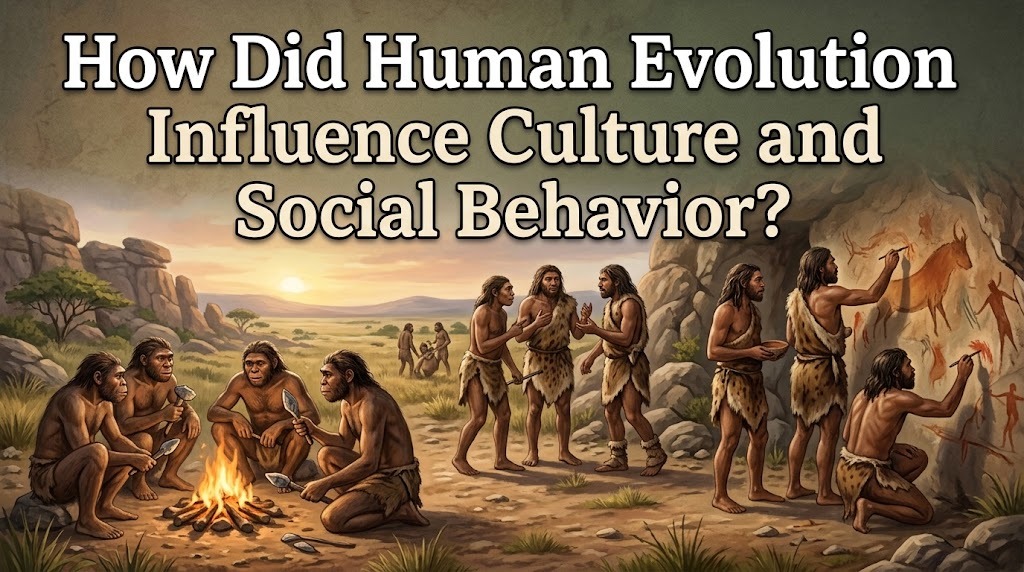
Human evolution influenced not only the physical characteristics of humans but also the ways people communicate, cooperate, and develop cultures. Over millions of years, changes in the human brain, language abilities, and social relationships helped early human populations adapt to different environments. These developments gradually shaped traditions, shared knowledge, family relationships, and systems of cooperation.
Culture and social behavior did not emerge from a single evolutionary change. Instead, they developed through interactions between biological evolution, environmental conditions, and learning from other people. By studying fossils, archaeological discoveries, and human behavior, scientists can better understand how evolution contributed to the development of modern societies.
BRAIN DEVELOPMENT AND SOCIAL INTERACTION
Brain development played an important role in shaping human social behavior. As human ancestors evolved, changes in cognitive abilities supported learning, memory, planning, and the interpretation of social information. These abilities helped individuals recognize relationships, respond to the behavior of others, and coordinate activities within groups. Social interaction also provided opportunities to learn useful skills and share knowledge about food, shelter, and potential dangers.
Modern humans use complex cognitive abilities to understand emotions, develop relationships, and cooperate with others. People can remember social experiences, recognize different perspectives, and adjust their behavior according to social expectations. These abilities support activities ranging from caring for children to organizing large communities. However, social intelligence did not develop in isolation, because interactions with other individuals also influenced learning and cognitive development. Human social behavior therefore reflects an ongoing relationship between biological capabilities and experience.
LANGUAGE AND THE DEVELOPMENT OF CULTURE
Language transformed human communication by allowing people to exchange detailed information and share experiences. Early human ancestors likely relied on gestures, facial expressions, and vocal sounds, although the exact development of spoken language remains uncertain. Over time, increasingly complex communication enabled people to coordinate activities, teach skills, and pass information between generations. This made it easier for groups to preserve useful knowledge without requiring every individual to discover everything independently.
Modern languages allow people to express emotions, communicate beliefs, tell stories, and explain complicated ideas. Through conversation and education, individuals learn social rules, traditions, and practical skills from others. Writing later made it possible to preserve knowledge across longer periods and share it with people outside immediate social groups. Language also supports cultural diversity because different communities develop their own expressions, stories, and communication practices. These abilities have helped culture become a major part of human life.
COOPERATION AND GROUP SURVIVAL
Cooperation was important for the survival of many early human populations. Working together could improve access to food, provide protection from predators, and help individuals care for children and vulnerable group members. Shared activities also allowed people to combine their knowledge and skills when facing difficult challenges. These benefits may have favored social behaviors that helped individuals maintain relationships and coordinate their actions.
Modern humans continue to depend on cooperation in families, workplaces, communities, and international organizations. People share responsibilities, exchange resources, and follow agreed rules to achieve common goals. Trust and reciprocity can strengthen these relationships, while communication helps resolve disagreements and coordinate decisions. Nevertheless, human social behavior includes competition and conflict as well as cooperation. Evolution influenced the capacity for these different behaviors, while culture and individual circumstances help shape how they are expressed.
FAMILY RELATIONSHIPS AND CHILDCARE
Human evolution also influenced family relationships and childcare. Human children generally require a long period of development before they can live independently, creating a need for sustained care and learning. Parents and other caregivers help children acquire language, social skills, and knowledge about their environment. Cooperation among family members and other members of a community may also have helped early human populations manage the demands of childcare.
Family structures vary widely across cultures and historical periods. Some societies emphasize extended family relationships, while others place greater responsibility on parents and smaller household units. Cultural traditions influence expectations about marriage, parenting, inheritance, and responsibilities between generations. Although biological factors contribute to human caregiving, they do not determine one universal family structure. Human family life reflects a combination of evolutionary history, social conditions, and cultural values.
THE TRANSMISSION OF KNOWLEDGE AND TRADITIONS
The ability to learn from others helped humans develop increasingly complex cultures. Early human groups could observe experienced individuals, imitate useful behaviors, and learn techniques for finding food or making tools. This process allowed knowledge to spread within communities and survive beyond the lifetime of the person who first developed it. Shared learning also reduced the need for each generation to solve the same problems independently.
Modern humans preserve and transmit knowledge through language, storytelling, education, written records, and digital technology. Traditions can include food preparation, artistic practices, ceremonies, craftsmanship, and methods of organizing community life. Some traditions change as societies encounter new environments, technologies, or ideas. Others remain important because they reinforce shared identity and relationships between generations. This ability to accumulate and modify knowledge is a major feature of human cultural development.
SOCIAL RULES, MORALITY, AND COMMUNITY VALUES
Living in groups encouraged the development of expectations about acceptable behavior. Early human communities likely needed ways to manage resource sharing, resolve disputes, and coordinate activities. Behaviors such as cooperation, fairness, and caring for group members could support stable relationships, although the specific rules of ancient communities are difficult to reconstruct. Social expectations may have developed through repeated interactions and the practical need to maintain group relationships.
Modern societies organize social behavior through customs, moral principles, laws, and formal institutions. These systems help people understand their responsibilities and manage disagreements. Ideas about fairness, respect, and acceptable conduct vary across cultures, showing that social rules are influenced by both shared human tendencies and historical experiences. Moral behavior cannot be explained by evolution alone, because education, reflection, cultural traditions, and social circumstances also play important roles. Human communities continue to revise their values as conditions and beliefs change.
ART, RELIGION, AND SYMBOLIC THINKING
Human evolution contributed to the cognitive abilities that support symbolic thinking, including the ability to attach meaning to objects, images, sounds, and actions. Archaeological discoveries such as ornaments, engraved objects, pigments, and cave art provide evidence of symbolic activities among ancient human populations. These findings suggest that some groups used objects and artistic expressions to communicate meanings beyond immediate practical needs. However, the precise beliefs and purposes associated with many ancient objects remain uncertain.
In modern societies, art, religion, ceremonies, and storytelling can strengthen social bonds and express shared identities. Music and visual art allow people to communicate emotions and experiences in ways that may cross language barriers. Religious and cultural ceremonies can bring communities together and reinforce collective values. These practices differ greatly across societies and cannot be reduced to a single evolutionary explanation. Instead, they reflect the interaction of human cognitive abilities, social relationships, historical experiences, and cultural creativity.
ENVIRONMENTAL ADAPTATION AND CULTURAL DIVERSITY
Environmental conditions influenced how early humans obtained food, built shelters, and organized their activities. Communities living in different climates and landscapes developed different strategies for survival. Some relied heavily on hunting and gathering, while others eventually developed farming, fishing, or animal herding practices suited to local resources. These differences encouraged the development of diverse skills, customs, and ways of organizing community life.
Modern cultural diversity continues to reflect both environmental influences and historical interactions. Food traditions, clothing, housing, and occupations often respond to local climates and available materials. However, geography does not determine culture entirely, because trade, migration, technology, and contact between communities also influence cultural change. People can adapt traditional practices to new circumstances while preserving aspects of their heritage. Human evolution provided general capacities for learning and adaptation, while individual societies developed distinct cultural solutions.
HOW BIOLOGY AND CULTURE INFLUENCE EACH OTHER
Biological evolution and cultural development are closely connected. Biological traits such as learning ability, memory, and language capacity provide foundations for cultural activities. In turn, cultural practices can change the environments in which people live and influence which biological traits offer advantages. For example, cooking food changed how humans processed and obtained nutrients, while agriculture transformed diets, settlement patterns, and exposure to certain diseases.
Scientists describe some of these interactions through the concept of gene-culture coevolution, in which genetic evolution and cultural practices influence one another over generations. Lactase persistence, the ability to digest lactose into adulthood, is one well-known example associated with the history of dairying in certain populations. This does not mean that every cultural practice causes genetic change, but it demonstrates that biology and culture are not completely separate processes. Understanding their interaction provides a more complete explanation of human development. It also shows why human social behavior cannot be understood through genetics alone.
CONCLUSION
Human evolution influenced culture and social behavior by contributing to the cognitive abilities, communication skills, and social relationships that allow people to live together and share knowledge. Cooperation, childcare, language, and social learning helped early human populations adapt to challenges and transmit useful practices across generations. These foundations supported the development of traditions, moral systems, art, and diverse forms of community life.
However, culture is not simply the result of biological evolution. Environmental conditions, historical events, education, and interactions between communities have also shaped how humans behave and organize their societies. Biological and cultural processes can influence one another, creating new ways of living over time. Studying this relationship helps explain why humans share certain social tendencies while maintaining a remarkable diversity of cultural practices around the world.
Recent Posts

Bagaimana Sistem SKS pada Program Kuliah... 22.11.2026/51 View

How Does Technology Make Daily Evaluation... 21.11.2026/81 View

Apa Strategi Menghadapi Kesenjangan antara Kompetensi... 21.11.2026/81 View

Mengapa Inventaris Aset Penting bagi Kelancaran... 21.11.2026/77 View

When Should Musicians Join a Record... 21.11.2026/82 View
