

How Did Humans Evolve According to Scientific Evidence?
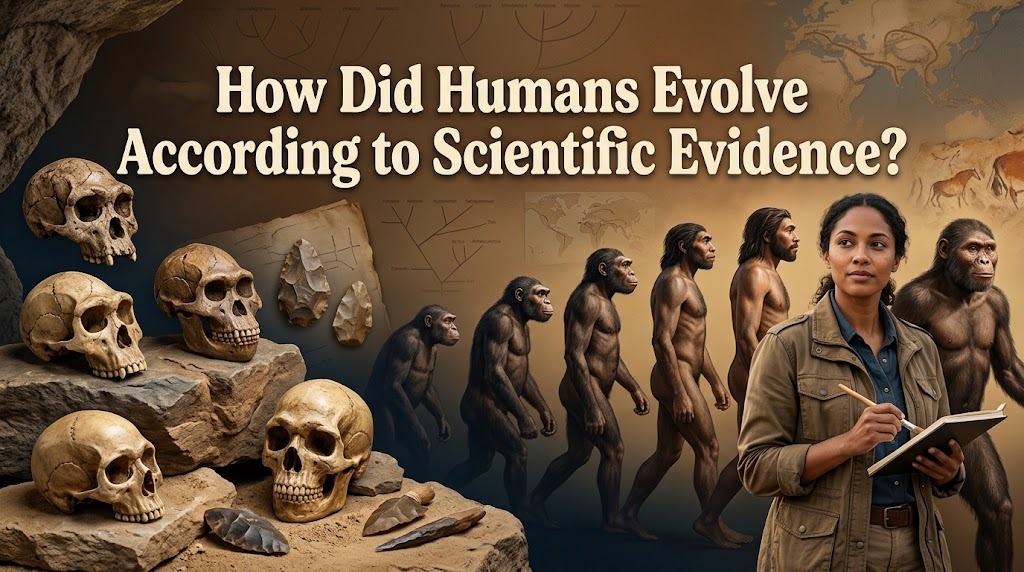
Human evolution is one of the most fascinating topics in science because it explains how modern humans developed over millions of years. Scientists study fossils, DNA, ancient tools, and archaeological discoveries to understand the origins of our species. These findings show that humans did not appear in their modern form all at once but gradually developed through a long evolutionary process. Human evolution also reveals how early human ancestors adapted to changing environments, developed new abilities, and spread across different parts of the world. Understanding this process helps explain the biological and cultural characteristics of modern humans.
WHAT IS HUMAN EVOLUTION?
Human evolution is the gradual biological development of humans from earlier ancestors over millions of years. It occurred through evolutionary processes such as genetic variation, natural selection, mutation, and genetic drift. These processes influenced physical characteristics, brain development, behavior, and the ability to survive in different environments. Humans belong to the primate group and share a common ancestor with chimpanzees and bonobos, although humans did not evolve directly from any living ape species.
The scientific study of human evolution is called paleoanthropology, which combines evidence from fossils, archaeology, genetics, and other scientific fields. Researchers use these sources to reconstruct how ancient human relatives lived and how different populations changed over time. Evidence indicates that human evolution was not a straight line from primitive ancestors to modern humans. Instead, multiple human species existed at different times, and some lived alongside one another before eventually becoming extinct.
FOSSILS PROVIDE EVIDENCE OF HUMAN EVOLUTION
Fossils are among the most important sources of evidence for understanding human evolution. They preserve bones, teeth, and other remains that reveal the physical characteristics of ancient human ancestors. By examining fossil structures, scientists can identify changes in the skull, teeth, pelvis, and leg bones over time. These changes provide clues about how early human relatives moved, ate, and adapted to their surroundings.
One important discovery is Australopithecus afarensis, an ancient hominin species that lived in Africa approximately 3.9 to 2.9 million years ago. The famous fossil known as Lucy belongs to this species and provides evidence that early human relatives could walk upright while retaining some adaptations for climbing. Later species of the genus Homo, including Homo erectus, showed additional changes in body proportions and movement. Fossils of Homo sapiens reveal the development of the skull and facial features associated with modern humans. Together, these discoveries help scientists reconstruct major stages of human evolutionary history.
GENETIC EVIDENCE REVEALS OUR ANCESTRAL CONNECTIONS
DNA provides powerful evidence that modern humans evolved through biological relationships with earlier populations. By comparing genetic material from people around the world, scientists can identify shared ancestry, genetic variation, and patterns of migration. Humans also share a large proportion of their DNA with other primates, especially chimpanzees and bonobos. These similarities support the conclusion that humans and these species descended from a common ancestor that lived millions of years ago.
Ancient DNA has also transformed our understanding of human evolution. Scientists have recovered genetic material from Neanderthals and Denisovans, two groups of ancient humans that were related to modern humans. Comparisons show that some modern human populations inherited small portions of their DNA from these groups because interbreeding occurred in the past. This evidence demonstrates that human evolution involved interactions between different populations rather than the complete replacement of every earlier group. Genetic research continues to reveal how ancient populations moved, mixed, and adapted to different environments.
WALKING UPRIGHT CHANGED HUMAN DEVELOPMENT
Walking on two legs, known as bipedalism, was one of the major developments in human evolution. Fossil evidence indicates that some human ancestors walked upright millions of years before the appearance of modern humans. This adaptation changed the structure of the pelvis, spine, legs, and feet. Although the exact reasons for its development remain under investigation, upright walking may have offered advantages for movement across varied landscapes and freed the hands for carrying objects.
Bipedalism did not develop in a single step. Different early hominin species displayed different combinations of walking and climbing adaptations. Over time, changes in body structure helped later human species move efficiently on the ground. Free hands also supported activities such as carrying food, transporting infants, and using tools. These advantages contributed to the development of new behaviors, although walking upright alone does not explain the full complexity of human evolution.
BRAIN DEVELOPMENT AND TOOL USE
Brain development played an important role in the evolution of the human genus Homo. Compared with many earlier hominins, several later human species developed larger brains relative to their bodies. However, brain size alone does not determine intelligence, and scientists also investigate brain organization, behavior, and environmental influences. The evolution of human cognitive abilities was gradual and varied among different species.
Stone tools provide another important source of evidence. Some of the earliest known stone tools date to approximately 3.3 million years ago, predating the earliest widely recognized fossils of the genus Homo. Later human groups produced increasingly diverse tools for cutting, processing food, and other activities. Toolmaking required learning, coordination, and the ability to use materials for particular purposes. Over time, the development of technology and social learning helped human populations adapt to different environments and pass useful knowledge between generations.
HOW CLIMATE AND ENVIRONMENT INFLUENCED HUMAN EVOLUTION
Environmental changes influenced human evolution by creating new challenges and opportunities for survival. In Africa, changing temperatures, rainfall patterns, and vegetation affected the habitats available to early hominins. These changes may have favored different adaptations, including changes in movement, diet, and behavior. However, scientists recognize that human evolution was shaped by several interacting factors rather than by climate alone.
As human populations spread into different regions, they encountered a wide range of environments. Some groups lived in grasslands, while others adapted to forests, colder climates, or coastal areas. Natural selection could favor inherited characteristics that improved survival and reproduction under particular conditions. Human migration also introduced populations to new food sources, diseases, and environmental pressures. These experiences contributed to the biological diversity found among modern human populations.
THE ORIGIN AND GLOBAL SPREAD OF HOMO SAPIENS
Modern humans, scientifically known as Homo sapiens, evolved in Africa approximately 300,000 years ago. Fossils from sites such as Jebel Irhoud in Morocco provide important evidence of the early history of our species. These discoveries suggest that the development of modern human characteristics occurred across different African populations rather than necessarily in one isolated location. Fossil evidence and genetic research together support an African origin for modern humans.
Over time, groups of Homo sapiens migrated beyond Africa and established populations in other parts of the world. Major expansions occurred at different periods, with one particularly important dispersal taking place roughly 60,000 to 70,000 years ago. As modern humans spread, they encountered other human groups, including Neanderthals and Denisovans, and sometimes interbred with them. Eventually, Homo sapiens became the only surviving human species. Migration, adaptation, and cultural development helped our species inhabit nearly every major region of the planet.
HOW SCIENTISTS STUDY HUMAN EVOLUTION
Scientists use several complementary methods to investigate human evolution. Paleontologists examine fossils to identify anatomical changes and relationships between ancient species. Archaeologists study stone tools, ancient settlements, and other remains to understand how early humans behaved. Geneticists compare modern and ancient DNA to investigate ancestry, population movements, and interbreeding between different human groups.
Researchers also use radiometric dating and other dating techniques to estimate the ages of fossils and archaeological discoveries. Geological evidence helps establish the environmental conditions in which ancient populations lived. Scientists compare findings from different fields to test explanations and identify areas of uncertainty. When new evidence becomes available, earlier interpretations may be revised. This process makes the scientific understanding of human evolution increasingly detailed and reliable.
CONCLUSION
Scientific evidence shows that human evolution was a complex process that unfolded over millions of years. Fossils reveal changes in anatomy, DNA explains ancestral relationships, and archaeological discoveries provide insight into the development of tools and behavior. Environmental changes, natural selection, migration, and interactions between different human populations all contributed to this history.
Modern humans did not evolve from today's chimpanzees or other living apes but share common ancestors with them. Homo sapiens emerged in Africa approximately 300,000 years ago and eventually spread across the world. Although many details of human evolution remain under investigation, the combined evidence from genetics, fossils, and archaeology provides a strong scientific explanation of how our species developed.
Recent Posts

Bagaimana Sistem SKS pada Program Kuliah... 22.11.2026/50 View

How Does Technology Make Daily Evaluation... 21.11.2026/80 View

Apa Strategi Menghadapi Kesenjangan antara Kompetensi... 21.11.2026/79 View

Mengapa Inventaris Aset Penting bagi Kelancaran... 21.11.2026/75 View

When Should Musicians Join a Record... 21.11.2026/80 View
