

How Did Stone Tools Contribute to Early Human Development?
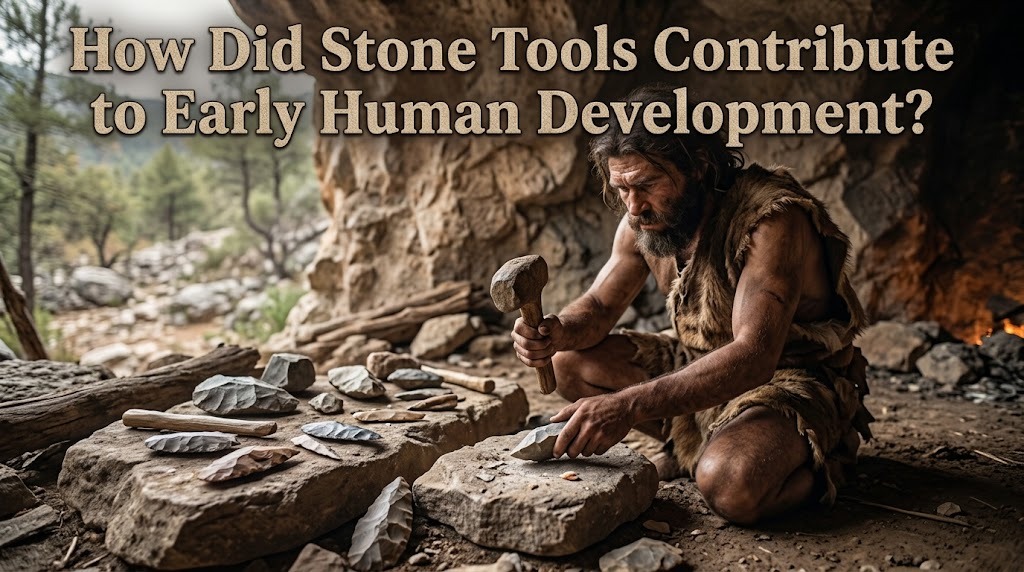
Stone tools played a major role in early human development by helping our ancestors obtain food, protect themselves, and adapt to changing environments. These tools appeared millions of years ago and gradually became more sophisticated as human ancestors developed new skills and learned from experience. By shaping stones into useful objects, early humans could cut meat, break bones, process plants, and perform tasks that were difficult to complete with their hands alone. The use of stone tools also encouraged problem-solving, learning, and cooperation within early human communities. Understanding how stone tools contributed to human development helps explain the relationship between technology, survival, and human evolution.
THE ORIGIN AND DEVELOPMENT OF STONE TOOLS
The earliest known stone tools date back at least 3.3 million years, although the identity of their makers remains uncertain. Some may have been created by hominins that lived before the emergence of the genus Homo. Early tools were relatively simple, often made by striking one stone against another to produce sharp edges. These basic implements allowed their makers to perform tasks that were previously more difficult. Over time, stone toolmaking became more varied as early humans developed different techniques and selected materials for specific purposes.
As human ancestors gained experience, they learned to produce tools with more controlled shapes and sharper edges. Archaeologists have identified several major stone tool traditions, including the Oldowan and Acheulean industries. Oldowan tools included simple flakes and stone cores, while Acheulean technology featured more carefully shaped implements, such as hand axes. These developments did not occur everywhere at the same time, and different groups used different technologies depending on their needs and environments. The growing complexity of stone tools provides important evidence of changes in early human behavior and technological knowledge.
HOW STONE TOOLS IMPROVED FOOD ACQUISITION
Stone tools made it easier for early humans to obtain and process food. Sharp stone flakes could cut animal tissue, separate meat from bones, and open animal hides. Other tools helped break bones to access marrow, which contains energy-rich fats and nutrients. These abilities allowed early humans to use animal resources more effectively, including carcasses that might otherwise have been difficult to process. Stone tools also helped people prepare plant foods by cutting, scraping, and pounding them.
Improved food processing may have contributed to changes in human nutrition and survival. Access to meat, marrow, and a wider range of plant foods provided important sources of energy and nutrients. However, stone tools did not automatically make early humans successful hunters, because many groups also relied on gathering and scavenging. Their diets varied according to the local environment and the resources available. By improving access to different foods, stone tools helped early humans become more flexible in how they met their nutritional needs.
THE ROLE OF STONE TOOLS IN HUMAN BRAIN DEVELOPMENT
Stone toolmaking required several abilities, including selecting suitable materials, controlling hand movements, and understanding how force could change the shape of a stone. Producing useful tools also involved learning through observation, practice, and experience. These activities engaged problem-solving skills and coordination between the hands and eyes. As toolmaking techniques became more sophisticated, early humans needed to remember useful methods and apply them to different situations.
The relationship between stone tools and brain development was complex rather than one-directional. More advanced cognitive abilities may have supported the creation of better tools, while tool use provided opportunities to practice planning, learning, and coordination. These developments occurred alongside other influences, including social interaction, environmental challenges, and changes in diet. Scientists cannot conclude that stone tools alone caused human brains to become larger or more complex. Instead, toolmaking was one part of a broader process of human evolution.
HOW STONE TOOLS HELPED EARLY HUMANS SURVIVE
Stone tools helped early humans adapt to different environments by making essential daily tasks easier. Sharp flakes could be used to cut materials, while heavier stones could help break hard objects or process food. Some tools were useful for scraping animal hides, which could later be used for clothing or other practical purposes. These activities helped early humans make better use of available resources and respond to environmental challenges. Although stone tools were not always used as weapons, certain sharp or heavy implements could also have supported defense and other protective activities.
The ability to make and use tools also increased the range of environments that early humans could exploit. People could process foods that required cutting or crushing and prepare animal materials for different uses. This flexibility became especially important as human populations moved into new regions and encountered unfamiliar resources. Nevertheless, survival depended on many factors, including access to water, shelter, social cooperation, and knowledge of the environment. Stone tools were valuable because they worked together with these other survival strategies.
THE IMPORTANCE OF STONE TOOLS IN SOCIAL LEARNING
Stone toolmaking encouraged early humans to learn from one another. Younger individuals could observe experienced toolmakers and gradually develop the skills needed to produce useful implements. Demonstration, imitation, and repeated practice helped preserve knowledge within groups. When successful techniques were shared, communities could benefit from discoveries made by individual members. This process contributed to the development of increasingly diverse toolmaking traditions.
The production and use of tools may also have supported cooperation among early human groups. Individuals could contribute to food processing, resource collection, and other activities that benefited the wider community. However, the archaeological record does not reveal every detail of how early humans communicated or organized their social lives. Researchers use patterns in tool design, distribution, and manufacturing techniques to investigate how knowledge may have spread. These findings suggest that stone tools were not merely objects for survival but also part of the development of human learning and social behavior.
THE EVOLUTION OF STONE TOOL TECHNOLOGY
Stone tool technology changed significantly over time as different human populations developed new manufacturing methods. Early tools often consisted of simple flakes and stone cores, while later technologies included more carefully shaped hand axes and specialized cutting implements. During later periods, some toolmakers produced smaller blades and tools designed for particular tasks. These changes demonstrate growing technical diversity, although technological development was not a simple, uninterrupted progression from primitive to advanced tools.
Different human species and populations used different stone tool technologies, sometimes at the same time. Tool design depended on available raw materials, local needs, learned traditions, and the skills of individual toolmakers. Some communities maintained established methods for long periods, while others experimented with new techniques. Archaeologists study the marks left by stoneworking to understand how tools were made and used. Through this evidence, researchers can reconstruct aspects of early human behavior that would otherwise remain unknown.
HOW STONE TOOLS INFLUENCED HUMAN EVOLUTION
Stone tools contributed to human evolution by expanding the range of activities early humans could perform. Better access to food and more efficient processing methods may have supported survival and reproduction in certain environments. Toolmaking also created opportunities for learning, planning, and cooperation, which were important parts of early human life. These behaviors developed alongside changes in anatomy, diet, movement, and social organization. Stone tools therefore provide evidence of the close relationship between biological evolution and cultural development.
The influence of stone tools continued as humans developed new technologies and ways of living. Knowledge of shaping stone was passed between generations, allowing communities to preserve useful skills and modify them over time. Later technologies increasingly included tools made from materials such as bone and wood, although stone remained important for a very long period. The archaeological record shows that technology became a lasting part of how humans interacted with their surroundings. Stone tools were not the only factor behind human development, but they played a significant role in the history of human adaptation.
CONCLUSION
Stone tools contributed to early human development by improving food processing, supporting survival, encouraging social learning, and expanding the range of tasks humans could perform. Their gradual development also provides evidence of growing technical knowledge and behavioral flexibility among early human populations. Although stone tools did not independently cause changes in the human brain or guarantee survival, they interacted with biological, environmental, and social factors throughout human evolution. By studying these ancient implements, scientists can better understand how early humans adapted to challenges and developed increasingly complex ways of life.
Recent Posts

Bagaimana Sistem SKS pada Program Kuliah... 22.11.2026/51 View

How Does Technology Make Daily Evaluation... 21.11.2026/81 View

Apa Strategi Menghadapi Kesenjangan antara Kompetensi... 21.11.2026/81 View

Mengapa Inventaris Aset Penting bagi Kelancaran... 21.11.2026/77 View

When Should Musicians Join a Record... 21.11.2026/82 View
