

How Did Trade Shape the Growth of Cities?
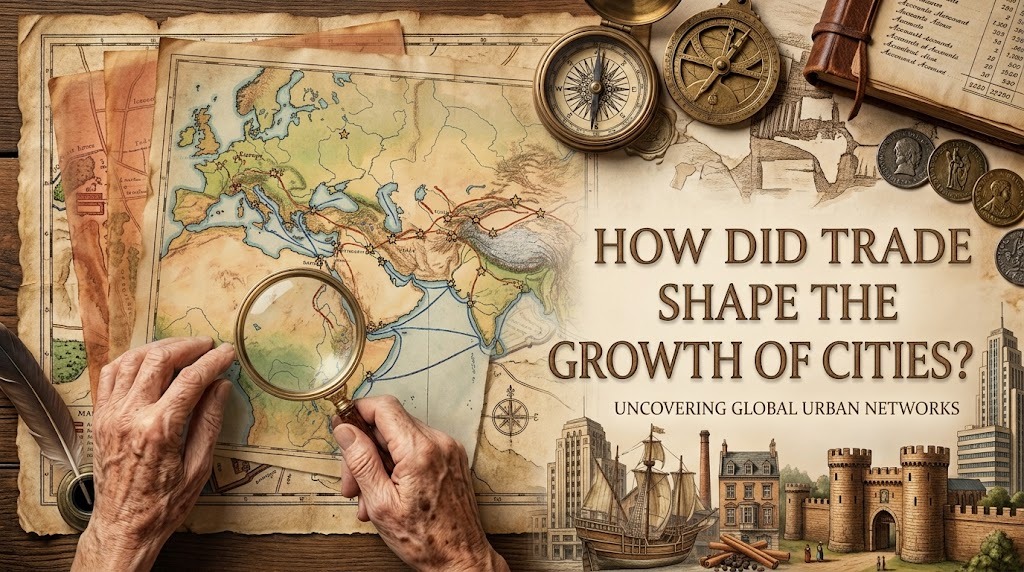
Trade has played an important role in the development of cities throughout history. Settlements located near rivers, coastlines, crossroads, and other transportation routes often became centers for exchanging goods and services. As commercial activity increased, more people moved to these locations to find work, conduct business, and access resources. Over time, trade could transform small settlements into large and influential urban centers.
TRADE ATTRACTED PEOPLE TO URBAN CENTERS
Cities with active markets created opportunities for merchants, farmers, craftsmen, transport workers, and other occupations. People often moved to these areas because they could earn income from producing, selling, or transporting goods.
Population growth increased demand for housing, food, clothing, tools, and services. This encouraged the development of shops, markets, workshops, and residential neighborhoods. As more people arrived, the settlement became increasingly urbanized.
MARKETS ENCOURAGED ECONOMIC DEVELOPMENT
Markets provided places where producers and consumers could exchange goods efficiently. Farmers could bring agricultural products to urban markets, while craftsmen could sell manufactured items to residents and visiting merchants.
Regular commercial activity generated income and encouraged specialization. Instead of producing everything they needed themselves, people could focus on particular occupations and obtain other goods through trade. This specialization helped create more complex urban economies.
TRANSPORTATION ROUTES CONNECTED CITIES
Trade encouraged the development of transportation networks. Roads, bridges, ports, canals, and later railways were built or expanded to make it easier to move people and goods.
Cities located at important transportation junctions often gained an advantage because merchants needed places to rest, store products, exchange goods, and organize shipments. These connections could turn cities into regional or international trading hubs.
PORTS SUPPORTED MARITIME TRADE
Coastal cities and settlements near navigable rivers could benefit significantly from maritime commerce. Ports provided locations where ships could load and unload goods, while warehouses and markets developed nearby.
As port activity expanded, cities often attracted merchants, shipbuilders, sailors, financial services, and other businesses. International trade could also introduce new products, technologies, languages, and cultural influences to port communities.
TRADE CREATED NEW OCCUPATIONS
Growing commercial activity created demand for a wide range of specialized jobs. Merchants needed accountants, warehouse workers, traders, translators, transport providers, and financial services.
Craft production could also expand because merchants needed goods to sell in distant markets. This encouraged industries such as textiles, metalworking, pottery, food processing, and shipbuilding in different historical periods. The growth of these occupations made cities economically more diverse.
TRADE INFLUENCED URBAN INFRASTRUCTURE
Successful trading centers required infrastructure to support commercial activity. Markets, warehouses, roads, docks, bridges, financial institutions, and public facilities could develop as trade expanded.
Governments and local authorities sometimes invested in infrastructure because commercial activity generated taxes and other economic benefits. These investments could further encourage merchants and businesses to operate in the city, creating a cycle of economic and urban growth.
TRADE ENCOURAGED CULTURAL EXCHANGE
Trade did more than move physical products between regions. Merchants and travelers also carried languages, beliefs, artistic styles, technologies, foods, and customs.
Cities connected to major trade networks therefore became places where different cultures interacted. This exchange could influence architecture, cuisine, clothing, religious practices, and everyday social life. Many historically important cities developed diverse cultural identities partly because of their connections to trade.
COMPETITION AND POLITICAL POWER
Trade could increase the political importance of cities because governments wanted to control valuable markets, ports, and transportation routes. Authorities might establish taxes, regulations, customs systems, or protective measures to manage commercial activity.
Wealth generated through trade could also strengthen political institutions and finance public projects. At the same time, competition over important trading centers could create conflicts between states or communities. Political stability was often important for maintaining long-distance commercial networks.
CHANGES IN TRADE COULD TRANSFORM CITIES
Cities could experience rapid growth when new trade routes opened, but they could also decline when commercial patterns changed. The discovery of alternative transportation routes, political conflicts, natural disasters, or technological developments could redirect trade away from an established center.
A city that once depended heavily on a particular market or route might need to adapt by developing new industries. Some former trading centers declined, while others successfully transformed themselves into manufacturing, administrative, cultural, or service-oriented cities.
CONCLUSION
Trade shaped the growth of cities by attracting people, creating employment, encouraging markets, and supporting transportation and infrastructure. Commercial connections also promoted cultural exchange and increased the political importance of successful trading centers. However, cities had to adapt when trade routes and economic conditions changed. The relationship between trade and urban development therefore helped shape many of the world's historic cities and continues to influence urban growth today.
Recent Posts

Bagaimana Sistem SKS pada Program Kuliah... 22.11.2026/50 View

How Does Technology Make Daily Evaluation... 21.11.2026/79 View

Apa Strategi Menghadapi Kesenjangan antara Kompetensi... 21.11.2026/79 View

Mengapa Inventaris Aset Penting bagi Kelancaran... 21.11.2026/75 View

When Should Musicians Join a Record... 21.11.2026/80 View
