

How Do Ancient Shipwrecks Help Us Understand Maritime History?
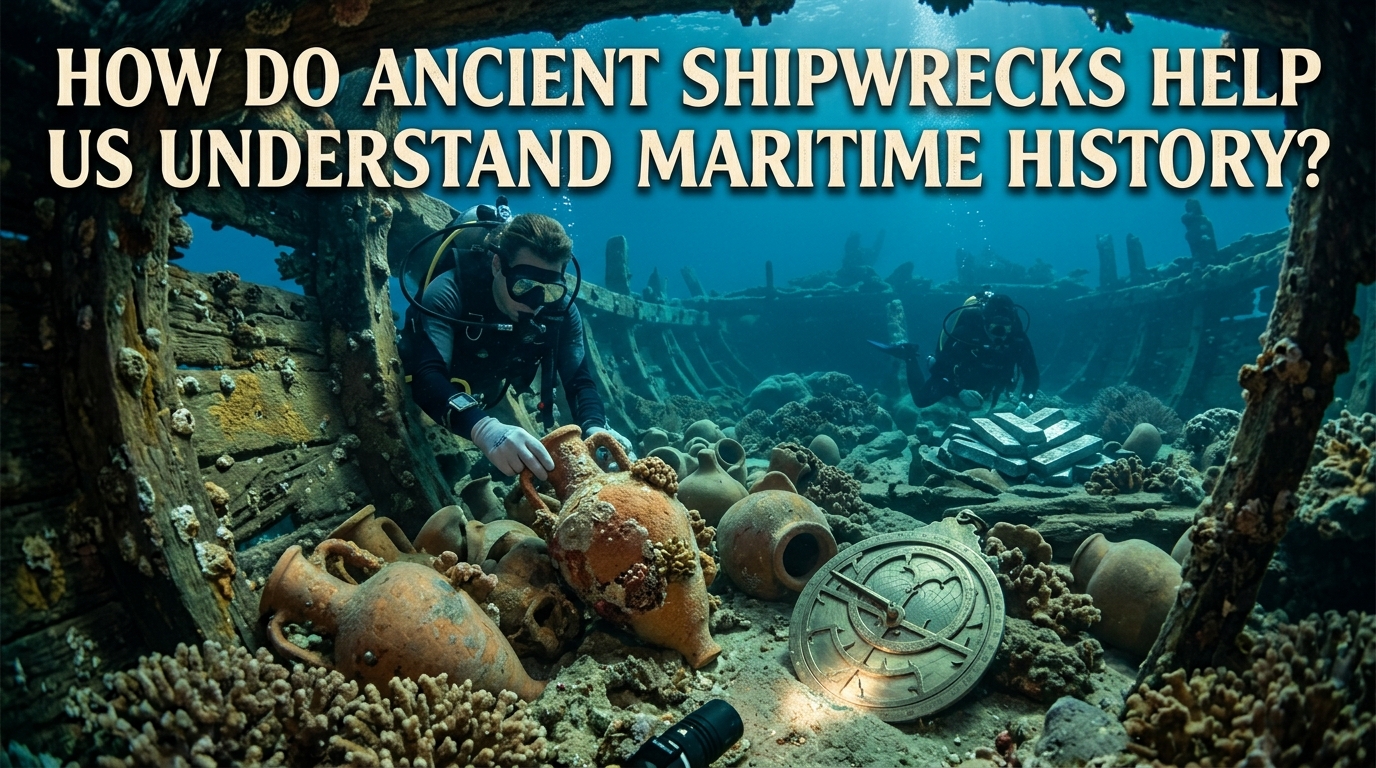
Ancient shipwrecks are valuable sources of information about how people traveled, traded, and explored the world's oceans in the past. When ships sank, they often carried cargo, tools, personal belongings, and equipment that remained underwater for centuries. These objects provide direct evidence of maritime activities that written records may describe only partially or not at all.
Through underwater exploration and scientific analysis, archaeologists can uncover the stories behind these sunken vessels. Shipwreck archaeology helps researchers understand ancient trade routes, shipbuilding techniques, cultural exchange, and the dangers faced by sailors. By studying these underwater sites, we gain a clearer picture of how maritime activities influenced the development of civilizations.
WHAT ARE ANCIENT SHIPWRECKS AND WHY ARE THEY IMPORTANT?
Ancient shipwrecks are the remains of vessels that sank in the past and survived in underwater environments or coastal landscapes. They may include trading ships, fishing boats, naval vessels, and ships used for exploration or transportation. Some wrecks are thousands of years old, while others provide evidence of more recent historical events.
These sites are important because they preserve physical evidence of maritime life. Ship structures, cargo, navigation equipment, and personal objects can reveal how ships were built, what they transported, and who may have traveled aboard them. Unlike many objects found on land, shipwreck discoveries can preserve a combination of materials in a single archaeological context. Each shipwreck offers a historical snapshot of the people, technology, and economic activities associated with its final voyage.
HOW SHIPWRECKS REVEAL ANCIENT TRADE ROUTES
One of the most important contributions of shipwreck archaeology is its ability to reveal ancient maritime trade networks. Cargo may include pottery, spices, metals, glassware, textiles, and other goods transported between distant ports. By identifying where these objects were produced and comparing them with discoveries from other sites, researchers can investigate connections between different regions.
For example, a ship carrying ceramics made in one region and metal goods originating elsewhere may indicate that several trading communities were connected through maritime commerce. The distribution of such cargo can help researchers reconstruct possible routes and identify important trading centers. However, a single wreck does not always reveal an entire trade network, because ships could change destinations or carry goods acquired at several ports. Comparing shipwreck evidence with historical records and land-based archaeological discoveries helps produce a more reliable picture of ancient trade.
WHAT SHIPWRECKS TELL US ABOUT ANCIENT SHIPBUILDING
The remains of sunken vessels provide valuable evidence about the development of ancient shipbuilding technology. Archaeologists examine hull shapes, wooden planks, fastenings, ropes, anchors, and other surviving components to understand how ships were constructed. These details can reveal the materials available to shipbuilders and the techniques they used to make vessels strong enough for different maritime conditions.
Researchers can also investigate how ship designs changed over time. Some vessels were designed for coastal transport and relatively calm waters, while others were built to carry heavy cargo over long distances. The size and construction of a ship may provide clues about its intended use, although its exact purpose often requires additional evidence. Shipwrecks preserve practical engineering knowledge that may be difficult to reconstruct from ancient illustrations or written descriptions alone.
HOW CARGO REVEALS DAILY LIFE AND CULTURAL EXCHANGE
Shipwreck cargo can provide detailed information about the goods people produced, purchased, and used in everyday life. Cooking vessels, storage containers, tools, ornaments, and food remains may reveal what sailors ate and how they organized life aboard a ship. Cargo records preserved in inscriptions or markings can sometimes provide additional information about the goods and people involved in maritime commerce.
Objects from different cultural backgrounds may also demonstrate cultural exchange through maritime travel. A vessel carrying goods from several regions suggests that people and products moved between communities, although the exact nature of those interactions must be established through careful analysis. Researchers can study pottery styles, inscriptions, and material composition to identify where objects originated. These discoveries show that maritime history involved not only trade but also the movement of ideas, artistic styles, technologies, and cultural practices.
HOW ARCHAEOLOGISTS EXPLORE UNDERWATER SHIPWRECKS
Exploring ancient shipwrecks requires specialized methods because underwater environments can be difficult and dangerous to investigate. Archaeologists may use divers, remotely operated vehicles, sonar systems, and underwater photography to locate and document wrecks. Sonar technology helps identify unusual features on the seabed, while underwater cameras and three-dimensional mapping can record the shape and condition of a site.
Once a wreck is located, researchers carefully document its position, structure, and surrounding environment. Excavation may be necessary, but removing objects without recording their original locations can destroy valuable historical information. Archaeologists therefore aim to preserve the relationship between artifacts, cargo, and the ship itself. Systematic underwater documentation helps ensure that discoveries can be studied accurately and protected for future research.
WHY DATING SHIPWRECKS IS IMPORTANT
Determining when a ship sank helps archaeologists connect its remains with historical events, trading periods, and technological developments. Researchers may examine pottery styles, coins, inscriptions, and other artifacts that provide clues about when the vessel was used. The construction of the ship itself can also offer evidence about its likely age and place of origin.
Scientific dating methods may provide additional information when suitable materials survive. Radiocarbon dating can estimate the age of appropriate organic materials, such as preserved wood, but the age of the wood does not necessarily match the date when the ship sank. The wood may have been stored or reused before construction. By combining scientific dating with artifact analysis, ship construction studies, and historical documents, researchers can develop a more dependable timeline.
FAMOUS SHIPWRECKS AND THEIR HISTORICAL SIGNIFICANCE
Several well-known shipwrecks demonstrate how underwater archaeology can transform our understanding of the past. The Uluburun shipwreck, discovered off the coast of Türkiye, dates to the Late Bronze Age and contained a remarkable cargo of metals, glass, pottery, and other goods. Its discoveries provide evidence of long-distance trade and connections between societies around the eastern Mediterranean during the second millennium BCE.
Another important example is the Antikythera shipwreck near Greece, which produced sculptures, luxury goods, and the famous Antikythera Mechanism, an ancient geared device used to model astronomical cycles. The wreck illustrates the technological and artistic achievements associated with the ancient Mediterranean world. In Southeast Asia, shipwreck discoveries have also helped researchers investigate the region's historical role in maritime trade between China, India, and other parts of Asia. These underwater discoveries reveal how interconnected ancient societies could be, even when long-distance travel involved considerable risks.
THE CHALLENGES OF PRESERVING ANCIENT SHIPWRECKS
Although underwater environments can protect shipwrecks, they do not preserve every material equally. Wood may survive in some conditions but deteriorate when exposed to oxygen after recovery. Metals can corrode, while ceramics and glass may become damaged by physical movement, sediment, or changing environmental conditions.
Shipwrecks also face threats from looting, fishing activities, coastal development, pollution, and climate-related changes. Removing artifacts without proper documentation can permanently destroy information about their original context. Responsible conservation involves monitoring underwater sites, limiting harmful disturbance, documenting vulnerable remains, and using suitable treatment methods for recovered materials. International cooperation and public education can also help protect shipwrecks as important parts of shared maritime heritage.
WHY SHIPWRECK ARCHAEOLOGY MATTERS TODAY
Studying ancient shipwrecks helps explain how maritime transportation shaped economies, societies, and political relationships. Ships connected distant communities, carried essential resources, and supported the movement of people and knowledge. Their remains provide evidence of how earlier societies responded to navigation challenges, developed new technologies, and organized long-distance trade.
Shipwreck archaeology also supports museum education, historical research, and the preservation of underwater cultural heritage. Protecting shipwreck sites ensures that their evidence remains available for future generations rather than being lost through damage or uncontrolled removal. By combining scientific research with responsible conservation, archaeologists can continue uncovering important details about humanity's relationship with the sea.
CONCLUSION
Ancient shipwrecks help us understand maritime history by preserving evidence of trade routes, shipbuilding techniques, cargo, cultural exchange, and life at sea. Their remains provide valuable information that may be missing from written records and reveal connections between ancient societies across long distances. Scientific dating and underwater exploration help researchers interpret these discoveries within their historical contexts.
However, shipwrecks are fragile archaeological resources that require careful investigation and protection. Responsible excavation, modern technology, and long-term conservation are essential for preserving their historical value. By studying and protecting ancient shipwrecks, we gain a deeper understanding of how maritime travel shaped civilizations and connected the world throughout history.
Recent Posts

Bagaimana Sistem SKS pada Program Kuliah... 22.11.2026/50 View

How Does Technology Make Daily Evaluation... 21.11.2026/79 View

Apa Strategi Menghadapi Kesenjangan antara Kompetensi... 21.11.2026/79 View

Mengapa Inventaris Aset Penting bagi Kelancaran... 21.11.2026/75 View

When Should Musicians Join a Record... 21.11.2026/80 View
