

How Do Automation and Robotics Affect the Demand for Workers?
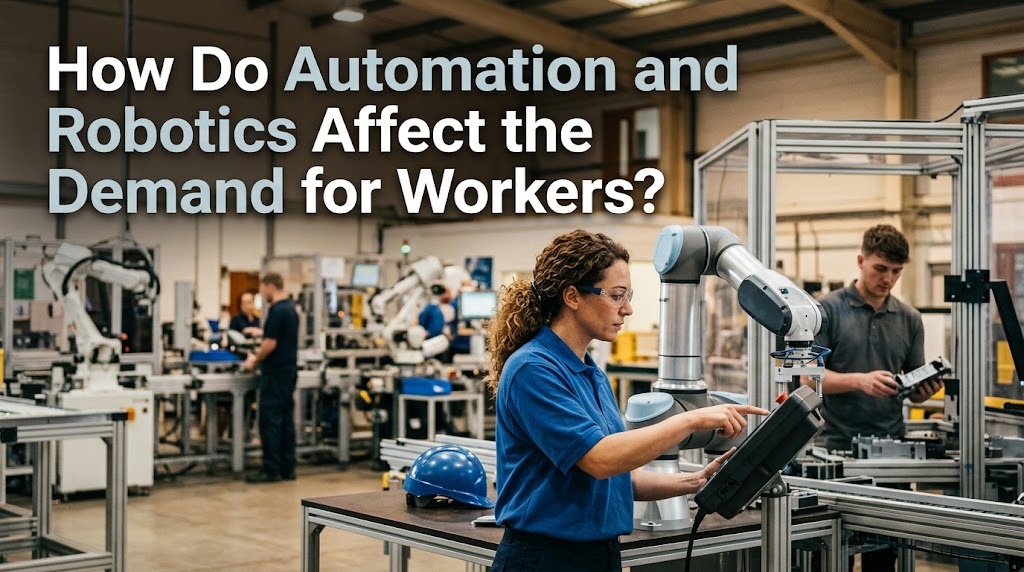
Automation and robotics are changing the modern workplace by allowing machines and computer systems to perform tasks that previously required human labor. These technologies are important parts of Industry 4.0, which combines digital systems, intelligent machines, and data analysis to improve industrial operations. Businesses use automation to increase productivity, maintain product quality, and reduce repetitive work. However, the growing use of machines also raises questions about job security, employment opportunities, and the skills workers need to remain competitive. Understanding these effects can help employees, employers, and policymakers prepare for changes in the labor market.
THE ROLE OF AUTOMATION AND ROBOTICS IN THE WORKPLACE
Automation refers to the use of technology to perform tasks with limited human intervention, while robotics focuses on designing, building, and operating robots. These technologies are widely used in manufacturing, logistics, healthcare, agriculture, and other industries. For example, factories use robotic arms to assemble components, automated systems to package products, and sensors to monitor production processes. Warehouses can also use automated equipment to move goods and organize inventory more efficiently.
The main purpose of these technologies is to improve speed, consistency, and operational efficiency. Machines can perform repetitive tasks for long periods and may reduce the risk of certain workplace injuries when they replace dangerous manual activities. However, robots and automated systems still require human supervision, maintenance, programming, and safety management. Automation changes how work is performed, rather than necessarily eliminating every job in which technology is introduced.
HOW AUTOMATION AFFECTS JOB DEMAND
Automation can reduce the demand for workers who mainly perform repetitive and predictable tasks. In manufacturing, machines may replace some manual assembly activities, while software can automate routine data entry, document processing, and basic administrative work. Businesses may adopt these technologies to reduce operating costs, increase output, or address labor shortages. Consequently, some occupations may experience declining demand as particular tasks become automated.
However, the effects vary across industries and occupations. Many jobs consist of several different responsibilities, and only some of those tasks may be suitable for automation. Workers may continue to perform activities that require judgment, communication, creativity, and the ability to respond to unexpected situations. Therefore, job transformation is often a more accurate way to describe the impact than assuming that all affected occupations will disappear. The actual outcome depends on technological capabilities, implementation costs, business needs, and the availability of workers with relevant skills.
NEW EMPLOYMENT OPPORTUNITIES CREATED BY ROBOTICS
Although automation can reduce demand for certain tasks, it can also create new employment opportunities. Companies need professionals to design, program, operate, repair, and improve automated equipment. Examples include robotics engineers, automation technicians, software developers, data analysts, and industrial maintenance specialists. As businesses introduce more advanced systems, they may also need cybersecurity professionals to protect connected machines and industrial networks.
Automation can support employment in industries beyond technology and manufacturing. For example, agricultural businesses may need technicians who manage automated irrigation systems, while logistics companies may employ specialists who monitor warehouse automation. Increased productivity can also help some businesses expand production, enter new markets, and create jobs in sales, customer service, and management. However, these benefits are not guaranteed because new positions may require different qualifications or emerge in different locations from the jobs that disappear. Training and workforce mobility are therefore essential for helping workers access new opportunities.
THE IMPORTANCE OF SKILLS AND WORKER TRAINING
As automation becomes more common, workers need to develop skills that complement technology. Digital literacy, technical knowledge, critical thinking, problem-solving, and communication can help employees adapt to changing workplace requirements. Some workers may need to learn how to operate computerized equipment, interpret production data, or collaborate with robotic systems. Others may benefit from developing skills in customer relations, supervision, planning, and complex decision-making.
Education and professional training can help workers prepare for these changes. Reskilling enables someone to prepare for a different occupation, while upskilling improves skills needed in an existing role. Employers can provide technical workshops, practical training, mentoring, and opportunities to learn new software or equipment. Governments and educational institutions can also support workers through affordable vocational programs and career guidance. Continuous learning helps employees remain adaptable as industries introduce new technologies and job requirements evolve.
THE CHALLENGES AND FUTURE OF AUTOMATED WORK
Despite the potential benefits, automation presents several economic and social challenges. Workers whose tasks are replaced may face unemployment, reduced income, or difficulties finding positions that match their existing qualifications. These problems can be more serious for people who have limited access to training or live in areas with fewer alternative employment opportunities. In addition, the cost of implementing advanced robotics can make it difficult for some small businesses to compete with larger companies.
Addressing these challenges requires cooperation between businesses, governments, and educational institutions. Companies should evaluate how automation affects employees and provide training or transition support when possible. Governments can strengthen vocational education, improve access to digital skills programs, and establish appropriate worker protections. Businesses must also ensure that automated equipment is safe, reliable, and used responsibly. A human-centered approach to automation can help society gain the benefits of technological progress while reducing unnecessary harm to workers and communities.
KESIMPULAN
Automation and robotics are changing the demand for workers by reducing the need for some repetitive tasks while creating opportunities in technical and technology-related occupations. Their overall impact depends on how businesses adopt these systems and how workers respond to changing skill requirements. Digital skills, continuous learning, and professional training are essential for helping employees adapt to the future workplace. Employers and governments also have an important role in supporting workers affected by technological change. By combining automation with responsible workforce development, industries can improve productivity while creating more opportunities for people to participate in the modern economy.
Recent Posts

Bagaimana Sistem SKS pada Program Kuliah... 22.11.2026/50 View

How Does Technology Make Daily Evaluation... 21.11.2026/79 View

Apa Strategi Menghadapi Kesenjangan antara Kompetensi... 21.11.2026/79 View

Mengapa Inventaris Aset Penting bagi Kelancaran... 21.11.2026/75 View

When Should Musicians Join a Record... 21.11.2026/80 View
