

How Do Biomimetic Robots Replicate Animal Movement Patterns?
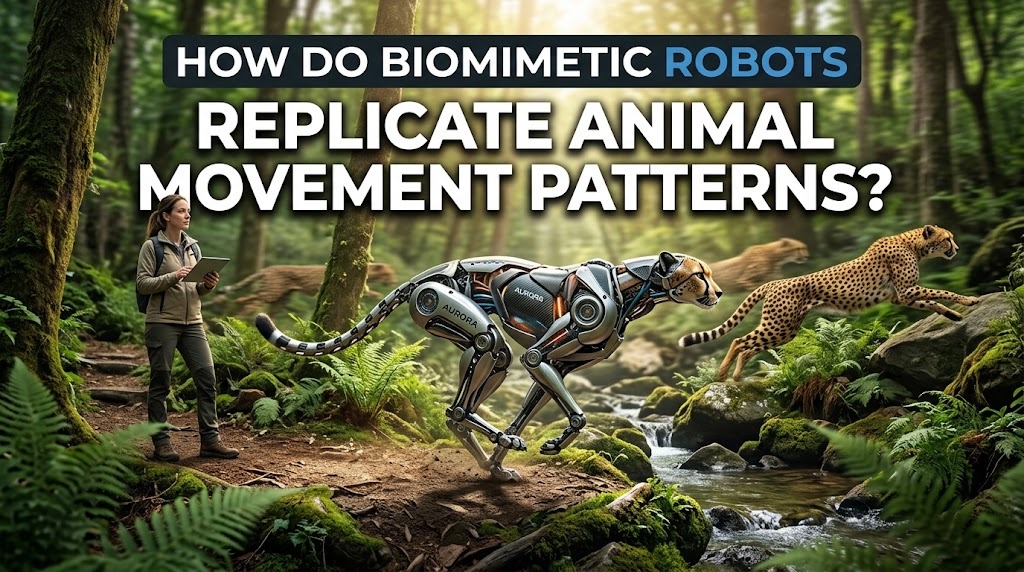
Biomimetic robots are machines designed to imitate biological structures, behaviors, and movements found in nature. By studying how animals walk, swim, fly, and climb, engineers can develop robots that move efficiently through different environments. These robots combine biological observations with mechanical engineering, sensors, and computer algorithms to reproduce selected animal movement patterns. Biomimetic robotics is increasingly useful in environmental research, search-and-rescue operations, underwater exploration, and other specialized applications.
STUDYING ANIMAL ANATOMY AND MOVEMENT
The development of biomimetic robots often begins with observing how animals move in their natural environments. Researchers examine body structure, joint flexibility, muscle coordination, and the interaction between limbs and surrounding surfaces. For example, a quadruped robot may imitate the leg coordination of a dog, while an underwater robot may reproduce the flexible body movement of a fish. High-speed cameras and motion-tracking systems can record these movements for detailed analysis. Engineers then identify the biological principles that can be translated into mechanical designs.
DESIGNING MECHANICAL STRUCTURES INSPIRED BY NATURE
After studying an animal's movement, engineers develop a robotic structure that reproduces the most relevant physical characteristics. Robotic legs may contain multiple joints to imitate the flexibility of animal limbs, while fish-inspired robots may use flexible bodies and oscillating tails. Flying robots often incorporate lightweight frames and wing mechanisms inspired by birds or insects. The design must balance flexibility, strength, weight, and energy consumption. Although biomimetic robots resemble animals in certain ways, their mechanical structures do not always reproduce biological anatomy exactly.
USING ACTUATORS TO GENERATE MOVEMENT
Actuators are components that convert energy into mechanical motion. Biomimetic robots may use electric motors, pneumatic systems, hydraulic mechanisms, or artificial muscles to reproduce animal movements. For example, electric motors can rotate robotic joints to simulate walking, while flexible actuators can create bending motions similar to those of fish or snakes. The placement and coordination of actuators influence the robot's speed, stability, and movement range. Selecting appropriate actuators helps engineers reproduce the specific motion patterns required for an application.
REPLICATING NATURAL GAITS AND SWIMMING PATTERNS
Different animals rely on distinct movement strategies to navigate their environments. Walking robots may imitate alternating leg movements, running robots may reproduce spring-like leg dynamics, and snake-inspired robots may move through coordinated body waves. Fish-inspired robots often use oscillating tails or flexible bodies to generate thrust in water. Engineers develop mathematical models and control algorithms to coordinate these movements. By adjusting timing, joint angles, and movement frequency, robots can reproduce selected biological locomotion patterns.
USING SENSORS FOR ADAPTIVE MOVEMENT
Animals continuously respond to changes in their surroundings, and biomimetic robots can use sensors to achieve similar adaptability. Accelerometers and gyroscopes help measure orientation and movement, while pressure sensors can detect contact with surfaces. Cameras and distance sensors provide information about nearby objects and obstacles. Control systems process these measurements and adjust motor commands to maintain balance or modify movement. This feedback allows robots to respond more effectively to uneven terrain, changing water conditions, or unexpected obstacles.
APPLYING ARTIFICIAL INTELLIGENCE AND CONTROL ALGORITHMS
Artificial intelligence and advanced control algorithms can help biomimetic robots learn and improve their movement strategies. Engineers may use simulations to test different combinations of joint movements before applying them to physical robots. Machine learning methods, including reinforcement learning, can help robots develop locomotion strategies through repeated practice in simulated environments. Conventional control methods remain useful when movement requirements are well defined and predictable. The appropriate approach depends on the robot's complexity, computational resources, and operating conditions.
OVERCOMING CHALLENGES IN BIOMIMETIC ROBOTICS
Replicating animal movement is challenging because biological systems are highly flexible, coordinated, and energy-efficient. Mechanical components may be heavier or less adaptable than muscles, tendons, and other biological structures. Robots must also manage power consumption, mechanical wear, sensor errors, and unstable surfaces. Furthermore, a movement pattern that works well in a laboratory may perform differently in a real environment. Researchers address these challenges through lightweight materials, improved actuators, adaptive control systems, and repeated testing.
APPLICATIONS OF ANIMAL-INSPIRED ROBOTS
Biomimetic robots can perform tasks that benefit from specialized movement abilities. Fish-inspired robots can support underwater observation, while snake-like robots may enter narrow spaces during infrastructure inspections. In search-and-rescue operations, animal-inspired legged robots can help navigate environments where wheeled machines struggle. Bird-inspired and insect-inspired robots are also studied for aerial monitoring and scientific research. These applications demonstrate how biological movement principles can provide practical solutions to engineering problems.
CONCLUSION
Biomimetic robots replicate animal movement patterns by combining biological observation with mechanical design, actuators, sensors, and motion-control algorithms. Engineers study how animals move and translate useful principles into robotic systems that can walk, swim, fly, or crawl. Although reproducing the full efficiency and adaptability of living organisms remains difficult, continued advances in materials and control technology are expanding the capabilities of these machines. Biomimetic robotics therefore offers promising opportunities for exploration, inspection, and other specialized tasks.
Recent Posts

Bagaimana Sistem SKS pada Program Kuliah... 22.11.2026/48 View

How Does Technology Make Daily Evaluation... 21.11.2026/76 View

Apa Strategi Menghadapi Kesenjangan antara Kompetensi... 21.11.2026/78 View

Mengapa Inventaris Aset Penting bagi Kelancaran... 21.11.2026/73 View

When Should Musicians Join a Record... 21.11.2026/78 View
