

How Do Delta Robots Accelerate High-Speed Packaging Operations?
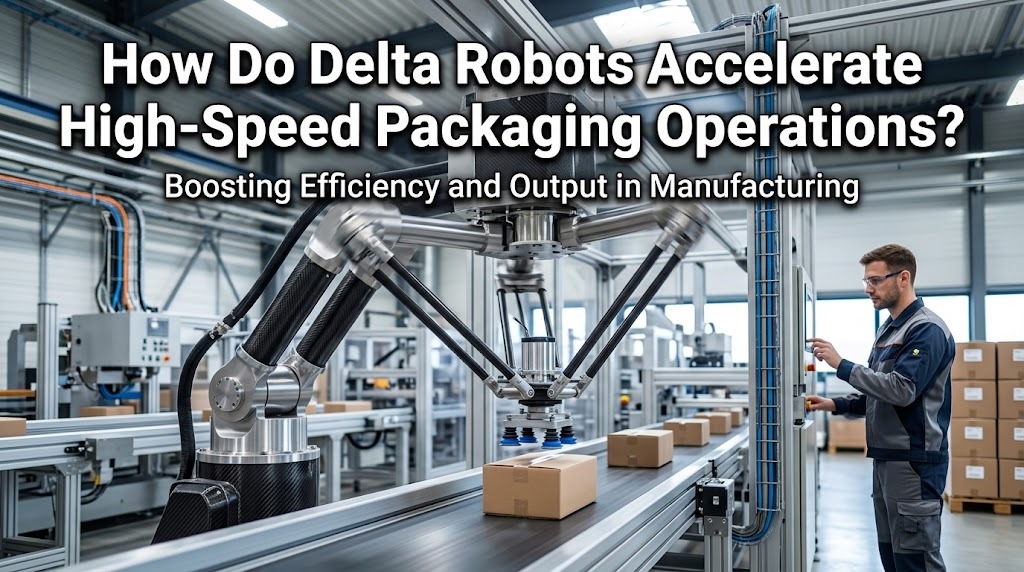
High-speed packaging operations require accuracy, consistency, and rapid movement to handle large product volumes. In industries such as food processing, pharmaceuticals, and consumer goods, even small delays can reduce production efficiency. Delta robots help address these challenges through a lightweight design, parallel mechanical structure, and fast picking capabilities. By automating repetitive packaging tasks, these robots enable manufacturers to increase throughput while maintaining consistent product handling.
UNDERSTANDING DELTA ROBOTS
Delta robots are industrial robots that typically feature three or four lightweight arms connected to a fixed frame and a moving platform. Their motors are usually mounted above the working area, reducing the mass that must move during operation. This parallel structure allows the robot to accelerate and decelerate rapidly while maintaining precise positioning. Delta robots are particularly suitable for tasks that involve picking, placing, sorting, and transferring lightweight products at high speeds.
INCREASING PICK-AND-PLACE SPEED
One of the main advantages of delta robots is their ability to perform rapid pick-and-place movements. In packaging lines, they can collect products from a conveyor and place them into trays, boxes, or designated containers. Their low moving mass helps reduce the time required to travel between pickup and placement points. When programmed efficiently, delta robots can complete repeated movements in short cycles, allowing packaging lines to process more products within a given period.
IMPROVING PRODUCT POSITIONING ACCURACY
Packaging often requires products to be placed in specific orientations and locations. Delta robots use motion controllers, encoders, and programmed trajectories to position items accurately. Vision systems can identify products on moving conveyor belts and provide coordinates for robotic picking. This combination helps reduce misplaced products and supports consistent package arrangement. Accurate positioning is especially important when products must fit into closely spaced compartments or follow strict packaging patterns.
INTEGRATING VISION SYSTEMS AND CONVEYORS
Delta robots commonly operate alongside conveyor systems and machine vision technology. Cameras identify products, estimate their positions, and send data to the robot controller. The controller calculates the required movement so the robot can pick items while the conveyor continues moving. This coordinated process reduces unnecessary conveyor stops and supports continuous production. Effective integration depends on suitable camera placement, reliable product detection, synchronized timing, and properly calibrated equipment.
HANDLING DIFFERENT TYPES OF PRODUCTS
Delta robots can handle a wide range of lightweight products, including packaged snacks, confectionery, small consumer goods, and selected pharmaceutical items. Different end effectors, such as vacuum grippers or mechanical fingers, allow the robot to handle products with different shapes and surface properties. Gentle gripping is essential when dealing with fragile items that may become damaged under excessive pressure. However, product weight, size, texture, and stability must remain within the robot's operating limits.
REDUCING LABOR AND OPERATIONAL BOTTLENECKS
Manual packaging can become a bottleneck when production volumes increase or tasks require frequent repetition. Delta robots can perform repetitive picking and placement consistently, reducing dependence on manual handling for suitable tasks. Workers can then focus on quality inspection, machine supervision, material preparation, and resolving production problems. Automation may also improve workflow consistency across shifts. However, actual labor savings depend on system costs, production requirements, maintenance needs, and how effectively the robot is integrated into the packaging line.
MAINTAINING SAFETY AND RELIABILITY
High-speed robotic movement requires appropriate safeguards to protect workers and equipment. Packaging systems may use safety barriers, interlocked access doors, emergency stops, and validated operating procedures. Regular maintenance helps preserve motion accuracy and prevent unexpected downtime. Manufacturers should also inspect grippers, sensors, cables, and mechanical joints to identify wear before it affects production. A well-maintained system can sustain reliable performance while reducing the risk of equipment failure.
THE FUTURE OF DELTA ROBOTS IN PACKAGING
Advances in machine vision, motion planning, artificial intelligence, and robotic grippers continue to expand the capabilities of delta robots. Improved software can optimize movement paths, coordinate multiple robots, and respond to changing product positions. More flexible systems may also switch between packaging formats with less manual reconfiguration. These developments can help manufacturers manage diverse product lines and changing customer demands. Nevertheless, the best solution depends on throughput targets, product characteristics, available space, and total operating costs.
CONCLUSION
Delta robots accelerate high-speed packaging operations through rapid movement, precise positioning, and efficient coordination with conveyors and vision systems. Their lightweight parallel structure makes them especially effective for repetitive pick-and-place tasks involving suitable products. When combined with reliable equipment, proper safety measures, and effective system integration, delta robots can increase throughput and improve packaging consistency.
Recent Posts

Bagaimana Sistem SKS pada Program Kuliah... 22.11.2026/49 View

How Does Technology Make Daily Evaluation... 21.11.2026/76 View

Apa Strategi Menghadapi Kesenjangan antara Kompetensi... 21.11.2026/78 View

Mengapa Inventaris Aset Penting bagi Kelancaran... 21.11.2026/74 View

When Should Musicians Join a Record... 21.11.2026/78 View
