

How Do Fossils Help Explain Human Evolution?
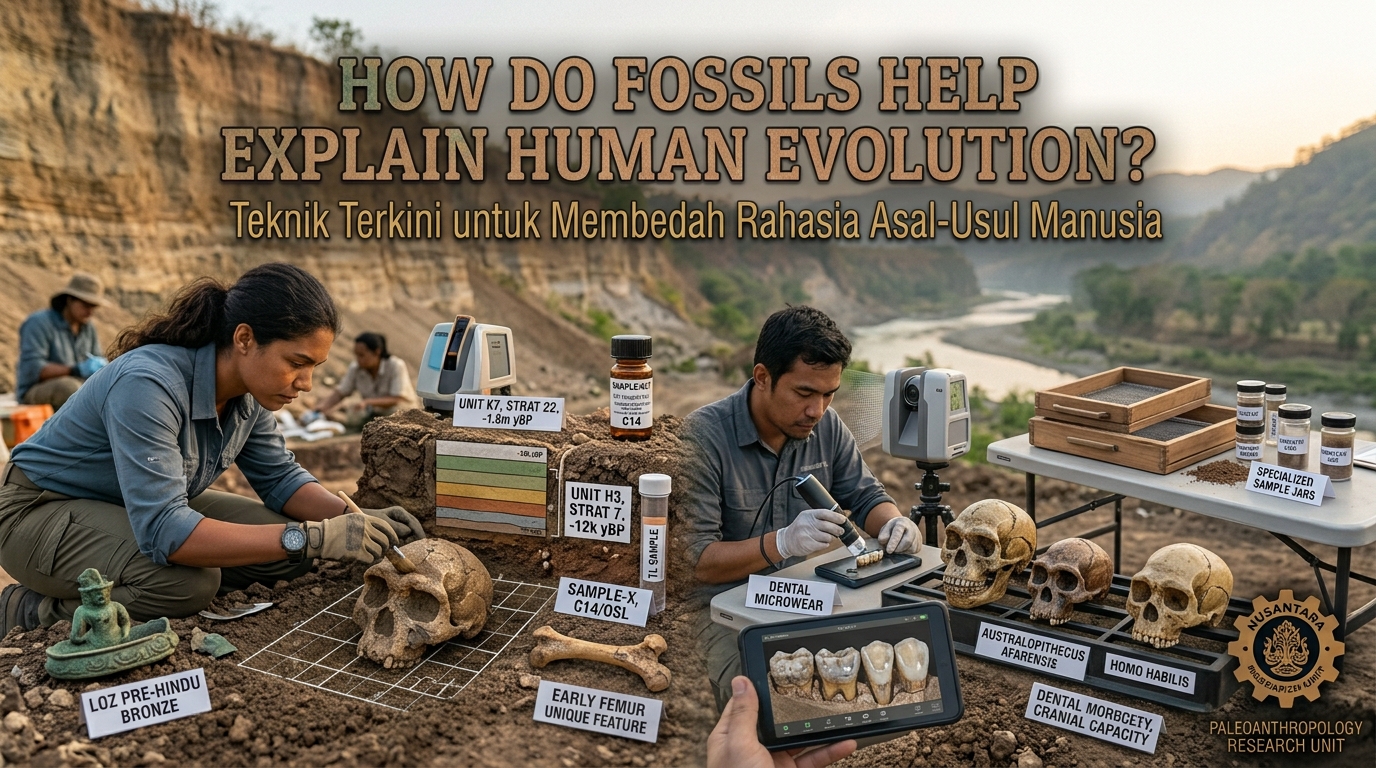
Fossils provide some of the most important evidence for understanding how humans evolved over millions of years. They preserve traces of ancient organisms, including bones, teeth, and other remains that reveal how early human relatives looked and lived. By studying these discoveries, scientists can investigate changes in body structure, brain size, movement, and adaptation to different environments. Human evolution was not a simple, straight path from ancient apes to modern humans, but a complex process involving many species and branches. Understanding how fossils help explain human evolution allows us to explore our origins through scientific evidence.
WHAT ARE FOSSILS AND WHY ARE THEY IMPORTANT?
Fossils are preserved remains, impressions, or traces of organisms that lived in the past. They can include bones, teeth, footprints, and occasionally impressions of soft tissues or other biological materials. Fossils form under particular conditions, often when remains are buried quickly and protected from decay. Over time, minerals and geological processes may preserve parts of an organism or leave an impression in sedimentary rock. These discoveries provide physical evidence of life that existed long before written history.
Fossils are especially valuable because they allow scientists to examine organisms that no longer exist. Human ancestor fossils help researchers compare ancient anatomy with the bodies of modern humans and other primates. Their features can reveal changes in walking, chewing, brain development, and other aspects of biology. The fossil record provides direct physical evidence of evolutionary change, although it remains incomplete because fossilization is rare. Each new discovery can add information or lead scientists to reconsider earlier interpretations.
FOSSILS REVEAL CHANGES IN HUMAN ANATOMY
One major way fossils explain human evolution is by showing how the human body changed over time. Scientists examine features such as the pelvis, leg bones, spine, feet, and skull to investigate how ancient human relatives moved. For example, several early hominins had anatomical features associated with bipedalism, or walking on two legs. Changes in the pelvis and lower limbs provide evidence of how upright walking developed in different human ancestors. These findings help researchers understand how movement adapted to different environments.
Fossil skulls and teeth also reveal important anatomical differences between species. The shape of the jaw, size of the teeth, and structure of the skull can provide clues about diet and evolutionary relationships. Some hominin species had relatively small brains, while later members of the human lineage included species with larger braincases. However, brain size alone does not determine intelligence or behavior, and scientists consider many other factors when interpreting fossils. By comparing multiple anatomical features, researchers can identify similarities, differences, and possible relationships among ancient populations.
FOSSILS SHOW HOW EARLY HUMANS WALKED
Bipedalism is one of the defining features of the human lineage, and fossils help scientists investigate how it developed. Fossilized leg bones, pelvises, and foot bones can reveal adaptations associated with upright walking. These features suggest that some early hominins could move on two legs before the evolution of the larger brains characteristic of later humans. This evidence challenges the idea that walking upright developed only after humans began to have larger brains. Instead, human evolution involved several changes that occurred at different times.
Fossil footprints provide another valuable source of information about movement. The footprints at Laetoli in Tanzania, for example, are approximately 3.6 million years old and are widely associated with early hominins that walked upright. Their shape and arrangement provide evidence about how these individuals placed their feet and moved across the ground. Footprints can also preserve details that bones alone may not reveal, such as aspects of walking patterns. Combining fossil bones with footprints gives scientists a clearer understanding of the development of human movement.
FOSSILS HELP EXPLAIN BRAIN DEVELOPMENT
The skulls of ancient hominins allow scientists to estimate cranial capacity, which is the space inside the skull that held the brain. Comparisons between fossils show that brain size varied among different hominin species and changed significantly in parts of the human evolutionary lineage. Researchers study these differences alongside changes in skull shape, teeth, and other anatomical features. This evidence helps scientists investigate when certain biological changes appeared and how they varied across species. However, the timing and causes of brain expansion remain important areas of research.
Brain development cannot be understood through fossil skulls alone. Scientists also examine archaeological evidence such as stone tools, animal remains, and signs of controlled fire to investigate behavior and technological abilities. These discoveries can provide clues about problem-solving, food processing, and adaptation to changing conditions. Nevertheless, the presence of a particular tool does not automatically reveal the full cognitive abilities of its maker. Fossils and archaeological evidence must be interpreted together to develop a more complete picture of the relationship between anatomy and behavior.
FOSSILS REVEAL ANCIENT ENVIRONMENTS AND ADAPTATION
Human evolution took place in changing environments, and fossils help scientists reconstruct those conditions. Animal bones, plant remains, pollen, and other biological evidence can reveal what lived in an area during a particular period. Geological layers and ancient soils can provide additional information about climate, vegetation, and landscape changes. Researchers compare this environmental evidence with hominin fossils to investigate how ancient populations responded to different conditions. These studies help explain why certain physical features or behaviors may have been useful in particular environments.
For example, changes in climate could have influenced food availability, water sources, and patterns of movement. Scientists investigate whether these changes were associated with shifts in diet, habitat use, or the appearance and disappearance of different hominin populations. However, environmental change rarely explains evolutionary developments through a single cause. Human evolution resulted from interactions among biology, environment, behavior, and chance over long periods. Fossils provide important clues, but researchers must consider multiple explanations before drawing conclusions.
FAMOUS FOSSIL DISCOVERIES THAT CHANGED OUR UNDERSTANDING
Several major fossil discoveries have helped transform scientific understanding of human evolution. Australopithecus afarensis, a species that lived in Africa millions of years ago, is represented by the famous fossil known as Lucy, discovered in Ethiopia in 1974. Lucy's remains provided important evidence about the anatomy and movement of an early hominin. The Laetoli footprints in Tanzania offered additional evidence of upright walking among early hominins. Together, these discoveries helped researchers investigate how bipedal movement developed before the appearance of modern humans.
Other discoveries have expanded knowledge of human diversity and migration. Fossils attributed to Homo erectus show that members of the human lineage spread beyond Africa and lived in parts of Asia. The discovery of Homo floresiensis on Flores Island in Indonesia revealed another distinctive human species with a small body and unusual combination of anatomical features. Meanwhile, Neanderthal fossils have helped scientists investigate the biology and behavior of an extinct human group that lived across parts of Europe and western Asia. These findings demonstrate that human evolution involved many different species, some of which lived during overlapping periods.
HOW SCIENTISTS STUDY AND DATE HUMAN FOSSILS
Scientists use several methods to examine and date fossils. They study the geological layers in which remains are found, compare anatomical features, and use laboratory techniques when suitable materials are available. Radiometric dating can estimate the age of certain rocks and minerals, while radiocarbon dating is useful for relatively recent organic materials, generally up to around 50,000 years under suitable conditions. For much older hominin fossils, researchers may date volcanic layers or use other geological and scientific methods. The most appropriate technique depends on the age, material, and context of the discovery.
Modern technology has made fossil research more detailed and precise. CT scanning can reveal internal structures without destroying a specimen, while digital models allow scientists to compare bones and skulls from different locations. Researchers may also analyze ancient DNA when it has survived, particularly in some relatively recent human remains. No single method answers every question, so scientists compare different types of evidence and acknowledge uncertainties. Careful dating and analysis help establish when ancient species lived and how their remains fit into the broader evolutionary timeline.
WHY FOSSILS MATTER FOR UNDERSTANDING HUMAN ORIGINS
Fossils help explain human origins by revealing biological changes that cannot be understood through written records alone. They provide evidence about ancient anatomy, movement, diet, and the diversity of species related to modern humans. When combined with archaeological discoveries and genetic research, fossils help scientists investigate how populations changed, migrated, and interacted over time. They also show that evolutionary development was complex rather than a simple progression toward modern humans. The fossil record is essential for testing scientific explanations of human evolution.
Studying fossils also demonstrates how scientific knowledge develops. New discoveries may support existing ideas, challenge earlier conclusions, or reveal previously unknown species. Scientists continually compare evidence and revise interpretations when stronger information becomes available. Although gaps remain in the fossil record, each carefully documented discovery can improve our understanding of the past. Protecting fossil sites and supporting scientific research helps ensure that future generations can continue investigating the origins and development of humanity.
CONCLUSION
Fossils help explain human evolution by preserving evidence of ancient human relatives and the biological changes that occurred over millions of years. Their bones, teeth, skulls, and footprints reveal important information about movement, anatomy, brain development, and adaptation to changing environments. Famous discoveries such as Lucy, the Laetoli footprints, and Homo floresiensis have expanded scientific knowledge of the diversity of the human lineage. By combining fossil evidence with geological dating, archaeology, and genetics, researchers can build a more reliable picture of human origins. Continued research and careful preservation of fossil sites remain essential for understanding how humans evolved and became what we are today.
Recent Posts

Bagaimana Sistem SKS pada Program Kuliah... 22.11.2026/50 View

How Does Technology Make Daily Evaluation... 21.11.2026/79 View

Apa Strategi Menghadapi Kesenjangan antara Kompetensi... 21.11.2026/79 View

Mengapa Inventaris Aset Penting bagi Kelancaran... 21.11.2026/75 View

When Should Musicians Join a Record... 21.11.2026/80 View
