

How Do Fossils Help Scientists Understand Human Evolution?
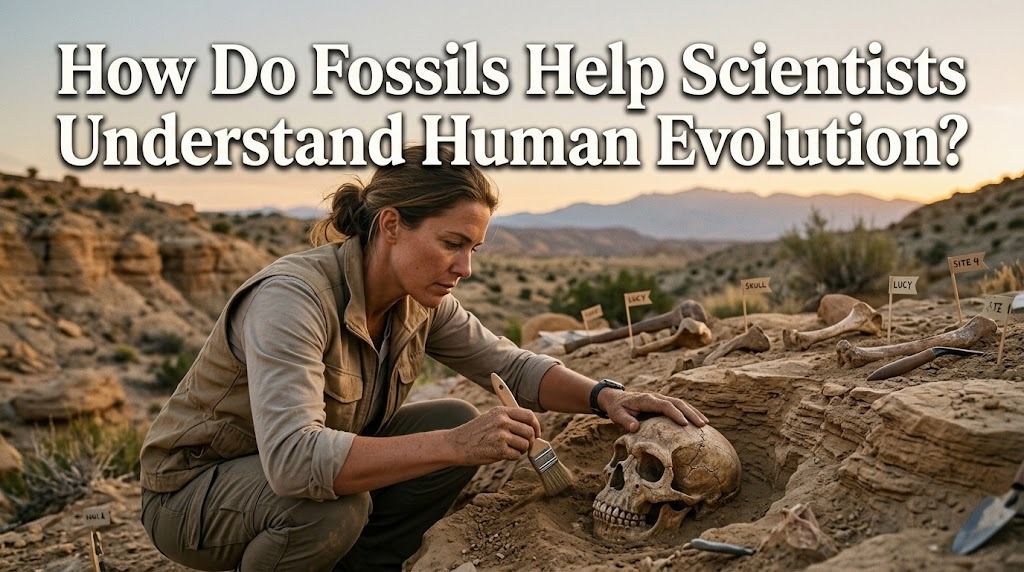
Fossils play an essential role in helping scientists understand human evolution and the development of the human species over millions of years. By studying ancient bones, teeth, footprints, and other preserved remains, researchers can discover how early humans lived, moved, and adapted to changing environments. These discoveries provide valuable evidence about the physical characteristics and behaviors of our ancestors. Fossils also help scientists identify relationships between ancient human relatives and modern humans. Although fossils do not reveal every detail of the past, they provide important clues about how humans evolved over time.
WHAT ARE FOSSILS AND WHY ARE THEY IMPORTANT?
Fossils are preserved remains or traces of organisms that lived in the past. They can include bones, teeth, footprints, and other evidence of ancient life. In human evolution research, fossils help scientists study hominins, a group that includes modern humans and our extinct relatives after their evolutionary line separated from that of chimpanzees. Some fossils preserve only small fragments, while others provide nearly complete skeletons. Each discovery can reveal information about the appearance, age, and possible lifestyle of an ancient individual.
Fossils are especially important because written records did not exist during the earliest stages of human evolution. Scientists use fossil evidence to reconstruct events that occurred millions of years ago. By comparing fossils from different periods, researchers can identify changes in body size, brain structure, teeth, and the ability to walk upright. These observations help explain how different human ancestors adapted to their environments. Fossils also allow scientists to test scientific explanations against physical evidence rather than relying only on assumptions.
HOW FOSSILS REVEAL CHANGES IN HUMAN ANATOMY
One of the most important contributions of fossils is the information they provide about changes in human anatomy. For example, fossilized pelvises, leg bones, and foot bones can reveal whether an ancient hominin walked on two legs. Scientists can also examine skulls to estimate brain size and study teeth to understand aspects of diet. These features help researchers compare ancient hominins with modern humans and other primates. Over time, the evidence shows that human evolution involved a combination of physical changes rather than one sudden transformation.
Some fossils demonstrate that early hominins could walk upright long before modern humans appeared. Australopithecus afarensis, a species that lived approximately 3.9 to 2.9 million years ago, provides important evidence of early bipedalism. The famous fossil known as Lucy belongs to this species and has helped scientists understand how upright walking developed. Other fossils, including those of early members of the genus Homo, provide evidence of changes in body proportions and brain size. Together, these discoveries show that different human characteristics evolved at different times.
HOW SCIENTISTS DETERMINE THE AGE OF HUMAN FOSSILS
Knowing the age of a fossil is essential for understanding human evolution. Scientists use several dating methods to estimate when an ancient organism lived. One method is radiometric dating, which measures the predictable decay of radioactive elements in suitable materials. For example, potassium-argon and argon-argon dating can help determine the age of volcanic rocks found near fossils. Scientists may also use stratigraphy, which examines the positions of rock layers, to establish the relative ages of fossil discoveries.
Radiocarbon dating is useful for relatively recent organic remains, generally up to around 50,000 years old under suitable conditions. However, it cannot directly date most early human fossils that are millions of years old. Researchers therefore select dating methods based on the age and geological conditions of each discovery. Sometimes, they combine several techniques to improve the reliability of their estimates. Accurate dating helps scientists determine the order in which different hominin species appeared and identify how long particular species existed.
HOW FOSSILS HELP SCIENTISTS UNDERSTAND HUMAN BEHAVIOR
Fossils can reveal more than physical appearance because they also provide clues about how ancient humans lived. Teeth and jawbones can help scientists investigate diet, while skeletal injuries may reveal aspects of physical activity or survival. Fossil footprints can provide evidence of walking patterns, group movement, and body proportions. When researchers study these findings alongside stone tools, animal remains, and other archaeological evidence, they can develop a clearer picture of ancient human life. However, scientists must interpret such evidence carefully because a fossil rarely reveals a complete story on its own.
For example, fossilized footprints at Laetoli in Tanzania, dating to approximately 3.66 million years ago, provide evidence that early hominins walked upright. The footprints preserve details of movement that bones alone cannot fully reveal. In other archaeological sites, the combination of fossils and stone tools helps researchers investigate how ancient hominins obtained food and interacted with their surroundings. Evidence from different sites can also reveal how environmental changes influenced survival. These findings help scientists understand the relationship between biological evolution and changes in behavior.
WHAT FOSSILS REVEAL ABOUT THE RELATIONSHIP BETWEEN ANCIENT AND MODERN HUMANS
Fossils help scientists identify similarities and differences among ancient hominins. By comparing skull shapes, teeth, pelvises, and other skeletal features, researchers can investigate how different species may be related. These comparisons reveal that human evolution was not a simple, straight line from an early ancestor to modern humans. Instead, several hominin species existed at different times, and some lived during overlapping periods. Many of these species became extinct, while Homo sapiens eventually became the only surviving human species.
Fossils also provide evidence that modern humans share an evolutionary history with other hominins. Neanderthal fossils, for example, reveal many anatomical similarities with modern humans, alongside distinctive physical characteristics. Fossil discoveries and ancient DNA studies show that Neanderthals and Homo sapiens interbred in the past. Denisovans, another group known through limited fossil remains and genetic evidence, also contributed DNA to some present-day human populations. These findings demonstrate that the history of human evolution includes both branching lineages and interactions between different groups.
THE LIMITATIONS OF FOSSIL EVIDENCE
Although fossils are valuable, they do not provide a complete record of human evolution. Fossilization is a rare process that requires particular environmental conditions, so many organisms leave no preserved remains. Bones can also break apart, become damaged, or disappear through erosion over thousands or millions of years. As a result, scientists often have to study incomplete skeletons or isolated teeth. This makes it difficult to reconstruct every aspect of an ancient species.
Scientists address these limitations by comparing multiple discoveries and combining fossil evidence with genetics, archaeology, geology, and modern biological research. New discoveries may also change earlier interpretations of human ancestry. For example, a newly discovered skull might reveal that a species had more anatomical variation than researchers previously understood. Scientific explanations are therefore updated when stronger evidence becomes available. This process helps ensure that current explanations of human evolution remain based on the best available evidence.
CONCLUSION
Fossils help scientists understand human evolution by providing physical evidence of ancient human ancestors and their extinct relatives. They reveal changes in anatomy, provide clues about diet and movement, and help researchers establish when different hominin species lived. When combined with geological dating, archaeological discoveries, and genetic research, fossils provide a more complete understanding of human origins. They also demonstrate that human evolution was a complex process involving many species and different adaptations over millions of years. Although the fossil record is incomplete, each new discovery can improve our understanding of how modern humans developed and how we are connected to our evolutionary past.
Recent Posts

Bagaimana Sistem SKS pada Program Kuliah... 22.11.2026/51 View

How Does Technology Make Daily Evaluation... 21.11.2026/81 View

Apa Strategi Menghadapi Kesenjangan antara Kompetensi... 21.11.2026/81 View

Mengapa Inventaris Aset Penting bagi Kelancaran... 21.11.2026/77 View

When Should Musicians Join a Record... 21.11.2026/82 View
