

How Do Number Sequences Evaluate Analytical Thinking Abilities?
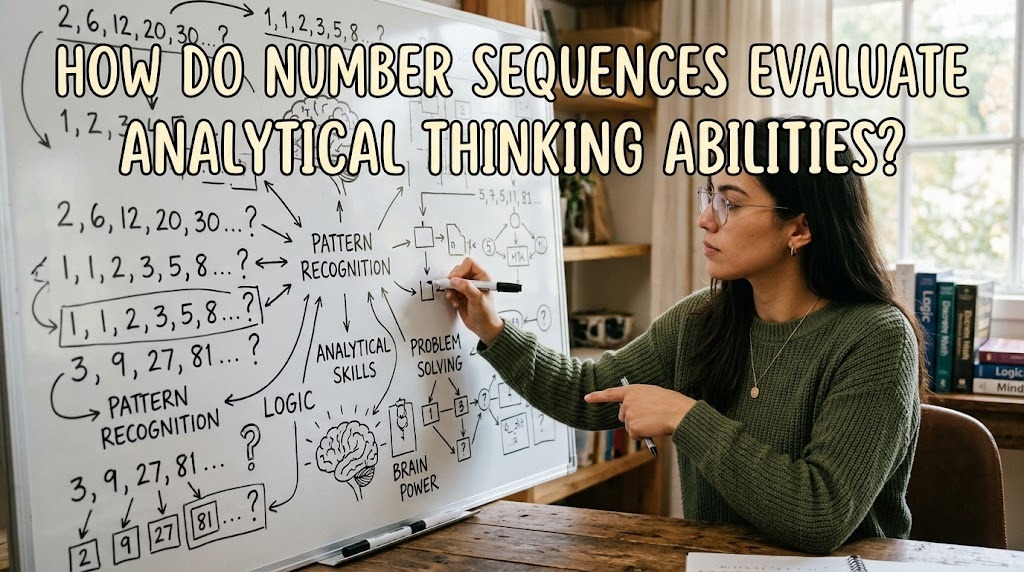
Number sequences are commonly used in numerical reasoning tests to assess how individuals recognize patterns and understand relationships between numbers. These questions present a series of values arranged according to a particular rule. Candidates must examine the sequence, identify the underlying relationship, and determine the missing or next number.
Although number sequence questions may appear simple, solving them requires several analytical skills. Candidates need to compare numerical values, test possible mathematical operations, recognize patterns, and verify their conclusions. These activities provide insight into how effectively someone processes information and approaches structured problems.
RECOGNIZING NUMERICAL PATTERNS
Pattern recognition is one of the main abilities evaluated through number sequence questions. Candidates must identify similarities and differences between consecutive numbers to discover the rule that connects them.
For example, the sequence 4, 8, 12, 16 follows a pattern in which each number increases by four. Recognizing this relationship allows candidates to predict that the next number is 20. More complicated sequences may involve alternating operations, increasing differences, or multiplication patterns that require closer examination.
ANALYZING RELATIONSHIPS BETWEEN NUMBERS
Number sequences also measure how well candidates understand relationships between numerical values. Instead of examining each number independently, they must determine how one value is connected to the next.
For instance, the sequence 3, 9, 27, 81 follows a multiplication pattern in which each number is multiplied by three. Candidates who recognize this relationship can identify the next value as 243. This process demonstrates the ability to compare information and establish logical connections.
DEVELOPING LOGICAL REASONING
Solving number sequences requires candidates to use logical reasoning rather than rely entirely on guesswork. They must consider possible mathematical rules and determine which explanation consistently fits the available numbers.
For example, a sequence may increase by different amounts, making a simple addition pattern difficult to identify. Candidates might need to calculate the differences between consecutive terms and examine whether those differences follow another pattern. This encourages structured thinking and the evaluation of possible explanations.
IDENTIFYING MATHEMATICAL RULES
Number sequence questions often involve mathematical operations such as addition, subtraction, multiplication, and division. Some questions also use square numbers, cube numbers, or combinations of different operations.
Candidates must recognize which mathematical rule explains the sequence. For example, the sequence 1, 4, 9, 16, 25 consists of square numbers. Identifying this relationship requires familiarity with mathematical concepts and the ability to apply them in a new context.
EVALUATING POSSIBLE SOLUTIONS
Analytical thinking involves examining possible answers before choosing the most suitable one. In number sequence tests, candidates may consider several mathematical rules but must verify which one explains all the available terms.
A possible pattern should not be accepted simply because it matches the first few numbers. Candidates need to check whether the same rule works consistently throughout the sequence. This process demonstrates their ability to evaluate information, eliminate unsuitable explanations, and select a logically supported answer.
IMPROVING PROBLEM-SOLVING STRATEGIES
Number sequences encourage candidates to approach problems systematically. Rather than trying random operations, they can begin by calculating differences, checking multiplication or division, and examining alternating patterns.
For more complex questions, candidates may need to separate a sequence into smaller groups or investigate how the differences change. Using a structured method makes the problem easier to understand and reduces the possibility of unnecessary calculations.
MEASURING ATTENTION TO DETAIL
Small numerical differences can reveal important information about a sequence. Candidates must pay attention to every term because overlooking one value may lead to an incorrect conclusion.
For example, a sequence containing alternating increases and decreases may appear irregular at first. By examining each position carefully, candidates may discover two separate patterns. This requires concentration, careful observation, and accuracy when comparing numerical information.
ASSESSING DECISION-MAKING UNDER TIME PRESSURE
Many numerical reasoning assessments include time limits. Candidates must identify patterns, perform calculations, and choose answers without spending too much time on individual questions.
This situation evaluates how efficiently they organize information and select an appropriate problem-solving approach. However, speed alone does not determine analytical ability. Accuracy and consistency are also important because quick answers based on incorrect assumptions can reduce overall performance.
BUILDING ANALYTICAL THINKING THROUGH PRACTICE
Regular practice can help candidates become more familiar with different types of number sequences. They should begin with simple addition and subtraction patterns before progressing to multiplication, division, alternating sequences, and changing differences.
Reviewing incorrect answers is also important. Candidates can examine why a particular rule did not work and identify which mathematical relationship they overlooked. Over time, this practice can strengthen pattern recognition, logical reasoning, and confidence when solving unfamiliar problems.
CONCLUSION
Number sequences evaluate analytical thinking by requiring candidates to recognize patterns, understand numerical relationships, identify mathematical rules, and evaluate possible solutions. These questions also involve attention to detail, logical reasoning, and structured problem-solving. Although performance on number sequence questions provides information about specific numerical reasoning skills, it does not measure every aspect of a person's overall intelligence or professional ability.
Recent Posts

Bagaimana Sistem SKS pada Program Kuliah... 22.11.2026/40 View

How Does Technology Make Daily Evaluation... 21.11.2026/71 View

Apa Strategi Menghadapi Kesenjangan antara Kompetensi... 21.11.2026/73 View

Mengapa Inventaris Aset Penting bagi Kelancaran... 21.11.2026/69 View

When Should Musicians Join a Record... 21.11.2026/73 View
