

How Do Practice Simulations Improve Science Olympiad Readiness?
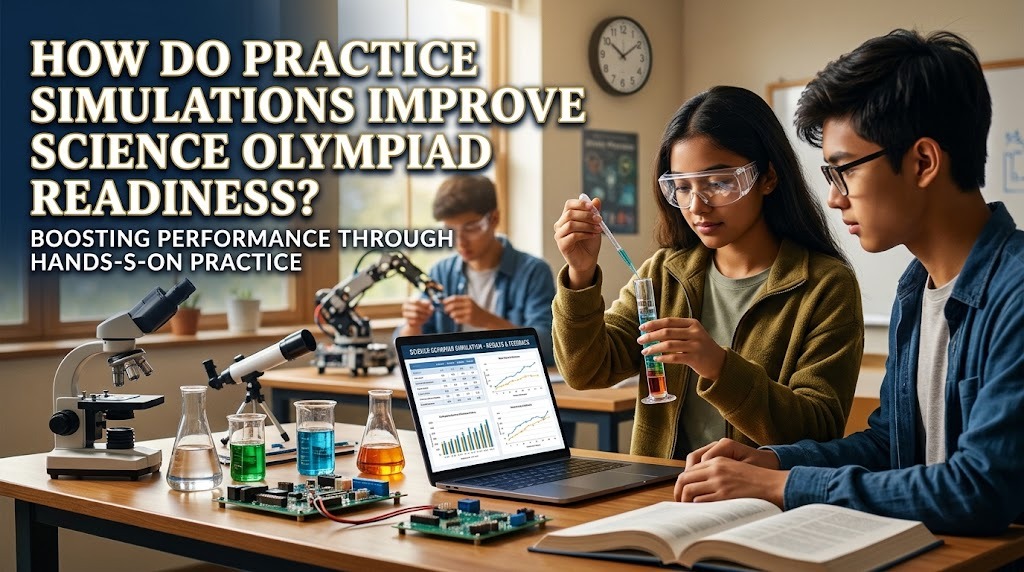
Preparing for a Science Olympiad requires more than understanding scientific theories and memorizing important formulas. Students also need to develop problem-solving abilities, manage examination time, and become familiar with different types of competition questions. Practice simulations provide an opportunity to develop these skills through activities that resemble actual competition conditions.
By participating in simulated examinations, students can experience time restrictions, challenging questions, and different assessment formats before facing the real competition. These activities help them identify weaknesses, evaluate their preparation, and build confidence. As a result, practice simulations can become an important part of an effective Science Olympiad training program.
CREATING REALISTIC COMPETITION CONDITIONS
One of the main benefits of practice simulations is that they introduce students to an examination environment similar to the actual Science Olympiad. Participants complete questions within a predetermined time limit and follow specific examination instructions.
This experience helps students understand how competition conditions may affect their concentration and decision-making. They can also become familiar with the pressure of answering questions independently without immediate assistance from teachers or classmates.
Repeated exposure to simulated examinations can make students feel more comfortable when facing the real competition. They become better prepared to manage the examination process and focus on solving problems.
IMPROVING TIME MANAGEMENT SKILLS
Science Olympiad examinations often contain questions with different levels of difficulty. Some require only a short explanation, while others involve complicated calculations and detailed scientific reasoning.
Practice simulations help students understand how much time they need to answer different types of questions. They can learn to prioritize questions, avoid spending too long on one problem, and reserve time for reviewing their answers.
After completing each simulation, students can evaluate their time distribution. This allows them to identify which sections require more efficient strategies and develop better examination habits.
IDENTIFYING KNOWLEDGE GAPS
Practice simulations provide valuable information about students' understanding of scientific subjects. Their results can reveal which concepts they have mastered and which topics still require additional study.
For example, a student may perform well in biology questions but struggle with physics calculations. Another participant may understand scientific theories but have difficulty interpreting experimental data.
Identifying these weaknesses allows students to create more focused study plans. Instead of reviewing every topic equally, they can spend additional time strengthening the areas where improvement is most necessary.
STRENGTHENING PROBLEM-SOLVING ABILITIES
Science Olympiad questions frequently require students to apply scientific knowledge to unfamiliar situations. Practice simulations expose participants to different question formats and encourage them to develop flexible problem-solving strategies.
Students learn to identify relevant information, recognize scientific principles, and determine appropriate methods for reaching a solution. They also become more familiar with questions that combine multiple concepts.
Regular exposure to challenging problems can improve analytical thinking. Participants gradually become more comfortable approaching unfamiliar questions without relying entirely on memorized answers.
BUILDING CONFIDENCE AND REDUCING EXAMINATION ANXIETY
Some students understand scientific concepts but feel nervous when participating in formal examinations. They may worry about limited time, difficult questions, or the possibility of making mistakes.
Practice simulations help reduce uncertainty by allowing students to experience examination conditions before the actual competition. As they become familiar with the format, they can develop greater confidence in their preparation.
These activities also teach students how to respond to mistakes constructively. Instead of becoming discouraged by low practice scores, they can use the results to understand their weaknesses and improve their performance.
DEVELOPING ACCURACY AND CONCENTRATION
Answering difficult scientific questions requires careful attention to details. Small mistakes in calculations, measurements, or interpretations can lead to incorrect conclusions.
Practice simulations encourage students to maintain concentration throughout an examination. They learn to read instructions carefully, identify important information, and check their answers before submitting them.
Repeated practice can also help participants recognize situations in which they tend to make mistakes. By reviewing these patterns, students can develop habits that support greater accuracy during the actual competition.
PROVIDING IMMEDIATE FEEDBACK FOR IMPROVEMENT
Feedback is an essential part of effective Science Olympiad preparation. After completing a practice simulation, students should review their answers and understand why certain responses are correct or incorrect.
Teachers and mentors can use simulation results to explain difficult concepts, discuss alternative problem-solving methods, and provide additional exercises. Students can also compare their performance across several practice sessions.
This feedback process turns each simulation into a learning opportunity. Rather than focusing only on scores, participants can use the information to improve their scientific understanding and examination strategies.
ENCOURAGING HEALTHY COMPETITION AND COLLABORATION
Practice simulations can be organized individually or in groups. Group activities allow students to experience friendly competition while learning from the different strengths of their classmates.
For example, teachers can organize mock Science Olympiad examinations in which students complete the same set of questions under identical time restrictions. Afterward, they can discuss difficult problems and compare their approaches.
These activities encourage students to share knowledge and develop mutual support. However, individual simulations are also important because actual examinations generally require participants to demonstrate their own understanding and abilities.
HELPING TEACHERS EVALUATE STUDENT READINESS
Practice simulations are useful not only for students but also for teachers and mentors. The results provide information about students' academic progress, problem-solving abilities, and readiness for competition.
Teachers can examine performance patterns to determine whether students need additional instruction, more advanced exercises, or further practice with specific question formats. They can also evaluate whether the current training program is meeting its learning objectives.
By using simulation results systematically, schools can develop more effective training plans. This makes it easier to provide support based on students' actual learning needs rather than general assumptions.
CREATING AN EFFECTIVE SCIENCE OLYMPIAD SIMULATION PROGRAM
To gain meaningful benefits, practice simulations should be organized regularly and designed according to the students' competition level. The questions should cover relevant scientific topics and include different levels of difficulty.
Several methods can help make simulation activities more effective:
- Use Relevant Questions: Select practice materials that match the competition syllabus and expected examination format.
- Apply Time Restrictions: Set a realistic duration to help students develop time management skills.
- Include Different Topics: Cover various scientific concepts to evaluate students' overall understanding.
- Review Every Result: Discuss incorrect answers and explain the scientific principles behind each solution.
- Track Learning Progress: Compare results from different sessions to identify improvements and recurring weaknesses.
- Adjust Training Materials: Provide additional exercises based on students' individual learning needs.
A consistent simulation program helps students prepare gradually while giving teachers useful information for evaluating their development.
CONCLUSION
Practice simulations improve Science Olympiad readiness by familiarizing students with competition conditions, strengthening time management, and identifying knowledge gaps. They also support problem-solving abilities, concentration, confidence, and examination accuracy.
More importantly, simulations provide opportunities for students and teachers to evaluate preparation through measurable results. When combined with regular study, constructive feedback, and focused training, these activities can help participants approach Science Olympiad competitions with greater confidence and readiness.
Recent Posts

Bagaimana Sistem SKS pada Program Kuliah... 22.11.2026/48 View

How Does Technology Make Daily Evaluation... 21.11.2026/76 View

Apa Strategi Menghadapi Kesenjangan antara Kompetensi... 21.11.2026/78 View

Mengapa Inventaris Aset Penting bagi Kelancaran... 21.11.2026/73 View

When Should Musicians Join a Record... 21.11.2026/78 View
