

How Do Professional Accountants Prepare Accurate Financial Statements?
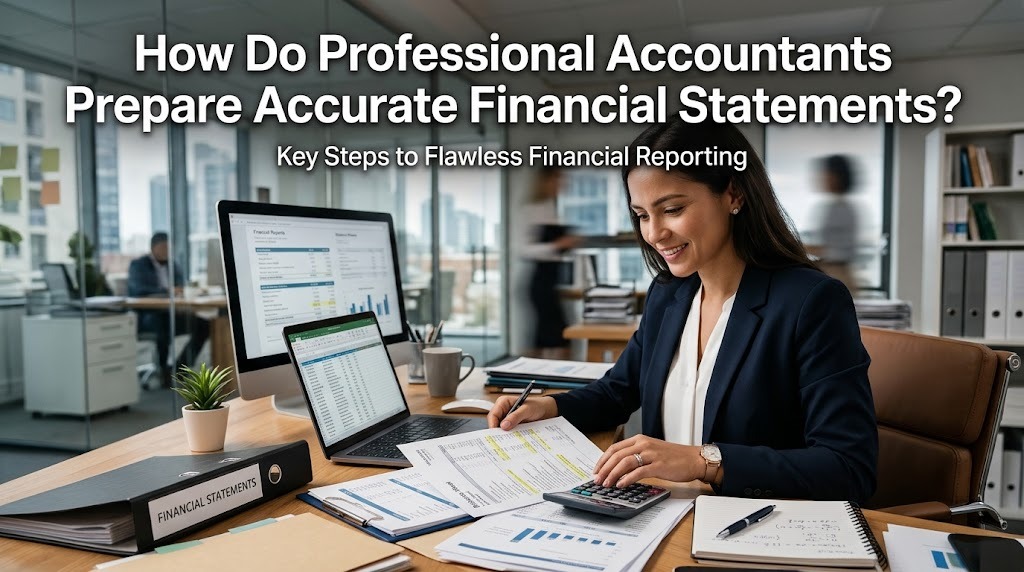
Preparing accurate and reliable financial statements is one of the most critical responsibilities entrusted to a professional accountant. These formal reports summarize an enterprise’s financial activities, operating performance, and liquidity position over a specific fiscal reporting period. External stakeholders, including commercial lenders, tax authorities, and equity investors, rely heavily on these disclosures to make informed economic decisions. To ensure absolute precision, accountants must follow a structured preparation workflow governed by international financial reporting standards (IFRS) and national accounting frameworks. Rigorous methodology minimizes calculation errors and guarantees that corporate financial health is portrayed truthfully.
In modern corporate environments, financial statement preparation combines traditional bookkeeping principles with advanced enterprise resource planning (ERP) software and automated ledger tools. Accountants transition raw transactional data collected throughout the fiscal year into structured balance sheets, income statements, and cash flow reports. Each statement serves a distinct analytical purpose, providing a comprehensive window into corporate profitability and capital allocation. Mastering this intricate preparation process is essential for maintaining corporate transparency and regulatory compliance. Accurate financial reporting forms the bedrock of sustainable enterprise governance and investor confidence.
WHAT IS THE ROLE OF THE TRIAL BALANCE IN FINANCIAL PREPARATION?
The preparation of financial statements begins with the generation and verification of an unadjusted trial balance from the general ledger. A trial balance compiles the ending debit and credit balances of every active account in the company's chart of accounts. The primary purpose of this step is to mathematically verify that total debits equal total credits before proceeding with closing adjustments. If an imbalance exists, the accountant must investigate and correct ledger entry errors, missing receipts, or posting mistakes. Ensuring mathematical equilibrium in the trial balance prevents downstream reporting inaccuracies.
Furthermore, reviewing the trial balance allows accountants to spot unusual account fluctuations or unexpected negative balances early in the reporting cycle. This preliminary screening phase acts as an essential quality control checkpoint before major end-of-period adjustments are calculated. Accountants verify that all asset, liability, equity, revenue, and expense accounts are categorized correctly according to standard accounting classifications. Establishing a clean trial balance provides a solid, reliable platform for executing subsequent adjusting journal entries. Methodical data verification is the hallmark of professional accounting precision.
HOW DO ACCOUNTANTS EXECUTE ADJUSTING JOURNAL ENTRIES?
Once the trial balance is verified, accountants must record necessary adjusting journal entries to account for accruals, prepayments, depreciation, and deferrals. Under accrual accounting principles, revenues must be recorded when earned and expenses when incurred, regardless of when cash changes hands. Adjusting entries allocate unrecorded revenues, accrued salaries, prepaid insurance, and monthly asset depreciation to their correct fiscal periods. For example, performing routine bank reconciliation ensures that interest income and bank fees are accounted for accurately before statements are finalized. These adjustments bridge the gap between daily cash movements and true financial performance.
Failing to record proper adjusting entries results in materially misstated financial reports that can violate statutory regulations and mislead corporate stakeholders. Accountants review every accrual account meticulously to ensure that estimates are backed by verifiable documentation and commercial reality. Once all adjusting entries are posted to the general ledger, an adjusted trial balance is generated to confirm updated financial balances. This meticulous adjustment phase ensures that corporate earnings reflect true operational performance for the period. Precision in adjusting entries prevents costly financial restatements later.
HOW ARE INCOME STATEMENTS AND BALANCE SHEETS CONSTRUCTED?
Following the successful posting of all adjusting entries, the accountant begins constructing the primary financial reports, starting with the income statement. The income statement summarizes all revenue earned and expenses incurred over the accounting period, resulting in net operating income or loss. It provides management and investors with a clear view of top-line growth, operational efficiency, and profit margins. Next, the accountant compiles the balance sheet, which outlines the company’s total assets, liabilities, and shareholders' equity at a specific point in time. The balance sheet must satisfy the fundamental accounting equation where assets equal liabilities plus equity.
In addition to the income statement and balance sheet, accountants prepare the statement of cash flows and the statement of changes in equity. The cash flow statement categorizes cash movements into operating, investing, and financing activities to reveal true enterprise liquidity. Every figure reported on these major statements traces back directly to verified ledger balances and adjusting journal entries. Ensuring cross-statement consistency is vital, as net income from the income statement must tie directly into retained earnings on the balance sheet. Rigorous cross-checking eliminates discrepancies across all published corporate financial documents.
WHY IS COMPLIANCE WITH IFRS AND TAX LAWS ESSENTIAL?
Financial statements must be prepared in strict compliance with established international financial reporting standards (IFRS) and statutory legal frameworks. Adhering to recognized reporting frameworks ensures that financial disclosures are consistent, comparable, and transparent across different global markets and industries. Accountants must stay constantly updated on evolving accounting standards, such as new rules governing lease accounting or digital asset revenue recognition. Furthermore, maintaining strict tax compliance during financial statement preparation ensures that corporate tax liabilities are calculated and reported lawfully to revenue authorities. Regulatory adherence protects companies from severe legal penalties and government audits.
When preparing statements for public corporations or companies seeking commercial bank loans, compliance with statutory audit standards is mandatory. External auditors review the accountant’s working papers, journal entries, and underlying documentation to issue an independent audit opinion. Transparent reporting builds immediate credibility with commercial lenders, institutional investors, and regulatory oversight bodies. Ignoring accounting standards or tax regulations exposes the enterprise to catastrophic financial and legal risks. Uncompromising regulatory compliance is non-negotiable for professional accountants.
HOW DO PROFESSIONAL REVIEW AND INTERNAL CONTROLS PREVENT ERRORS?
Before financial statements are officially published or presented to executive boards, they undergo rigorous internal review and supervisory sign-off procedures. Robust internal control frameworks require that financial reports are reviewed by senior accounting managers or corporate controllers to catch residual calculation errors. Implementing segregation of duties ensures that the staff member who prepares ledger entries is not the sole person reviewing final statements. Internal reviews evaluate financial ratios, comparative period variances, and unusual ledger spikes to ensure reporting accuracy. Multi-tiered review processes act as a powerful safeguard against accidental errors or fraudulent reporting.
Additionally, utilizing modern cloud accounting software with automated validation checks significantly reduces manual transposition errors during statement compilation. Accountants document all adjustments and working paper assumptions thoroughly to create an auditable paper trail for external statutory reviewers. Taking the time to perform comprehensive pre-issuance reviews protects the enterprise’s financial reputation and market credibility. Professional accountability ensures that published financial statements present a fair, accurate picture of corporate solvency. Diligent quality control marks the final step in professional reporting excellence.
CONCLUSION
Preparing accurate financial statements requires a professional accountant to maintain rigorous tax compliance, perform detailed bank reconciliation, execute precise adjustments, uphold certified public accountant standards, and deliver reliable financial accounting reports.
Recent Posts

Bagaimana Sistem SKS pada Program Kuliah... 22.11.2026/53 View

How Does Technology Make Daily Evaluation... 21.11.2026/82 View

Apa Strategi Menghadapi Kesenjangan antara Kompetensi... 21.11.2026/81 View

Mengapa Inventaris Aset Penting bagi Kelancaran... 21.11.2026/77 View

When Should Musicians Join a Record... 21.11.2026/82 View
