

How Do Regional Languages Reflect the Cultural Values of Communities?
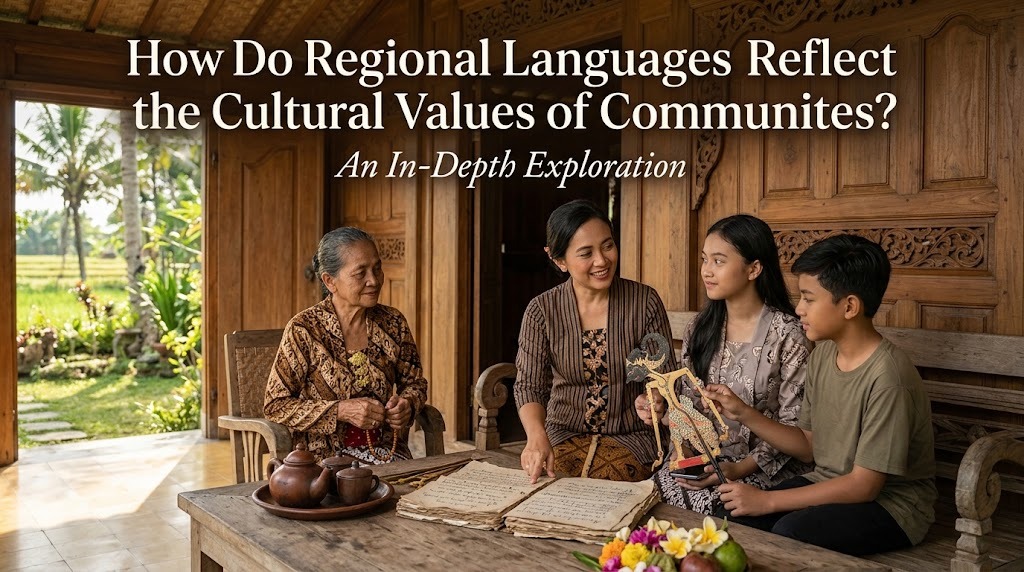
Regional languages are an important part of Indonesia's cultural heritage because they reflect how communities communicate, maintain traditions, and understand their social relationships. Across Indonesia, languages such as Javanese, Sundanese, Balinese, and Minangkabau contain expressions that have developed alongside local customs and ways of life. These languages do more than convey information because they also communicate respect, cooperation, family relationships, and community values. Through everyday conversations, traditional ceremonies, stories, and proverbs, people pass cultural knowledge from one generation to another. Understanding how regional languages reflect cultural values helps explain why preserving them is important for Indonesia's cultural diversity.
REGIONAL LANGUAGES EXPRESS RESPECT AND POLITENESS
One important way regional languages reflect cultural values is through expressions of respect and politeness. Some languages have specific words or speech patterns for addressing elders, respected community members, or people in formal situations. For example, Javanese has speech levels, including ngoko and krama, that can express different degrees of formality and social respect. Choosing the appropriate form depends on the relationship between speakers and the situation in which they communicate.
These language patterns teach speakers to consider how their words may affect other people. Children who learn such expressions from their families can also become familiar with local expectations about politeness and social interaction. However, the use of respectful language varies according to region, family habits, and individual circumstances. Politeness in regional languages reflects cultural expectations about how people should treat one another. Learning these expressions helps younger generations understand not only vocabulary but also the social values connected to everyday communication.
REGIONAL LANGUAGES STRENGTHEN FAMILY AND COMMUNITY RELATIONSHIPS
Family relationships are central to many communities in Indonesia, and regional languages often contain expressions that help people communicate within these relationships. Special terms may distinguish older and younger siblings, grandparents, relatives, and respected community members. These terms help speakers recognize family connections and communicate in ways that reflect their social roles. In everyday life, familiar expressions can also create a sense of closeness and belonging.
Regional languages help maintain relationships between generations because parents and grandparents often use them to share experiences, advice, and family stories. Through these conversations, children learn how their community understands responsibility, mutual assistance, and respect for older people. In some communities, local expressions also emphasize cooperation and collective responsibility. Language helps strengthen social bonds by connecting communication with shared cultural expectations. When families continue using their regional languages, they preserve both their vocabulary and the values communicated through it.
PROVERBS AND TRADITIONAL STORIES TEACH MORAL VALUES
Many regional languages contain proverbs, traditional stories, folk tales, and sayings that communicate lessons about human behavior. These forms of expression often teach values such as honesty, patience, humility, hard work, and responsibility. Because they are usually shared through memorable words and storytelling, they can help people understand complicated ideas through familiar examples. Parents, elders, and community leaders may use these expressions to guide younger people when discussing everyday problems.
Traditional stories also explain how communities interpret their histories, relationships, and surroundings. Some stories describe the consequences of selfish behavior, while others emphasize courage, generosity, or cooperation. The original language can preserve particular expressions, humor, and cultural meanings that may be difficult to reproduce fully in translation. Proverbs and oral traditions serve as informal tools for cultural education. Recording these stories and encouraging children to learn them can help preserve valuable knowledge that might otherwise become less familiar to future generations.
REGIONAL LANGUAGES REFLECT LOCAL CUSTOMS AND TRADITIONS
Regional languages are closely connected to traditional ceremonies, community celebrations, and customary practices. In different parts of Indonesia, local languages may be used during weddings, customary meetings, traditional performances, and important community gatherings. Certain expressions used in these situations carry meanings associated with blessings, responsibilities, family relationships, or community expectations. Understanding the language can therefore help people understand the purpose and significance of the tradition itself.
For example, traditional speeches and ceremonial expressions may communicate respect between families or acknowledge the role of community elders. In Bali, local-language expressions may appear in cultural activities and customary settings, while Minangkabau language and oral traditions can help communicate values associated with family and customary life. Practices differ across communities, so no single language or tradition represents all Indonesian cultural values. Regional languages preserve the meanings behind local customs, allowing people to understand more than the visible activities of a ceremony. Teaching these expressions helps ensure that traditions remain meaningful rather than becoming activities whose cultural significance is forgotten.
REGIONAL LANGUAGES REFLECT COMMUNITIES' RELATIONSHIPS WITH NATURE
The vocabulary of regional languages can reveal how communities interact with their natural environments. People who live in coastal areas, farming regions, forests, or mountainous landscapes may develop specialized words for local plants, animals, weather conditions, landscapes, and traditional occupations. These terms reflect knowledge gained through generations of observation and experience. In some communities, this vocabulary supports practical activities such as farming, fishing, food preparation, and the management of local resources.
Regional languages can also preserve knowledge about seasonal patterns, traditional crops, local ecosystems, and the appropriate use of natural materials. Such knowledge may be communicated through stories, proverbs, instructions, and conversations between experienced community members and younger generations. However, not every regional language contains the same environmental knowledge, and these traditions should be understood within their specific local contexts. Language can act as a record of traditional ecological knowledge. Documenting specialized vocabulary and recording explanations from knowledgeable speakers can help preserve information that may be useful for cultural education and environmental understanding.
PRESERVING REGIONAL LANGUAGES MEANS PRESERVING CULTURAL VALUES
When a regional language becomes less widely spoken, communities may lose opportunities to pass down the cultural meanings contained in its expressions, stories, and traditional vocabulary. Translation can help communicate these meanings to other people, but some cultural details may be difficult to express fully in another language. Preserving a language therefore involves more than creating a dictionary or recording individual words. It also requires maintaining the social situations in which people use the language and understand its cultural significance.
Families can support preservation by speaking regional languages at home, telling traditional stories, and encouraging children to communicate with older relatives. Schools can introduce local-language lessons, cultural projects, and storytelling activities, while community organizations can document oral histories and organize cultural events. Digital platforms also provide opportunities to publish regional-language videos, songs, podcasts, and educational materials. The continued use of regional languages helps keep cultural values active in everyday life. By combining family learning, education, documentation, and digital resources, communities can preserve their linguistic heritage while adapting to changing social conditions.
CONCLUSION
Regional languages reflect the cultural values of communities through expressions of respect, family relationships, traditional stories, local customs, and knowledge of the natural environment. They help people understand how their communities communicate, maintain relationships, and pass important lessons from one generation to another. Each regional language has distinctive features shaped by its history and cultural context. When a language is no longer used regularly, some of the knowledge and meanings associated with it may become harder to preserve. Protecting regional languages is an important way to maintain cultural identity and living traditions. Families, schools, communities, and digital creators can contribute by encouraging everyday use, teaching younger generations, and documenting local knowledge for the future.
Recent Posts

Bagaimana Sistem SKS pada Program Kuliah... 22.11.2026/49 View

How Does Technology Make Daily Evaluation... 21.11.2026/76 View

Apa Strategi Menghadapi Kesenjangan antara Kompetensi... 21.11.2026/78 View

Mengapa Inventaris Aset Penting bagi Kelancaran... 21.11.2026/74 View

When Should Musicians Join a Record... 21.11.2026/78 View
