

How Do Robots Support Experiments in Microgravity Environments?
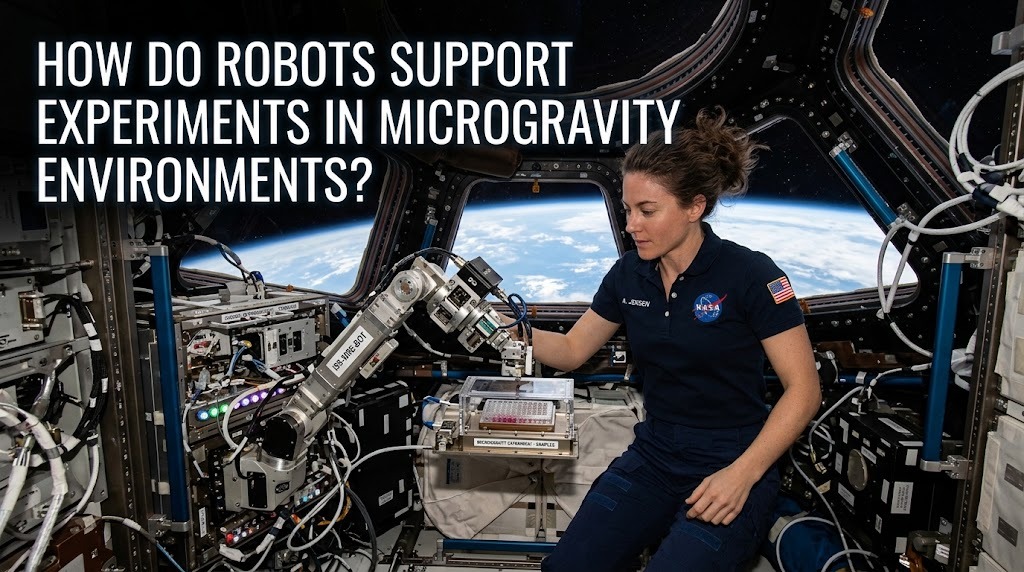
Microgravity environments provide unique opportunities for scientific experiments that are difficult to perform on Earth. In space, objects experience very little apparent weight, allowing researchers to investigate fluid behavior, biological processes, material properties, and physical phenomena under unusual conditions. However, conducting experiments in orbit presents challenges because astronauts have limited time, equipment must be handled carefully, and small movements can affect results. Robots help address these challenges by automating procedures, manipulating scientific instruments, and collecting experimental data with greater consistency.
UNDERSTANDING MICROGRAVITY ENVIRONMENTS
Microgravity refers to conditions in which the effects of gravity are greatly reduced relative to everyday experiences on Earth. It does not mean that gravity is completely absent. Objects in orbit, including spacecraft and their contents, experience apparent weightlessness because they are in continuous free fall. These conditions allow researchers to observe processes without many of the effects caused by ordinary gravitational forces. Robotic systems support these investigations by positioning equipment, handling samples, and performing tasks that require controlled movements.
AUTOMATING SCIENTIFIC EXPERIMENTS
Robots can automate repetitive procedures that would otherwise require astronauts to perform them manually. These tasks may include moving sample containers, operating laboratory instruments, adjusting experimental equipment, and recording measurements. Automation helps researchers maintain consistent procedures across multiple trials and reduces the time astronauts spend on routine operations. Robotic systems can also execute programmed sequences when direct human involvement is unnecessary. However, experiments involving unexpected changes may still require human supervision or adjustments to the control program.
HANDLING SAMPLES AND SCIENTIFIC EQUIPMENT
Manipulating objects in microgravity requires careful control because items do not settle naturally on surfaces as they do under normal conditions. A small push can cause a sample container or instrument to drift away. Robotic arms and specialized grippers help secure, position, and transfer experimental materials without relying on ordinary gravity. Force sensors and cameras can provide information about object contact and position. These capabilities are useful when handling delicate biological samples, assembling experimental equipment, or moving instruments inside spacecraft laboratories.
SUPPORTING BIOLOGICAL RESEARCH
Microgravity research can help scientists investigate how living organisms respond to altered mechanical conditions. Experiments may examine cell growth, microbial behavior, plant development, and changes in biological structures. Robots can help position culture containers, transfer samples, operate imaging equipment, and collect measurements at scheduled intervals. Automated procedures also make it easier to repeat observations under consistent conditions. Although robotic systems improve experimental handling, researchers must still account for factors such as radiation exposure, temperature, and differences between spaceflight and ground-based environments.
INVESTIGATING FLUIDS AND MATERIALS
Microgravity changes the relative influence of buoyancy-driven convection and sedimentation, making it valuable for studying fluids and material processing. Researchers can investigate how liquids mix, how crystals grow, and how certain materials solidify under altered gravitational conditions. Robots may control experimental chambers, position sensors, and operate equipment that requires precise timing or movement. Automated monitoring can capture changes that would be difficult to observe continuously through manual operation. These measurements can improve scientific understanding of material behavior and support the development of specialized manufacturing processes.
IMPROVING PRECISION AND EXPERIMENTAL SAFETY
Robotic systems can perform carefully controlled movements and repeat the same procedure many times. This consistency helps reduce variations caused by differences in human handling. Sensors can monitor position, temperature, force, pressure, and other experimental variables, depending on the equipment installed. Robots may also perform tasks near hazardous materials or in locations that are difficult for astronauts to access safely. Nevertheless, robotic systems require testing, fault detection, and appropriate safeguards because equipment failures can interrupt experiments or damage valuable samples.
ENABLING REMOTE OPERATION AND AUTONOMY
Communication delays and limited opportunities for direct intervention can make remote scientific operations challenging, especially beyond low Earth orbit. Autonomous robots can follow programmed instructions, monitor sensor readings, and respond to predefined conditions without waiting for continuous commands. Ground-based researchers may supervise operations and adjust procedures when communication is available. Onboard processing can also help robots identify abnormal conditions and prioritize important measurements. The level of autonomy depends on the mission, available computing resources, communication reliability, and consequences of a possible error.
CHALLENGES OF ROBOTICS IN MICROGRAVITY
Designing robots for microgravity requires specialized engineering. Robots must operate reliably within limited spaces, manage power consumption, withstand launch conditions, and avoid producing forces that could disturb experiments. Moving equipment also requires careful stabilization because reaction forces can affect the robot, its target, or the surrounding spacecraft. Maintenance and repairs may be difficult when replacement parts and technical support are limited. Engineers must therefore test robotic systems thoroughly and design them to tolerate faults while protecting astronauts and scientific equipment.
THE FUTURE OF ROBOTIC MICROGRAVITY RESEARCH
Future space laboratories may use more advanced robotic manipulators, autonomous experiment platforms, and AI-assisted monitoring systems. These technologies could help researchers conduct longer experiments, process larger amounts of data, and respond more quickly to changing conditions. Robots may also support experiments on lunar or Martian surfaces, where environmental conditions differ from those in orbital laboratories. Improved autonomy and modular equipment could make scientific operations more adaptable. Human researchers will remain important for interpreting results, designing experiments, and handling situations that require complex judgment.
CONCLUSION
Robots support experiments in microgravity by automating procedures, handling samples, controlling equipment, and collecting scientific measurements. Their ability to perform precise and repeatable tasks helps researchers investigate biological processes, fluid behavior, and material properties in space. Although limited power, operational complexity, and equipment reliability remain challenges, robotics can make space-based research more efficient and consistent.
Recent Posts

Bagaimana Sistem SKS pada Program Kuliah... 22.11.2026/49 View

How Does Technology Make Daily Evaluation... 21.11.2026/77 View

Apa Strategi Menghadapi Kesenjangan antara Kompetensi... 21.11.2026/78 View

Mengapa Inventaris Aset Penting bagi Kelancaran... 21.11.2026/74 View

When Should Musicians Join a Record... 21.11.2026/79 View
