

How Do Safety Standards Guide Collaborative Robot Installation?
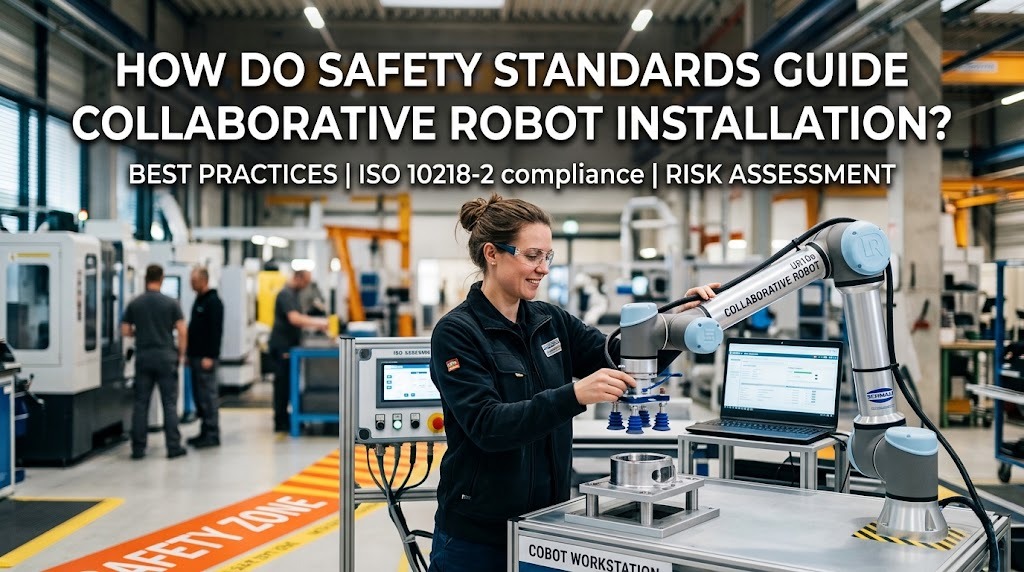
Collaborative robots, commonly called cobots, are designed to work alongside people in shared industrial environments. They can improve productivity in assembly, packaging, inspection, and material handling, but their installation requires careful safety planning. Safety standards help manufacturers identify hazards, select protective measures, and verify that robots can operate safely around workers. Following these standards reduces the likelihood of injuries while supporting reliable and efficient automation.
IDENTIFYING HAZARDS BEFORE INSTALLATION
Safety standards encourage manufacturers to conduct a risk assessment before installing a collaborative robot. This process examines potential hazards associated with the robot, its end effector, the workpiece, surrounding equipment, and the intended task.
Common risks include crushing, trapping, impact, sharp edges, and unexpected robot movement. The assessment should also consider the robot's speed, payload, operating environment, and the possibility of human error. Identifying these hazards early helps engineers choose appropriate safeguards before production begins.
UNDERSTANDING INTERNATIONAL SAFETY STANDARDS
Several international standards provide guidance for industrial robot safety. ISO 10218 addresses safety requirements for industrial robots and robotic applications, while ISO/TS 15066 provides additional guidance for collaborative industrial robot applications.
These standards help organizations evaluate robot design, system integration, protective measures, and human interaction. Compliance requirements depend on the applicable edition, local regulations, and the specific application. Installing a robot marketed as collaborative does not automatically make the entire installation safe.
SELECTING THE APPROPRIATE COLLABORATIVE MODE
Collaborative robot applications may use different safety methods depending on the task and risk assessment. Common approaches include safety-rated monitored stop, hand guiding, speed and separation monitoring, and power and force limiting.
Each method controls a different aspect of human-robot interaction. For example, speed and separation monitoring maintains a suitable distance between the robot and people, while power and force limiting restricts certain contact forces and pressures. Engineers must select and validate the method that best fits the application rather than assuming one approach works for every installation.
DESIGNING A SAFE WORKSPACE
The robot's physical environment plays an important role in installation safety. Engineers should examine workspace dimensions, operator access, nearby machinery, pedestrian routes, and potential trapping points.
Even when a cobot can operate without a traditional safety fence in certain conditions, additional guards or restricted areas may still be necessary. Sharp tools, hot workpieces, heavy loads, and dangerous surrounding machinery can create risks that the robot's collaborative features do not eliminate. Workspace design should account for the complete robotic application.
CONFIGURING SAFETY SYSTEMS AND SENSORS
Collaborative robot installations may use safety-rated sensors, scanners, interlocks, emergency stops, and monitored control functions. These devices help detect people, limit hazardous movement, and initiate protective responses when unsafe conditions occur.
Engineers must verify that the safety devices cover the relevant hazards and operate correctly under expected conditions. Sensor placement, response time, environmental interference, and stopping distance all affect performance. Protective functions should be tested during commissioning and whenever significant system changes are made.
TRAINING OPERATORS AND MAINTENANCE STAFF
Safety standards and workplace procedures emphasize the importance of personnel competence. Operators need to understand normal robot behavior, safe working distances where applicable, emergency stops, and procedures for responding to faults.
Maintenance staff require additional training for tasks involving electrical, mechanical, pneumatic, or hydraulic hazards. Before servicing equipment, appropriate energy-isolation and lockout procedures should be followed. Clear instructions help prevent workers from entering hazardous areas or restarting equipment unexpectedly.
TESTING AND VALIDATING THE INSTALLATION
Before production begins, the complete robotic application should undergo commissioning checks and safety validation. This includes testing emergency stops, safety sensors, speed limits, stopping behavior, protective separation, and relevant force or pressure limits where applicable.
Testing should reflect realistic operating conditions, including the actual end effector, workpiece, robot trajectory, and nearby equipment. Engineers should document test results, correct identified deficiencies, and confirm that protective measures remain effective. A successful robot startup alone is not proof of safety.
MAINTAINING COMPLIANCE AFTER INSTALLATION
Safety management continues after the robot enters service. Changes to software, payload, tooling, speed, layout, or production tasks can introduce new hazards and may require another risk assessment.
Regular inspections, preventive maintenance, software management, and incident reviews help keep the installation safe. Organizations should also retain risk assessments, validation records, operating instructions, and maintenance logs to support accountability and future improvements.
CONCLUSION
Safety standards guide collaborative robot installation by establishing a structured approach to risk assessment, workspace design, protective system selection, personnel training, and validation. Standards such as ISO 10218 and ISO/TS 15066 provide important guidance, but safe operation depends on evaluating the entire robot application. By validating safeguards and reassessing risks whenever conditions change, manufacturers can improve worker protection and maintain dependable collaborative automation.
Recent Posts

Bagaimana Sistem SKS pada Program Kuliah... 22.11.2026/49 View

How Does Technology Make Daily Evaluation... 21.11.2026/77 View

Apa Strategi Menghadapi Kesenjangan antara Kompetensi... 21.11.2026/78 View

Mengapa Inventaris Aset Penting bagi Kelancaran... 21.11.2026/74 View

When Should Musicians Join a Record... 21.11.2026/79 View
