

How Do Science Olympiads Inspire Future Scientific Researchers?
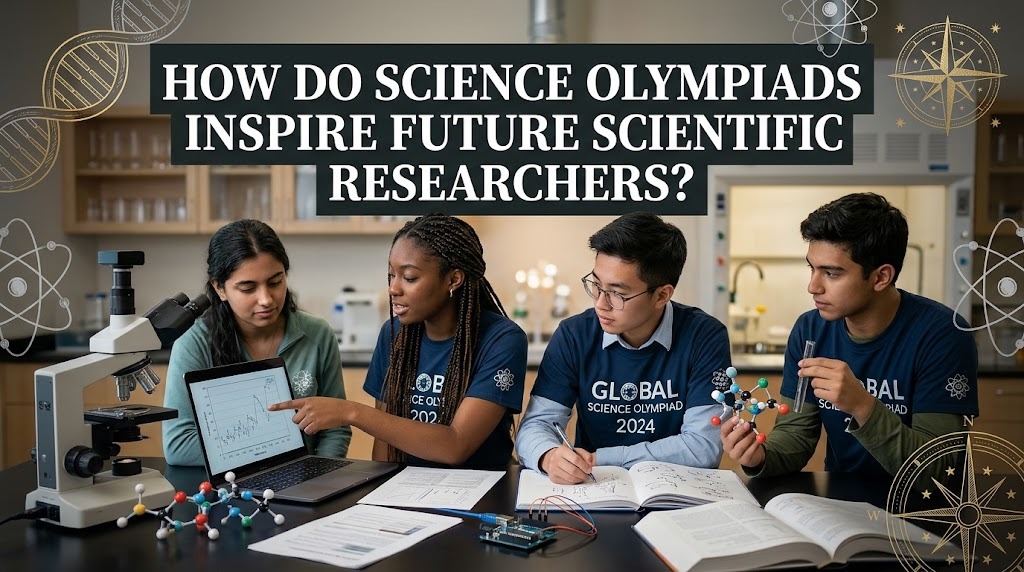
Science Olympiads are academic competitions that encourage students to explore scientific knowledge, solve complex problems, and develop analytical thinking. These competitions introduce young learners to the challenges and excitement of scientific discovery. Through challenging questions, experiments, and research activities, students can develop interests that may influence their future educational and career choices.
Scientific researchers play an important role in expanding human knowledge and finding solutions to real-world problems. However, becoming a researcher requires more than understanding scientific theories. It also involves curiosity, creativity, patience, and the ability to investigate questions systematically. Science Olympiads help introduce students to these qualities and inspire them to consider careers in scientific research.
DEVELOPING CURIOSITY ABOUT SCIENTIFIC QUESTIONS
Curiosity is one of the main motivations behind scientific discovery. Researchers often begin their work by asking questions about natural phenomena, technological developments, or problems that have not been fully understood. Science Olympiads encourage students to develop similar curiosity by introducing challenging topics that go beyond ordinary classroom lessons.
When students encounter unfamiliar scientific concepts, they are encouraged to investigate how things work and why certain processes occur. They may become interested in exploring subjects such as genetics, astronomy, environmental science, or advanced mathematics. This curiosity can motivate them to read additional materials, conduct experiments, and explore scientific topics independently.
INTRODUCING STUDENTS TO RESEARCH-BASED LEARNING
Science Olympiad preparation often involves more than memorizing formulas and definitions. Students need to understand scientific principles, examine evidence, and apply knowledge to unfamiliar problems. These activities introduce them to research-based learning, which is an important part of scientific work.
Through this process, students become familiar with gathering information, comparing explanations, and evaluating the reliability of evidence. They also learn that scientific conclusions should be supported by logical reasoning and accurate observations. These experiences provide an early foundation for conducting research in higher education.
STRENGTHENING CRITICAL THINKING AND ANALYTICAL SKILLS
Scientific researchers must be able to analyze information and identify relationships between different variables. Science Olympiads help develop these abilities through questions that require logical reasoning, mathematical calculations, and careful interpretation of scientific data.
Students learn to break complicated problems into smaller parts and examine each component systematically. They also practice identifying assumptions, comparing possible explanations, and selecting solutions based on available evidence. These analytical skills are essential for researchers who need to understand complex scientific problems and develop reliable conclusions.
ENCOURAGING EXPERIMENTATION AND SCIENTIFIC DISCOVERY
Experiments allow students to understand how scientific theories can be tested through practical activities. In some Science Olympiad training programs, participants work with laboratory equipment, conduct observations, and investigate scientific processes. These experiences can make science more engaging and help students understand the relationship between theory and practice.
Experimentation also introduces students to the process of developing hypotheses and evaluating results. They learn that unexpected findings may require further investigation rather than immediate conclusions. This experience can inspire them to explore scientific questions and develop an interest in laboratory research.
BUILDING PERSISTENCE IN SOLVING COMPLEX PROBLEMS
Scientific research often takes considerable time because some problems cannot be solved through a single experiment or calculation. Researchers may need to repeat procedures, revise hypotheses, and examine different possibilities before reaching a reliable conclusion.
Science Olympiads expose students to challenging problems that require patience and consistent effort. When an approach does not work, participants have opportunities to review their reasoning and try another method. This process develops persistence and helps students understand that scientific progress often involves learning from mistakes.
EXPOSING STUDENTS TO DIFFERENT SCIENTIFIC FIELDS
Science Olympiads introduce students to various disciplines, including biology, chemistry, physics, mathematics, and computer science. Each field offers different questions, research methods, and opportunities for discovery. Exposure to these subjects can help students identify areas that match their interests and abilities.
For example, students who enjoy studying living organisms may become interested in biology or biotechnology. Those who prefer mathematical models and logical systems may explore physics, engineering, or computer science. Understanding these different fields can help students make more informed decisions about their future academic paths.
INSPIRING INDEPENDENT LEARNING AND RESEARCH
Independent learning is important for students who want to pursue scientific research. Researchers must regularly update their knowledge, explore new publications, and investigate questions that may not have straightforward answers. Science Olympiad preparation can introduce students to this habit at an early stage.
Participants may search for scientific articles, use educational resources, watch laboratory demonstrations, and practice additional problems outside school. These activities encourage them to take responsibility for their learning. Over time, independent study can develop into a stronger interest in conducting original research.
CREATING OPPORTUNITIES FOR INTERNATIONAL SCIENTIFIC EXCHANGE
International Science Olympiads bring together talented students from different countries and educational backgrounds. These competitions allow participants to exchange ideas, discuss scientific topics, and learn about different approaches to solving problems.
Interactions with students from other countries can broaden their understanding of global scientific development. Participants may also build connections with teachers, mentors, and other young people who share similar interests. These relationships can encourage future collaboration and strengthen their motivation to pursue research opportunities.
DEVELOPING COMMUNICATION AND COLLABORATION SKILLS
Scientific research is not always an individual activity. Many research projects involve teams of scientists who share responsibilities, exchange information, and evaluate findings together. Effective communication is therefore an important skill for future researchers.
Through group preparation, discussions, and scientific presentations, Science Olympiad participants can practice explaining their ideas clearly. They also learn to listen to different opinions, consider feedback, and work toward shared objectives. These experiences can prepare them for collaborative research projects at universities and scientific institutions.
CONNECTING SCIENTIFIC KNOWLEDGE WITH REAL-WORLD CHALLENGES
Science becomes more meaningful when students understand how it can help address problems in society. Science Olympiads can introduce topics related to climate change, renewable energy, public health, biodiversity, and technological innovation. These subjects help students recognize the practical importance of scientific knowledge.
Students may become interested in researching solutions to environmental damage, developing medical technologies, or improving access to clean energy. Understanding the connection between science and social needs can give their academic interests a clearer purpose. It can also inspire them to pursue research that contributes to long-term improvements in people's lives.
CONCLUSION
Science Olympiads inspire future scientific researchers by developing curiosity, critical thinking, experimentation, persistence, and independent learning. They introduce students to different scientific disciplines while providing opportunities to exchange ideas and connect scientific knowledge with real-world challenges.
Although participating in an Olympiad does not automatically determine a student's future career, the experience can help them discover a genuine interest in research. With continued education, practical experience, and guidance from teachers or mentors, these early interests may develop into a commitment to scientific discovery and innovation.
Recent Posts

Bagaimana Sistem SKS pada Program Kuliah... 22.11.2026/47 View

How Does Technology Make Daily Evaluation... 21.11.2026/75 View

Apa Strategi Menghadapi Kesenjangan antara Kompetensi... 21.11.2026/77 View

Mengapa Inventaris Aset Penting bagi Kelancaran... 21.11.2026/73 View

When Should Musicians Join a Record... 21.11.2026/77 View
