

How Do You Read and Understand Color Blindness Test Results?
Color blindness tests help identify whether a person has difficulty distinguishing certain colors. These examinations are important for understanding how well the eyes recognize different shades, particularly red, green, blue, and yellow. However, receiving a test result does not always mean someone has complete color blindness. The results must be interpreted according to the type of test, the number of errors, and the colors that are difficult to recognize.
Understanding how to read color blindness test results can help individuals recognize possible vision problems and determine whether further examinations are necessary. Different tests also have different scoring methods, so knowing what each result means is important before drawing conclusions about eye health.
WHAT DO COLOR BLINDNESS TEST RESULTS MEAN?
Color blindness test results indicate how accurately someone can recognize and distinguish colors. In general, normal results suggest that a person can identify the colors or patterns presented during the examination according to the test's expected standards. Meanwhile, abnormal results may indicate a color vision deficiency that affects the ability to recognize certain color combinations.
However, an abnormal result does not automatically mean that someone cannot see colors at all. Many people experience partial color blindness, which means they have difficulty distinguishing specific colors while still recognizing others normally. For example, someone with red-green color vision deficiency may confuse certain shades of red, green, brown, or orange.
The meaning of a result also depends on the examination method being used. Some tests focus on identifying numbers within colored patterns, while others measure the ability to arrange colors according to their shades. Therefore, the interpretation should always consider the scoring guidelines of the specific examination.
HOW TO READ ISHIHARA COLOR BLINDNESS TEST RESULTS
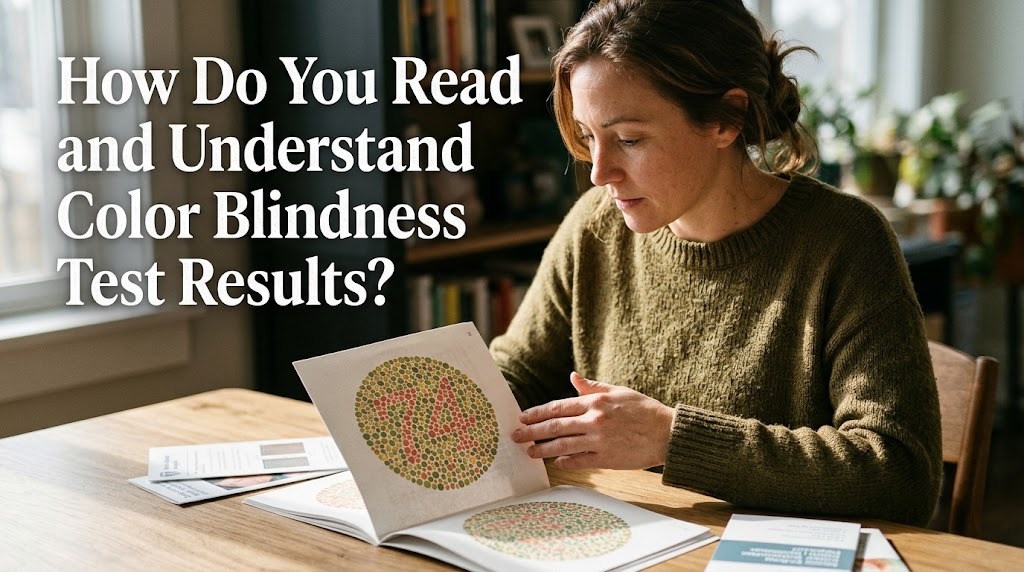
The Ishihara test is one of the most commonly used examinations for detecting red-green color vision deficiency. It uses circular patterns made from small colored dots that form numbers or shapes. Individuals are asked to identify the numbers or patterns displayed on each plate within a specific period.
People with normal color vision can generally recognize the expected numbers or patterns correctly. However, individuals with certain types of red-green color blindness may see different numbers, have difficulty identifying the patterns, or see no clear number at all. The differences occur because some colors that appear distinct to people with normal color vision may look similar to those with a color vision deficiency.
The examiner compares the answers with the official interpretation guide for the test. The number and type of incorrect answers help determine whether a red-green color vision deficiency may be present. However, not every incorrect answer indicates color blindness because lighting conditions, visual sharpness, and unfamiliarity with the test can also influence performance.
WHAT DO NORMAL AND ABNORMAL TEST RESULTS INDICATE?
A normal color blindness test result generally means that the individual can distinguish the tested colors within the expected range. This suggests that the tested aspects of color vision are functioning normally. However, a normal result does not necessarily rule out every possible color vision problem because some examinations only detect specific types of deficiencies.
An abnormal result may indicate difficulty distinguishing certain color combinations. For example, protan deficiency affects the perception of red, while deutan deficiency affects the perception of green. These conditions are common forms of red-green color vision deficiency and can vary from mild to more significant difficulties.
In some cases, additional examinations may be needed to determine the exact type and severity of the condition. A person may also have a blue-yellow color vision deficiency, known as tritan deficiency, which is not reliably identified by every standard screening test. Therefore, abnormal results should be evaluated by an eye specialist rather than interpreted independently.
HOW TO UNDERSTAND THE LEVEL OF COLOR BLINDNESS
Color vision deficiency can vary in severity, and understanding its level helps explain how significantly it affects daily activities. Mild color vision deficiency may cause occasional confusion between similar shades, particularly when colors have similar brightness. Individuals with this condition can usually recognize most colors but may experience difficulties in specific situations.
Moderate color vision deficiency can make it more difficult to distinguish certain color combinations. For example, individuals may confuse red and green objects, have trouble reading color-coded charts, or struggle with activities that require accurate color identification. These difficulties can become more noticeable under poor lighting conditions.
Severe color vision deficiency causes greater difficulty distinguishing affected colors and may interfere with more activities. Complete color blindness is much rarer and involves a major loss of color perception, sometimes resulting in vision that is mainly limited to shades of gray. However, not all tests can identify or measure every type of color vision deficiency, so specialized examinations may be necessary.
WHAT SHOULD YOU DO AFTER RECEIVING THE TEST RESULTS?
After receiving color blindness test results, the first step is to understand the explanation provided by the examiner. If the result indicates a possible color vision deficiency, consulting an ophthalmologist can help confirm the condition. The specialist may recommend additional examinations to identify which colors are difficult to distinguish and how severe the problem is.
Individuals should also understand that many inherited forms of color blindness cannot currently be permanently cured. However, several practical strategies can help make everyday activities easier. These include using labels, patterns, brightness differences, and digital accessibility settings instead of relying entirely on color differences.
If color vision problems develop suddenly, medical evaluation is particularly important. Unlike many inherited conditions, acquired color vision changes may be associated with eye diseases, certain medications, or neurological problems. Identifying the underlying cause can help determine whether appropriate treatment or further medical care is needed.
CONCLUSION
Reading and understanding color blindness test results requires more than simply checking whether the answers are correct or incorrect. The results help identify possible difficulties in recognizing specific colors, determine the type of color vision deficiency, and indicate whether further examinations are necessary. Although normal results generally suggest healthy color discrimination, abnormal results should be interpreted according to the examination method and individual visual condition.
Understanding these results allows individuals to become more aware of their vision and take appropriate steps to manage color recognition difficulties. Consulting an eye specialist is the best way to obtain an accurate diagnosis and understand the meaning of the test results.
Recent Posts

Bagaimana Sistem SKS pada Program Kuliah... 22.11.2026/42 View

How Does Technology Make Daily Evaluation... 21.11.2026/72 View

Apa Strategi Menghadapi Kesenjangan antara Kompetensi... 21.11.2026/74 View

Mengapa Inventaris Aset Penting bagi Kelancaran... 21.11.2026/70 View

When Should Musicians Join a Record... 21.11.2026/73 View
