

How Does a Dosimeter Detect Invisible Radiation Rays?
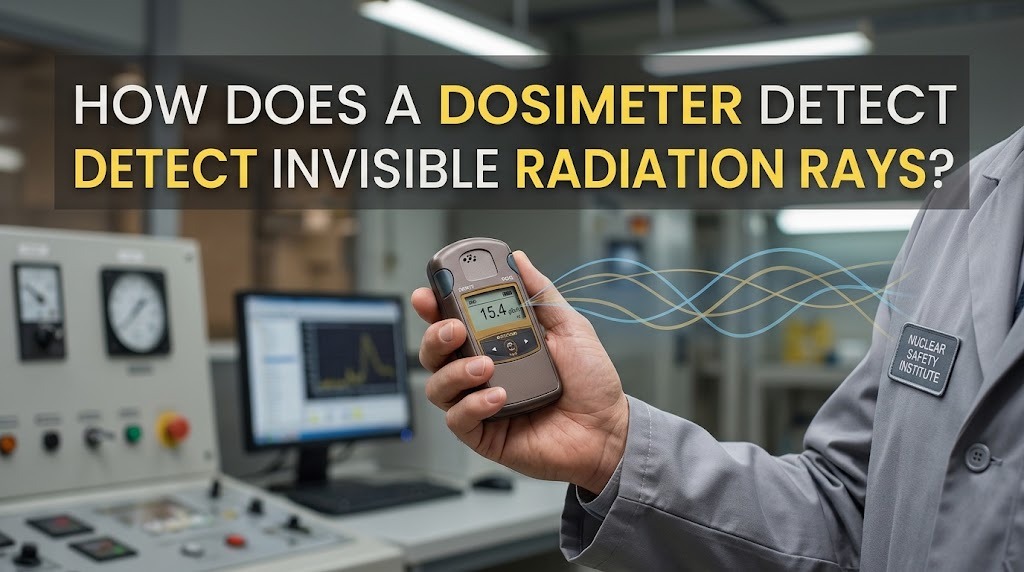
You cannot see, smell, or feel most radiation, yet workers in hospitals and nuclear plants can measure it accurately every day. The tool that makes this possible is the dosimeter, a small device that records how much radiation a person has been exposed to. Understanding how a dosimeter detects invisible radiation rays shows why this simple gadget plays such a big role in workplace safety.
WHAT IS A DOSIMETER?
A dosimeter is a device that measures the radiation dose a person or place receives over time. It is usually small and light, so it can be clipped to a shirt, worn on a wrist, or attached to a ring. People who work near ionizing radiation, such as radiographers, dentists, nuclear technicians, and airline crew on certain routes, often wear one during their shifts.
The main purpose of a dosimeter is to keep exposure within safe limits. Radiation cannot be sensed by the human body, so a measuring tool is the only reliable way to know the dose. The readings are recorded and reviewed, which helps employers protect workers and follow safety regulations.
WHY IS RADIATION INVISIBLE?
Ionizing radiation such as X-rays, gamma rays, and beta particles sits outside the range of light that human eyes can see. It has no color, no smell, and no sound. Even a high dose may cause no feeling at the moment of exposure, and symptoms may appear hours, days, or even years later.
Because of this, people cannot rely on their senses to judge danger. Detection depends on the way radiation interacts with matter. When rays hit certain materials, they leave measurable changes, such as electric charge, trapped energy, or tiny chemical marks. A dosimeter is built to capture exactly these changes.
HOW DOSIMETERS DETECT RADIATION
The basic idea is simple: radiation gives up energy inside the detector, and the device turns that energy into a signal or record. The amount of energy absorbed is proportional to the dose. By measuring this change, the dosimeter can calculate how much radiation passed through it.
Different dosimeters use different materials to do this. Some contain gas or crystals that react to rays, while others use special film or electronic sensors. Each design has its own strengths, such as low cost, high accuracy, or instant readings. The choice depends on the type of radiation and the work environment.
COMMON TYPES OF DOSIMETERS
The film badge uses photographic film that darkens when exposed to radiation. After a set period, a laboratory develops the film and measures how dark it is to find the dose. A thermoluminescent dosimeter (TLD) contains crystals that store energy from radiation. When the lab heats the crystal, it releases that energy as light, and the amount of light shows the dose.
An optically stimulated luminescence (OSL) dosimeter works in a similar way but uses a laser or LED instead of heat, which allows more precise and repeatable readings. The electronic personal dosimeter (EPD) uses a semiconductor sensor that creates a tiny electric signal when radiation hits it. This type shows the dose in real time and can sound an alarm if exposure becomes too high.
WHERE ARE DOSIMETERS USED?
Dosimeters are essential in hospitals where X-ray, CT, and radiotherapy equipment is used. They are also common in nuclear power plants, research laboratories, and industrial sites that use radioactive materials for testing welds or pipes. Emergency responders may carry them in accident areas where radiation levels are unknown.
Some dosimeters are placed in fixed locations to monitor the environment instead of a person. For example, they can track background radiation near a facility or in a storage room. Records from these devices help prove that safety rules are being followed and allow quick action when readings rise.
TIPS FOR USING A DOSIMETER CORRECTLY
A dosimeter only works well if it is worn properly. Wear it on the chest or torso between the neck and waist, and place it under a lead apron when one is used, unless the facility gives other instructions. Never share your badge with someone else, and do not leave it near heat, moisture, or a radiation source when you are not working.
Return the device on schedule so its readings can be processed on time. Check regularly that it is calibrated and not damaged. Following these habits, along with the ALARA principle of keeping exposure as low as reasonably achievable, helps ensure the results are accurate and your health stays protected.
CONCLUSION
A dosimeter detects invisible radiation by measuring the energy that rays leave behind in a sensitive material, then converting it into a readable dose. Film badges, TLDs, OSL devices, and electronic dosimeters each use a different method, but they share the same goal of protecting people from overexposure. With correct use, this small device turns an invisible risk into clear, measurable information.
Recent Posts

Bagaimana Sistem SKS pada Program Kuliah... 22.11.2026/53 View

How Does Technology Make Daily Evaluation... 21.11.2026/82 View

Apa Strategi Menghadapi Kesenjangan antara Kompetensi... 21.11.2026/81 View

Mengapa Inventaris Aset Penting bagi Kelancaran... 21.11.2026/77 View

When Should Musicians Join a Record... 21.11.2026/82 View
