

How Does Applied Research Contribute To Sustainable Development?
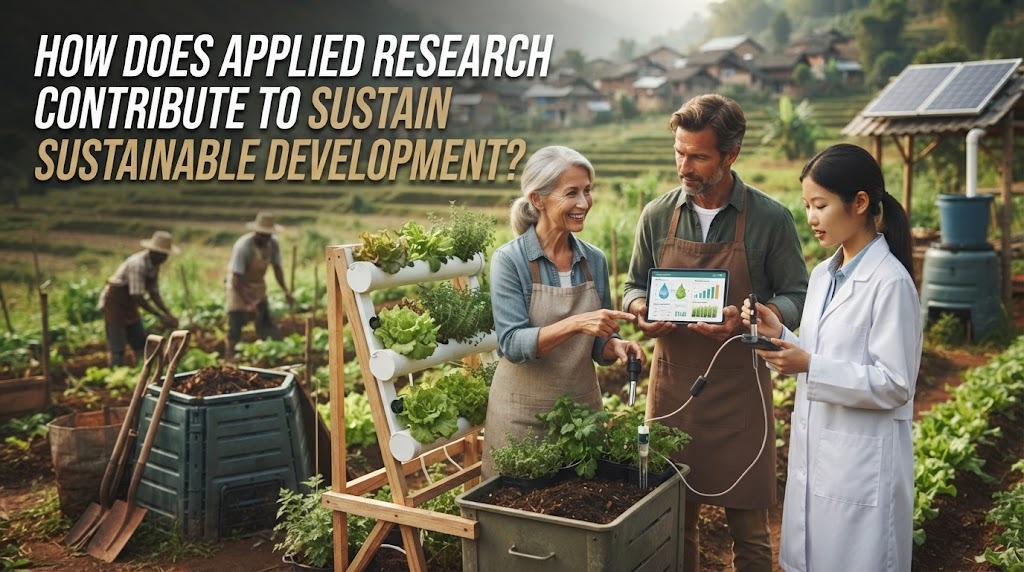
Sustainable development aims to meet present needs without compromising the ability of future generations to meet their own needs. It involves balancing economic growth, social well-being, and environmental protection. However, achieving these goals requires practical solutions based on reliable evidence. This is where applied research becomes important. By investigating real-world problems and testing possible solutions, applied research helps governments, businesses, and communities make informed decisions, use resources more efficiently, and develop strategies that support long-term sustainability.
UNDERSTANDING APPLIED RESEARCH IN SUSTAINABLE DEVELOPMENT
Applied research is a systematic investigation designed to solve specific practical problems. Unlike research that mainly expands theoretical knowledge, applied research focuses on using knowledge to improve real situations. In sustainable development, it can address challenges such as pollution, resource shortages, poverty, food security, and access to clean energy. Researchers collect and analyze data, test potential solutions, and evaluate their effectiveness under real conditions. For example, a research team may investigate how local farmers can reduce water consumption without lowering crop yields. Applied research connects scientific knowledge with practical action, helping communities develop solutions that are suitable for their needs and circumstances.
PROTECTING THE ENVIRONMENT AND NATURAL RESOURCES
Applied research helps identify ways to protect ecosystems and use natural resources responsibly. Researchers can study pollution levels, water quality, soil conditions, deforestation, and waste management to understand environmental problems. They can then test methods that reduce environmental damage and improve resource efficiency. For example, researchers may evaluate biodegradable packaging, wastewater treatment systems, or recycling methods to determine which options work best in particular settings. These findings can help businesses and local governments choose more environmentally responsible practices. By providing evidence about the effectiveness of different solutions, applied research supports environmental protection and the long-term availability of natural resources.
SUPPORTING ECONOMIC GROWTH AND INNOVATION
Sustainable development requires economic progress that creates opportunities without unnecessarily damaging the environment or exhausting resources. Applied research helps businesses improve production methods, develop useful technologies, and reduce operational costs. It can also identify opportunities for new products, services, and industries that respond to changing social and environmental needs. For example, research into energy-efficient manufacturing can help companies reduce electricity consumption while maintaining productivity. Research-driven innovation may improve competitiveness, create employment opportunities, and encourage investment in sustainable technologies. When economic decisions are supported by reliable research, businesses and policymakers can pursue growth while considering its long-term social and environmental effects.
IMPROVING AGRICULTURE AND FOOD SECURITY
Agriculture is essential to food security, rural livelihoods, and economic development. However, farmers may face challenges such as climate change, soil degradation, water shortages, pests, and rising production costs. Applied research can help address these problems by testing improved crop varieties, efficient irrigation systems, soil management methods, and environmentally responsible pest control. For example, researchers can compare irrigation techniques to identify methods that maintain crop productivity while using less water. The results can help farmers make informed decisions based on local conditions and available resources. Sustainable agricultural research supports reliable food production, reduces resource waste, and helps farming communities adapt to changing environmental conditions.
PROMOTING SOCIAL WELL-BEING AND PUBLIC HEALTH
Sustainable development is not only about the environment and the economy; it also involves improving people's quality of life. Applied research can help identify barriers to healthcare, education, sanitation, housing, and other essential services. Researchers may evaluate community health programs, investigate local disease risks, or study methods for improving access to educational resources. For example, research into affordable water filtration systems can help communities identify practical ways to improve access to safer drinking water. Evidence from these studies can guide public policies and help organizations direct resources toward the people who need them most. Socially focused applied research supports more inclusive development by helping communities address real needs and reduce inequalities.
DEVELOPING CLEAN ENERGY SOLUTIONS
Access to reliable and affordable energy is important for households, businesses, and public services. At the same time, dependence on fossil fuels contributes to greenhouse gas emissions and climate change. Applied research helps researchers and industries develop and evaluate alternatives such as solar power, wind energy, and improved energy storage. It can also investigate how renewable energy systems perform under different weather conditions and how their costs can be reduced. For example, a community may use research findings to assess whether solar panels are suitable for local electricity needs. Clean energy research supports the transition toward lower-emission energy systems while helping decision-makers consider reliability, affordability, and local conditions.
SUPPORTING EVIDENCE-BASED POLICIES
Governments need reliable information to create policies that address environmental, economic, and social challenges. Applied research provides evidence about which programs work, who benefits from them, and what improvements may be necessary. Researchers can evaluate public transportation systems, waste reduction programs, renewable energy incentives, and community development projects. For example, a local government may study traffic patterns and public transportation use before changing bus routes or introducing new transport services. These findings can help policymakers compare options, allocate public funds more effectively, and monitor results. Evidence-based policymaking improves the chances that development programs will respond to actual needs rather than relying only on assumptions.
REDUCING WASTE AND IMPROVING RESOURCE EFFICIENCY
Waste reduction is another important part of sustainable development. Applied research helps organizations understand how materials, energy, and water are used throughout production and consumption. Researchers can identify inefficient processes and test ways to reuse materials, improve recycling, and reduce unnecessary consumption. For instance, a food processing company may investigate how to turn suitable agricultural by-products into useful materials instead of sending them to landfills. These approaches can reduce waste while creating additional value from existing resources. Resource efficiency and waste prevention help businesses lower costs and reduce environmental impacts, although each solution must be assessed for safety, feasibility, and its overall environmental effects.
OVERCOMING CHALLENGES IN SUSTAINABLE RESEARCH
Although applied research offers many benefits, several challenges can limit its contribution to sustainable development. Research projects may face insufficient funding, limited technical facilities, unreliable data, or a shortage of trained specialists. In addition, successful research findings may not be adopted because of high implementation costs, limited public awareness, or weak cooperation between researchers, businesses, and governments. Some solutions that work in one region may also be unsuitable elsewhere because local environments and community needs differ. Addressing these challenges requires long-term investment, collaboration, public participation, and careful evaluation. Researchers should also monitor the results of implemented solutions to determine whether they remain effective and sustainable over time.
CONCLUSION
Applied research contributes to sustainable development by turning scientific knowledge into practical solutions for environmental protection, economic progress, public health, agriculture, clean energy, and resource management. It helps communities and organizations understand problems, compare possible approaches, and make decisions based on reliable evidence. However, research findings must be supported by sufficient resources, effective cooperation, and real-world implementation to create lasting benefits. Combining research, innovation, and community participation can help ensure that development strategies respond to current needs while protecting future opportunities. Ultimately, applied research is an important tool for building a more sustainable, inclusive, and resilient future.
Recent Posts

Bagaimana Sistem SKS pada Program Kuliah... 22.11.2026/44 View

How Does Technology Make Daily Evaluation... 21.11.2026/73 View

Apa Strategi Menghadapi Kesenjangan antara Kompetensi... 21.11.2026/75 View

Mengapa Inventaris Aset Penting bagi Kelancaran... 21.11.2026/70 View

When Should Musicians Join a Record... 21.11.2026/74 View
