

How Does Archaeology Help Us Understand Prehistoric Societies?
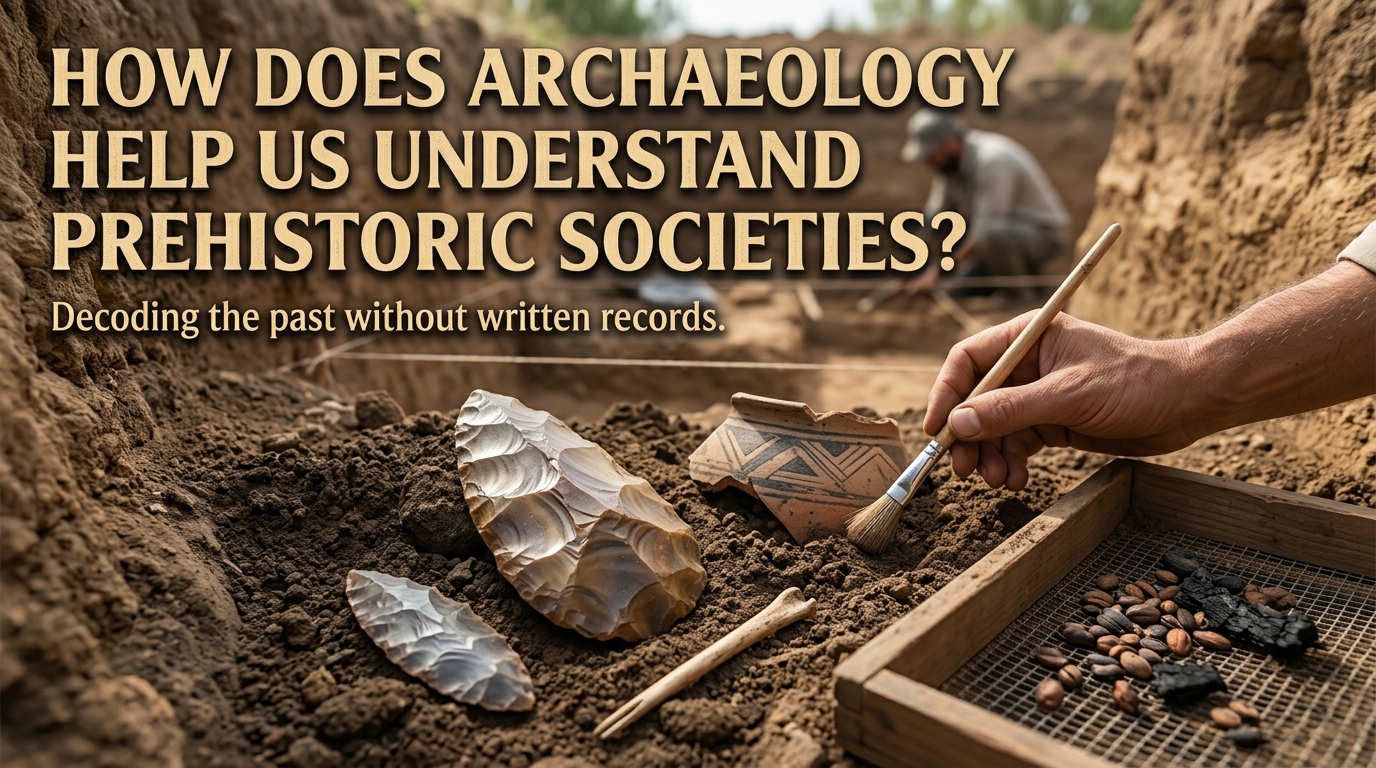
Archaeology plays an important role in helping us understand prehistoric societies, the communities that lived before written records existed. By studying ancient tools, bones, pottery, buildings, and other remains, archaeologists can discover how early humans lived, worked, communicated, and adapted to their environments. These discoveries provide valuable information about human development and the origins of modern civilization.
Unlike historical periods documented through writing, prehistory relies heavily on physical evidence to reconstruct the past. Archaeologists carefully examine artifacts and archaeological sites to understand ancient lifestyles, social relationships, and cultural traditions. Their research helps explain how early societies developed from small groups of hunter-gatherers into more complex communities.
WHAT IS PREHISTORIC ARCHAEOLOGY?
Prehistoric archaeology is the study of human societies that existed before written records became available. It investigates physical evidence left behind by early communities, including stone tools, animal bones, pottery, ornaments, and ancient settlements. These remains help researchers understand how prehistoric people obtained food, built shelters, and interacted with their surroundings. Archaeologists also study the age and location of discoveries to establish when and where particular communities lived. Through this research, scientists can reconstruct important aspects of human life that would otherwise remain unknown.
Prehistoric archaeology covers a long period of human history, from the earliest human ancestors to societies that developed writing. Its timeline varies across regions because different civilizations began using written records at different times. Archaeological evidence is essential for understanding communities that left no written documents. By comparing discoveries from different places, researchers can identify similarities and differences in ancient cultures. This knowledge provides a broader picture of how human societies developed over thousands of years.
HOW ARCHAEOLOGY REVEALS DAILY LIFE IN PREHISTORIC SOCIETIES
Archaeological discoveries help researchers understand the everyday activities of prehistoric people. Stone tools, cooking areas, animal bones, and food remains reveal how communities hunted, gathered plants, prepared meals, and protected themselves. The arrangement of objects inside ancient shelters can also provide clues about how people organized their living spaces. For example, evidence of hearths suggests that fire played an important role in cooking, warmth, and social interaction. These findings help archaeologists reconstruct daily routines without relying on written descriptions.
Researchers also examine clothing tools, ornaments, and personal objects to learn about practical needs and individual preferences. Evidence of repeated activities at particular locations may indicate that certain places were used for cooking, making tools, or storing resources. Archaeologists must interpret these discoveries carefully because a single artifact rarely explains an entire activity. They compare several types of evidence to develop more reliable conclusions. As a result, archaeology brings prehistoric daily life into clearer focus.
UNDERSTANDING PREHISTORIC FOOD AND SURVIVAL
Food remains provide important information about how prehistoric communities survived. Animal bones, plant seeds, pollen, and preserved food residues can reveal which resources people used and how their diets changed over time. Researchers may also examine human teeth and skeletal remains to identify signs of nutritional stress or dietary patterns. These findings help explain whether a community relied mainly on hunting, fishing, gathering wild plants, or farming. Understanding ancient diets also shows how people responded to changes in climate and the availability of natural resources.
The development of agriculture was a major turning point in many prehistoric societies. Archaeological evidence of domesticated plants, animal remains, farming tools, and permanent settlements can help researchers identify the spread of food production. Farming sometimes supported larger populations and more settled communities, although its development varied between regions. It could also introduce new challenges, including crop failure, infectious diseases, and greater dependence on particular food sources. Studying prehistoric food systems therefore helps explain how people adapted their survival strategies and transformed their environments.
DISCOVERING SOCIAL STRUCTURES AND COMMUNITY RELATIONSHIPS
Archaeology provides clues about how prehistoric societies were organized. Differences in house sizes, burial practices, personal ornaments, and access to valuable objects may suggest variations in wealth, status, or social roles. For example, some burials contain more elaborate goods than others, which may indicate social distinctions within a community. However, archaeologists cannot automatically assume that expensive objects prove a person held political power. They must consider cultural traditions, age, gender, religious beliefs, and other possible explanations before drawing conclusions.
Evidence from settlements can also reveal how people cooperated and shared resources. The construction of large communal structures, irrigation systems, or defensive walls may indicate organized labor and collective planning. Exchanges of materials between distant communities can demonstrate trade networks and social connections. Researchers can sometimes identify the movement of people by comparing human remains, artifacts, and scientific evidence from different regions. These discoveries show that prehistoric societies had complex relationships and organizational systems, even when they lacked written laws or formal governments.
EXPLORING PREHISTORIC BELIEFS AND CULTURAL TRADITIONS
Prehistoric artifacts can provide valuable clues about spiritual beliefs, symbolic communication, and cultural practices. Cave paintings, carved figures, decorated objects, and burial arrangements may reflect ideas about animals, human identity, death, or the natural world. Some cave paintings depict animals and human figures, while other objects appear to have been created for symbolic or ceremonial purposes. However, the exact meanings of many prehistoric images remain uncertain because the people who created them left no written explanations. Archaeologists compare artistic evidence with its archaeological context to develop possible interpretations.
Burial sites are especially useful for investigating how prehistoric communities treated their dead. The position of bodies, the presence of grave goods, and differences in burial methods can reveal patterns in ritual behavior and social traditions. These practices varied significantly across cultures and periods, so they should not be interpreted as evidence of one universal belief system. Archaeologists also study repeated symbols and artistic styles to identify cultural connections between communities. By examining symbolic and ritual evidence, researchers can better understand how prehistoric people may have expressed identity, memory, and beliefs about life and death.
HOW ARCHAEOLOGICAL TECHNOLOGY IMPROVES OUR UNDERSTANDING
Modern technology has made prehistoric research more accurate and efficient. Radiocarbon dating can estimate the age of suitable organic materials, such as charcoal, wood, and bone, within its applicable dating range. Other techniques, including stratigraphy, dendrochronology, and luminescence dating, help researchers establish when archaeological deposits or objects formed. Scientists also use DNA analysis and isotope testing to investigate ancient ancestry, migration, diet, and relationships between populations. Combining these methods helps create a more detailed picture of prehistoric life.
Digital tools have also improved the discovery and documentation of archaeological sites. Satellite imagery, geographic information systems, ground-penetrating radar, and three-dimensional modeling can help researchers identify buried structures and record fragile discoveries. These technologies sometimes allow archaeologists to investigate sites with less physical disturbance. However, the results still require careful interpretation and verification through archaeological evidence. By combining scientific methods with traditional excavation, researchers can develop more reliable explanations of how prehistoric societies lived and changed.
UNDERSTANDING MIGRATION AND HUMAN DEVELOPMENT
Archaeology helps explain how early humans moved across landscapes and adapted to different environments. The distribution of stone tools, settlement remains, fossils, and other artifacts can reveal patterns of movement between regions. Researchers compare these findings with geological evidence and environmental changes to understand why people may have migrated. Ancient DNA and isotope analysis can provide additional clues about ancestry and the geographic origins of individuals. Together, these sources help reconstruct important stages of human migration and population history.
Archaeological research also reveals how human communities developed new technologies and ways of life. Changes in toolmaking, housing, food production, and transportation show how people responded to new opportunities and challenges. These developments did not occur at the same time everywhere, and communities often followed different paths. Some groups continued hunting and gathering for thousands of years, while others adopted farming or established larger settlements. Studying these different pathways helps explain the diversity of human societies and the long process of cultural and technological change.
WHY PRESERVING PREHISTORIC ARCHAEOLOGICAL SITES MATTERS
Prehistoric archaeological sites are valuable sources of information about humanity's shared past. Once a site is destroyed by construction, looting, erosion, or careless excavation, important evidence may be lost permanently. Protecting these locations allows researchers to study artifacts in their original context, which is essential for understanding their meaning. Conservation also helps preserve cultural heritage for future generations. Responsible archaeological preservation ensures that important discoveries remain available for education, scientific research, and public understanding.
Communities, governments, researchers, and heritage organizations all have roles in protecting archaeological resources. Public education can encourage people to respect historical locations and report discoveries to the appropriate authorities. Professional archaeologists also document findings carefully and follow ethical standards when handling human remains and culturally significant objects. Museums and educational programs can make archaeological knowledge accessible while explaining the importance of protecting original sites. By supporting preservation, society can safeguard evidence that helps future generations understand prehistoric cultures and human development.
CONCLUSION
Archaeology helps us understand prehistoric societies by examining the physical evidence they left behind. Artifacts, human remains, ancient settlements, and scientific dating methods reveal how early people obtained food, organized communities, developed cultural traditions, and adapted to changing environments. These discoveries also explain important developments in migration, technology, and the growth of settled life. Although many questions about prehistory remain unanswered, ongoing research continues to improve our knowledge of the past. Ultimately, archaeology connects modern people with ancient human experiences and helps us understand how diverse societies contributed to the development of humanity.
Recent Posts

Bagaimana Sistem SKS pada Program Kuliah... 22.11.2026/50 View

How Does Technology Make Daily Evaluation... 21.11.2026/80 View

Apa Strategi Menghadapi Kesenjangan antara Kompetensi... 21.11.2026/79 View

Mengapa Inventaris Aset Penting bagi Kelancaran... 21.11.2026/75 View

When Should Musicians Join a Record... 21.11.2026/80 View
