

How Does Archaeology Uncover The Secrets Of Ancient Civilizations?
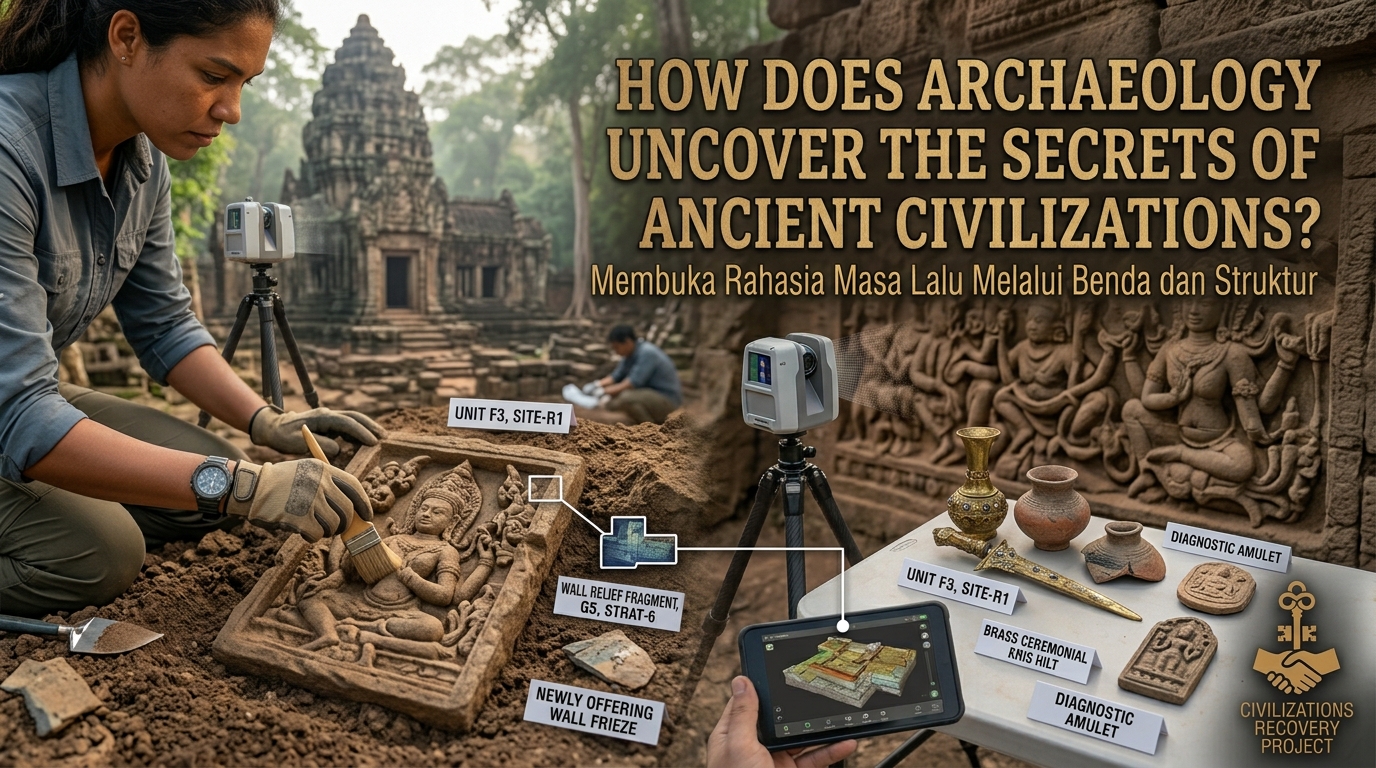
Archaeology helps us understand how ancient civilizations lived, worked, traded, and developed their cultures. By studying ancient artifacts, historical structures, human remains, and archaeological sites, researchers can uncover valuable information about societies that existed thousands of years ago. These discoveries reveal how people adapted to their environments, organized their communities, and responded to challenges throughout history.
Unlike stories passed down through generations, archaeology provides physical evidence of the past. Through scientific methods and modern technology, archaeologists can reconstruct parts of ancient life that written records may not explain. Understanding these methods allows us to appreciate how archaeology reveals the hidden stories of human civilization.
WHAT IS ARCHAEOLOGY AND WHY DOES IT MATTER?
Archaeology is the scientific study of past human societies through their material remains. These remains include pottery, tools, buildings, jewelry, food remains, and burial sites. By examining these objects and their locations, archaeologists can learn about ancient people's daily activities, beliefs, social structures, and technological achievements.
Archaeology is especially important when written records are limited or unavailable. Some ancient societies left behind few documents, while others developed writing systems that researchers have not fully deciphered. In such cases, physical evidence becomes an essential source of historical knowledge. Archaeological research also helps preserve cultural heritage and provides a deeper understanding of how modern societies developed.
HOW ARCHAEOLOGISTS FIND ANCIENT CIVILIZATIONS
Archaeologists begin by identifying locations that may contain evidence of past human activity. They examine historical documents, local traditions, old maps, aerial photographs, and satellite images to identify promising areas. They may also conduct field surveys to locate pottery fragments, stone tools, building foundations, or unusual changes in the landscape.
Modern technology has made this process more efficient. Satellite imagery, aerial photography, and geographic information systems help researchers identify possible archaeological sites without excavating large areas. Technologies such as LiDAR can reveal hidden structures beneath dense vegetation by measuring the distance between a sensor and the ground. However, these discoveries must be verified through fieldwork and scientific investigation before researchers can draw reliable conclusions.
HOW ARTIFACTS REVEAL ANCIENT DAILY LIFE
Artifacts are objects made, modified, or used by people in the past. They include cooking utensils, farming tools, weapons, coins, ornaments, and pottery. Each object provides clues about how ancient communities obtained food, produced goods, developed technologies, and interacted with neighboring societies.
For example, pottery containing traces of plant or animal remains may reveal what people ate. Tools made from particular materials can show the technologies available to a community, while imported objects may indicate long-distance trade and cultural exchange. When archaeologists compare artifacts from different locations, they can identify similarities and differences between civilizations. These findings help researchers understand how ordinary people lived, rather than focusing only on rulers and major historical events.
HOW EXCAVATION REVEALS BURIED HISTORY
Archaeological excavation is the careful process of uncovering and recording evidence preserved beneath the ground. Over time, buildings, tools, and other remains may become buried by soil, natural disasters, vegetation, or human activity. Archaeologists remove soil gradually, documenting the position of every important discovery to preserve its archaeological context.
The location of an object can be as important as the object itself. Different layers of soil may represent different periods of human activity, allowing researchers to investigate how a settlement changed over time. However, layers can be disturbed by construction, flooding, animal activity, or earlier excavations, so archaeologists must examine the evidence carefully. Accurate excavation records help researchers reconstruct past environments, building layouts, and patterns of settlement while minimizing the loss of information.
HOW SCIENTIFIC METHODS DETERMINE THE AGE OF DISCOVERIES
Determining the age of archaeological evidence helps researchers establish when ancient people lived and how civilizations developed. One common approach is stratigraphy, which examines the position of objects within layers of soil. In undisturbed deposits, deeper layers are generally older than those above them, although this principle must be checked against the site's conditions.
Scientists also use dating techniques to estimate the age of certain materials. Radiocarbon dating measures the remaining carbon-14 in suitable organic materials, such as charcoal, wood, or bone containing preserved organic matter. Other techniques, including dendrochronology, examine tree-ring patterns, while luminescence dating can estimate when certain minerals were last exposed to sunlight or sufficient heat. Combining these methods with archaeological evidence helps researchers build more reliable timelines of ancient civilizations.
HOW MODERN TECHNOLOGY HELPS UNCOVER HIDDEN SECRETS
Modern technology allows archaeologists to investigate sites more efficiently and sometimes without disturbing the ground. Ground-penetrating radar can detect underground features by sending electromagnetic signals into the ground and recording their reflections. Other geophysical methods, such as magnetometry and electrical resistivity surveys, can identify anomalies that may indicate buried walls, pits, or other structures.
Researchers also use 3D scanning, digital mapping, drones, and laboratory analysis to document discoveries in greater detail. Three-dimensional models help specialists examine fragile objects and architectural remains, while chemical analysis can identify residues or determine where certain materials originated. Artificial intelligence may assist with recognizing patterns in large datasets, but its results still require expert evaluation. These technologies support archaeological interpretation, yet they do not replace careful observation, scientific testing, and field research.
WHAT ANCIENT STRUCTURES REVEAL ABOUT CIVILIZATIONS
Ancient temples, palaces, roads, irrigation systems, and residential buildings provide important evidence about how civilizations were organized. Their size, design, construction materials, and locations can reveal information about engineering knowledge, economic resources, religious beliefs, and political authority. For example, extensive irrigation networks may indicate that a society developed coordinated methods for managing water and supporting agriculture.
Burial structures and ceremonial buildings can also offer clues about religious practices, social hierarchies, and cultural traditions. However, archaeologists must avoid assuming that every structure had the same purpose across different societies. They compare architectural evidence with artifacts, environmental data, and other archaeological findings to develop well-supported interpretations. This approach helps researchers understand both the achievements and the everyday realities of ancient communities.
HOW ARCHAEOLOGISTS RECONSTRUCT ANCIENT CULTURES
Archaeologists do not rely on a single discovery to explain an entire civilization. Instead, they compare evidence from several sources, including artifacts, human remains, animal bones, plant remains, architecture, and environmental records. This process helps researchers identify patterns in food production, migration, trade, population changes, and cultural practices.
For example, similarities in pottery styles across distant settlements may suggest contact between communities, although they do not automatically prove direct migration. Scientific analysis of human remains may reveal aspects of diet, health, physical activity, and population history when preservation conditions allow. Combining different types of evidence reduces the risk of drawing conclusions from incomplete information. Archaeological interpretations can also change when new discoveries provide stronger explanations for the available evidence.
WHY PRESERVING ARCHAEOLOGICAL SITES IS ESSENTIAL
Archaeological sites are valuable because they contain information that may not exist anywhere else. Excavation, erosion, urban development, looting, and uncontrolled tourism can permanently damage these resources. Once an artifact is removed without proper documentation or a site is destroyed, important information about its original context may be lost forever.
Archaeological preservation involves protecting sites, documenting discoveries, managing visitor access, and using suitable conservation techniques. Local communities, researchers, governments, and heritage organizations all play important roles in this process. Responsible preservation also includes respecting cultural traditions and consulting communities connected to archaeological places. Protecting these sites ensures that future generations can continue learning from the material evidence of human history.
CONCLUSION
Archaeology uncovers the secrets of ancient civilizations by combining careful excavation, artifact analysis, scientific dating, modern technology, and historical interpretation. Each discovery provides clues about how people lived, what they believed, how they traded, and how their societies changed over time. By comparing different types of evidence, archaeologists can develop a more complete and reliable picture of the past.
However, archaeological discoveries require careful interpretation because evidence can be incomplete or disturbed. Scientific research and responsible preservation are essential for protecting cultural heritage and improving our understanding of human history. Through continued investigation, archaeology connects the present with ancient societies and reveals how their experiences helped shape the world we live in today.
Recent Posts

Bagaimana Sistem SKS pada Program Kuliah... 22.11.2026/50 View

How Does Technology Make Daily Evaluation... 21.11.2026/79 View

Apa Strategi Menghadapi Kesenjangan antara Kompetensi... 21.11.2026/79 View

Mengapa Inventaris Aset Penting bagi Kelancaran... 21.11.2026/75 View

When Should Musicians Join a Record... 21.11.2026/80 View
