

How Does Basic Research Help Explain Natural Phenomena?
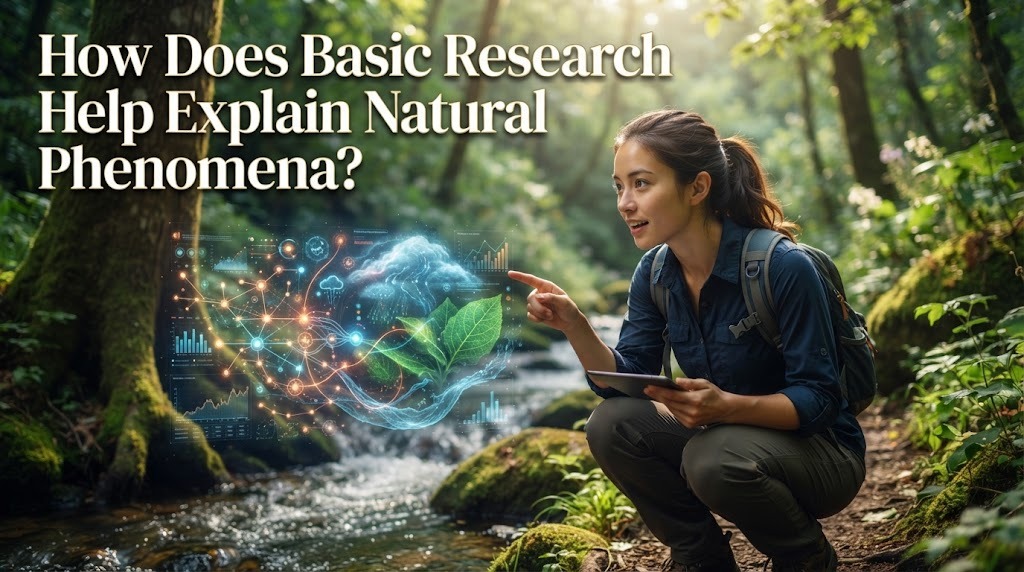
Basic research plays an important role in explaining natural phenomena by helping scientists understand how and why events occur in the natural world. Natural phenomena include earthquakes, rainfall, plant growth, ocean currents, and the movement of planets. Through observation, experimentation, and scientific analysis, researchers investigate the fundamental principles behind these events. Rather than focusing only on immediate solutions, basic research aims to expand scientific knowledge and develop explanations supported by evidence. Its findings help people understand nature more accurately and provide a foundation for future discoveries.
UNDERSTANDING THE FUNDAMENTAL LAWS OF NATURE
Basic research helps explain natural phenomena by identifying the fundamental laws and principles that govern the universe. Scientists investigate relationships between matter, energy, forces, and living systems to understand how different processes work. For example, physicists study gravity to explain why objects fall toward Earth and how planets move around the Sun. These investigations help researchers develop mathematical models and theories that describe observable events. By understanding fundamental principles, scientists can explain many phenomena rather than treating each event as an isolated occurrence.
Scientific explanations are strengthened when observations and experiments support existing theories or reveal where those theories need improvement. Researchers compare predictions with evidence and revise their explanations when necessary. This process allows scientific knowledge to develop as new information becomes available. Basic research therefore provides a systematic way to investigate natural events and distinguish evidence-based explanations from unsupported assumptions.
EXPLAINING WEATHER AND CLIMATE PATTERNS
Basic research helps scientists understand weather and climate by examining atmospheric processes, ocean circulation, solar energy, and interactions between the Earth's surface and atmosphere. Researchers investigate how temperature differences create air movement, how water vapor forms clouds, and how atmospheric pressure influences weather systems. These studies explain the physical mechanisms behind phenomena such as rainfall, storms, and seasonal changes. Scientists also examine long-term climate patterns to understand how different components of the Earth system influence one another.
For example, research into the water cycle explains how water evaporates, condenses into clouds, and returns to the surface as precipitation. This knowledge helps scientists understand the conditions that influence rainfall and drought. Research into greenhouse gases also helps explain how certain gases absorb and re-emit infrared radiation, affecting Earth's energy balance. Although basic research may not directly prevent extreme weather events, it provides essential knowledge for improving climate models and understanding environmental changes.
UNDERSTANDING EARTHQUAKES AND GEOLOGICAL PROCESSES
Basic research contributes to understanding earthquakes by investigating the structure of Earth, the movement of tectonic plates, and the behavior of rocks under stress. Geologists and geophysicists examine seismic waves, rock formations, and measurements of ground movement to understand processes occurring beneath the surface. Their findings help explain why earthquakes occur when accumulated stress causes rocks to break or slip along faults. Research also investigates volcanic activity, mountain formation, and the movement of materials within Earth's interior.
Understanding these geological processes can improve scientific knowledge of how the planet changes over time. For example, studies of tectonic plate movement help explain why earthquakes and volcanic activity are concentrated in certain regions. However, scientists cannot predict the exact time, location, and magnitude of every earthquake with reliable precision. Basic research provides a stronger understanding of the mechanisms involved, which can support improved hazard assessment and disaster preparedness.
EXPLAINING THE GROWTH AND BEHAVIOR OF LIVING ORGANISMS
Basic research in biology helps explain natural phenomena involving plants, animals, microorganisms, and other living organisms. Scientists investigate cellular processes, genetic information, evolution, and interactions between organisms and their environments. For example, researchers study photosynthesis to understand how plants use light energy to convert carbon dioxide and water into energy-rich compounds. This process explains how plants grow and contributes to the movement of carbon and energy through ecosystems.
Researchers also examine how animals adapt to environmental conditions and how species evolve across generations. Studies of genetics can reveal how inherited characteristics influence biological traits, while ecological research explains how organisms interact with one another. These investigations help scientists understand biodiversity, food webs, and the relationships that maintain ecosystems. The knowledge gained through basic biological research can later support applications in medicine, agriculture, and environmental conservation.
UNDERSTANDING ASTRONOMICAL PHENOMENA
Basic research in astronomy helps explain events and objects beyond Earth, including eclipses, planetary motion, star formation, and the evolution of galaxies. Astronomers observe celestial objects using telescopes and analyze the light and other signals they produce. These observations provide information about their distance, temperature, composition, and movement. Researchers use this evidence to develop and test theories about how the universe works.
For example, research into planetary motion helps explain how gravitational interactions influence the movement of planets around the Sun. Studies of stars also help scientists understand how stars form from clouds of gas and dust, change throughout their lifetimes, and eventually reach different final stages. Research into distant galaxies provides further evidence about the history and expansion of the universe. Through these investigations, basic research expands our understanding of the cosmos and the physical laws that govern it.
USING OBSERVATION AND EXPERIMENTATION TO TEST EXPLANATIONS
Observation and experimentation are essential methods in basic research because they allow scientists to examine natural phenomena systematically. Researchers begin by identifying a question, reviewing existing knowledge, and developing a hypothesis or possible explanation. They then collect observations, conduct experiments when appropriate, and analyze the evidence to determine whether it supports their ideas. For example, scientists investigating seed germination may compare how different levels of moisture affect the growth of seeds under controlled conditions.
Not every natural phenomenon can be tested through controlled laboratory experiments. Events such as hurricanes, volcanic eruptions, and planetary movements often require field observations, monitoring instruments, mathematical models, or computer simulations. Researchers use multiple sources of evidence to evaluate whether their explanations are consistent with observed patterns. Other scientists may repeat experiments or analyze independent datasets to check the reliability of the findings. This systematic process makes scientific explanations more reliable and allows them to improve when new evidence emerges.
WHY BASIC RESEARCH IS IMPORTANT FOR SCIENTIFIC PROGRESS
Basic research is important because it builds the foundation for scientific discoveries and helps researchers develop a deeper understanding of natural systems. By explaining the mechanisms behind natural phenomena, scientists can identify patterns, recognize relationships, and develop theories that apply across different situations. This knowledge also helps researchers identify new questions that require further investigation. Without fundamental research, many scientific explanations would remain incomplete or based on limited observations.
Basic research can also contribute to practical developments in technology, environmental protection, healthcare, and disaster risk management. For example, understanding atmospheric processes supports climate modeling, while knowledge of biological mechanisms can contribute to medical discoveries. However, these applications may require additional applied research and development before they become useful in practice. The benefits of basic research are not always immediate, but its discoveries can support important advances over many years.
CONCLUSION
Basic research helps explain natural phenomena by investigating the fundamental principles and processes that govern the natural world. Through observation, experimentation, and scientific analysis, researchers develop evidence-based explanations for weather patterns, earthquakes, biological processes, astronomical events, and many other phenomena. These investigations improve scientific understanding and provide a foundation for future discoveries and practical applications. Although basic research does not always produce immediate solutions, it helps people understand nature more accurately and make informed decisions based on scientific evidence.
Recent Posts

Bagaimana Sistem SKS pada Program Kuliah... 22.11.2026/45 View

How Does Technology Make Daily Evaluation... 21.11.2026/73 View

Apa Strategi Menghadapi Kesenjangan antara Kompetensi... 21.11.2026/75 View

Mengapa Inventaris Aset Penting bagi Kelancaran... 21.11.2026/71 View

When Should Musicians Join a Record... 21.11.2026/75 View
