

How Does Big Data Help Predict Market Trends and Consumer Demand?
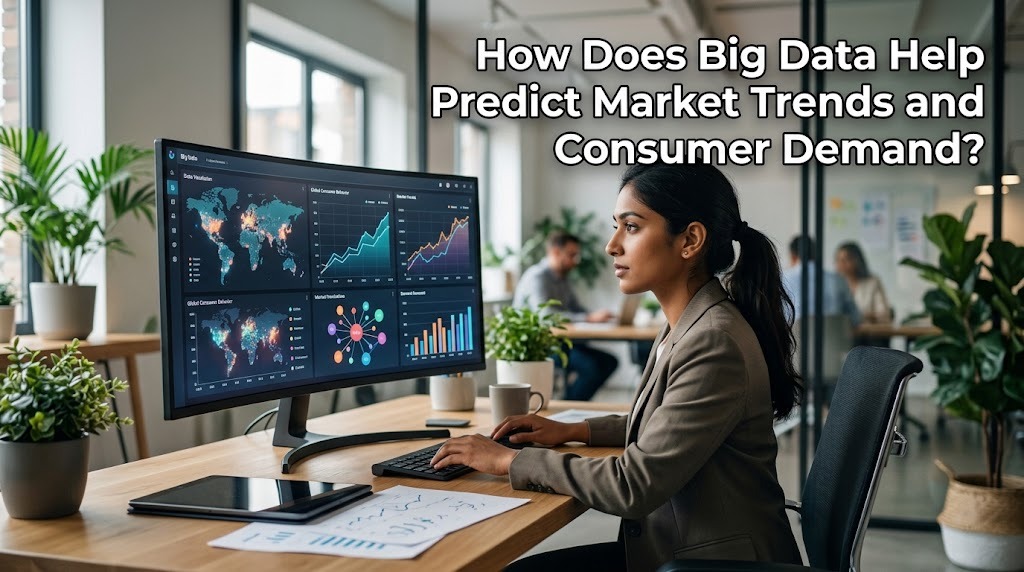
Big data has become an important tool for businesses that want to understand market trends and predict consumer demand. Every day, companies collect information from online transactions, social media, customer reviews, search activity, and purchasing records. When this information is analyzed effectively, businesses can identify patterns, understand changing preferences, and estimate which products or services customers may need in the future.
Predicting market trends and consumer demand helps companies make better decisions about product development, pricing, inventory, and marketing strategies. Instead of relying only on past experience or intuition, businesses can use data-driven insights to prepare for potential changes. Although predictions are never completely certain, big data can help organizations reduce uncertainty and respond more effectively to market opportunities.
UNDERSTANDING HOW BIG DATA PREDICTS MARKET TRENDS
Big data refers to large and complex collections of information gathered from multiple sources. These sources may include sales transactions, customer feedback, websites, social media platforms, and industry reports. By combining different types of information, businesses can develop a broader understanding of market conditions and consumer behavior. This makes it easier to identify patterns that might be difficult to notice through manual observation alone.
Data analytics helps companies examine historical information and compare it with current developments. For example, a clothing retailer may discover that demand for certain styles increases during specific seasons or after particular trends become popular online. By recognizing these patterns, the retailer can estimate which products may attract attention in the coming months. These insights help businesses prepare their strategies before demand changes significantly.
ANALYZING CONSUMER BEHAVIOR AND PURCHASING PATTERNS
One of the main ways big data helps predict consumer demand is by analyzing customer behavior. Businesses can study purchase histories, product searches, browsing activity, and customer feedback to understand what people prefer. This information can reveal which products customers frequently buy, what influences their decisions, and when they are most likely to make purchases. These patterns provide useful evidence for estimating future demand.
For example, an online store may notice that customers frequently search for a particular product but purchase a related alternative instead. This pattern may indicate that the original product is too expensive, unavailable, or unsuitable for customer needs. The company can investigate the reasons and adjust its pricing, inventory, or product selection. However, businesses should analyze customer information responsibly and follow applicable privacy requirements.
IDENTIFYING EMERGING MARKET TRENDS
Big data allows businesses to monitor changes in customer interests and market activity more systematically. Social media discussions, online searches, product reviews, and industry information can provide early signals of emerging trends. When these signals become more frequent or consistent, companies can investigate whether they represent a meaningful change in consumer preferences. This helps organizations recognize opportunities before a trend becomes widely established.
For instance, a food company may observe increasing interest in convenient meal options through customer searches and purchasing data. It can compare these findings with sales performance and feedback to determine whether demand is genuinely growing. If the evidence supports the trend, the company may develop new products or adjust its marketing strategy. Businesses should avoid treating every sudden increase in online attention as a lasting trend because temporary events can influence the data.
USING PREDICTIVE ANALYTICS TO FORECAST DEMAND
Predictive analytics uses historical data, statistical methods, and analytical models to estimate future outcomes. In demand forecasting, these techniques examine factors such as previous sales, seasonal patterns, pricing changes, promotions, and market conditions. The resulting forecasts help businesses estimate how much demand they may experience during a particular period. This information supports planning across sales, production, purchasing, and distribution.
For example, a supermarket can analyze sales from previous holiday seasons to estimate future demand for food, beverages, and household products. A manufacturer can use similar information to determine how much inventory to prepare before a busy period. Predictive models can also be updated when new information becomes available. Their accuracy depends on data quality, suitable modeling techniques, and the extent to which future conditions resemble the patterns found in historical data.
IMPROVING INVENTORY AND SUPPLY CHAIN MANAGEMENT
Accurate demand forecasting helps businesses maintain appropriate inventory levels and coordinate their supply chains more effectively. When companies understand which products are likely to sell and when demand may increase, they can plan purchasing and production more carefully. This reduces the risk of holding excessive stock or running out of popular products. It can also help organizations manage storage expenses and improve product availability.
For example, a retailer can combine sales forecasts with current inventory records to determine when to reorder products. A distribution company can use demand information to plan warehouse capacity and delivery schedules. Suppliers may also use shared forecasts to prepare materials and coordinate production. However, businesses should account for unexpected disruptions, supplier delays, and changes in customer behavior when using these forecasts.
SUPPORTING PRICING AND MARKETING DECISIONS
Big data helps businesses understand how customers respond to different prices, promotions, and marketing campaigns. By examining sales results alongside advertising activity and market conditions, companies can identify which strategies are associated with stronger demand. This information helps marketing teams develop more relevant campaigns and allocate budgets more effectively. It also supports pricing decisions by revealing how purchasing behavior changes under different conditions.
For example, an online retailer may compare sales during promotional periods with sales during regular pricing periods. The findings can help determine whether a discount increases total demand enough to justify the reduced profit margin. Companies can also identify customer groups that respond to particular offers and tailor their communication accordingly. Pricing decisions should still consider competition, operating costs, customer trust, and applicable laws.
MONITORING COMPETITORS AND MARKET CONDITIONS
Market trends and consumer demand are influenced by more than customer preferences alone. Competitor prices, new product launches, economic conditions, and changes in industry regulations can also affect purchasing decisions. Big data helps businesses monitor available market information and compare it with their own performance. This broader perspective can reveal external factors that influence demand.
For example, a technology retailer may observe changes in product sales after a competitor introduces a new model. By examining customer feedback, market prices, and sales patterns, the retailer can evaluate whether the change reflects stronger competition or a wider shift in consumer preferences. Companies can then consider appropriate responses, such as improving product features or adjusting promotional strategies. However, market information must be interpreted carefully because correlation does not necessarily mean that one event directly causes another.
BENEFITS OF PREDICTING MARKET TRENDS AND CONSUMER DEMAND
Using big data for forecasting can help businesses make decisions with greater confidence. Better demand estimates support inventory planning, production scheduling, budgeting, and marketing activities. Companies may also reduce waste by avoiding unnecessary production and purchasing. These improvements can increase operational efficiency and help organizations use their resources more effectively.
Another important benefit is the ability to respond more quickly to changing customer needs. Businesses that monitor relevant data can identify emerging opportunities and investigate potential risks earlier. They can test new products, adjust their strategies, and evaluate the results using measurable indicators. Nevertheless, the benefits depend on the quality of the information, the suitability of the analytical methods, and how effectively managers apply the findings.
CHALLENGES IN PREDICTING MARKET TRENDS WITH BIG DATA
Although big data can improve forecasting, several challenges can affect its reliability. Inaccurate records, incomplete datasets, and outdated information may lead to misleading predictions. Historical patterns can also become less useful when consumer preferences change rapidly or unexpected events disrupt the market. Businesses should regularly review their data and compare forecasts with actual results to identify weaknesses.
Privacy, cost, and technical expertise also require attention. Organizations need appropriate systems and skilled employees to collect, manage, and interpret information correctly. They must protect sensitive customer data and follow relevant privacy regulations. Most importantly, managers should treat forecasts as estimates rather than guaranteed outcomes and combine analytical insights with professional judgment and knowledge of current market conditions.
HOW BUSINESSES CAN USE BIG DATA EFFECTIVELY
Businesses should begin by defining the questions they want to answer, such as which products will experience higher demand or when customers are most likely to purchase. Clear objectives help organizations identify the relevant data sources and select suitable analytical methods. They should then collect reliable information from sales records, customer feedback, market research, and other appropriate sources. Organizing this information properly makes it easier to identify useful patterns.
Companies should also compare predictions with actual outcomes and update their forecasting methods regularly. Combining historical sales with current market signals can provide a more complete picture than relying on a single source. Businesses can begin with manageable projects, evaluate their results, and expand their use of analytics as their capabilities improve. This continuous process helps organizations develop more reliable forecasts and make better-informed decisions over time.
CONCLUSION
Big data helps businesses predict market trends and consumer demand by revealing purchasing patterns, identifying emerging interests, and supporting predictive analytics. These insights allow companies to improve inventory management, develop more effective marketing strategies, evaluate pricing decisions, and prepare for changes in the market. When used properly, big data can reduce uncertainty and help businesses recognize opportunities earlier.
However, predictions are not always accurate because consumer behavior and market conditions can change unexpectedly. Businesses need reliable information, suitable analytical methods, responsible data management, and regular evaluation to obtain meaningful results. By combining big data insights with human judgment and current market knowledge, companies can make more informed decisions and respond more effectively to consumer needs.
Recent Posts

Bagaimana Sistem SKS pada Program Kuliah... 22.11.2026/45 View

How Does Technology Make Daily Evaluation... 21.11.2026/73 View

Apa Strategi Menghadapi Kesenjangan antara Kompetensi... 21.11.2026/75 View

Mengapa Inventaris Aset Penting bagi Kelancaran... 21.11.2026/71 View

When Should Musicians Join a Record... 21.11.2026/75 View
