

How Does Data Science Transform the Way Businesses Analyze Customers?
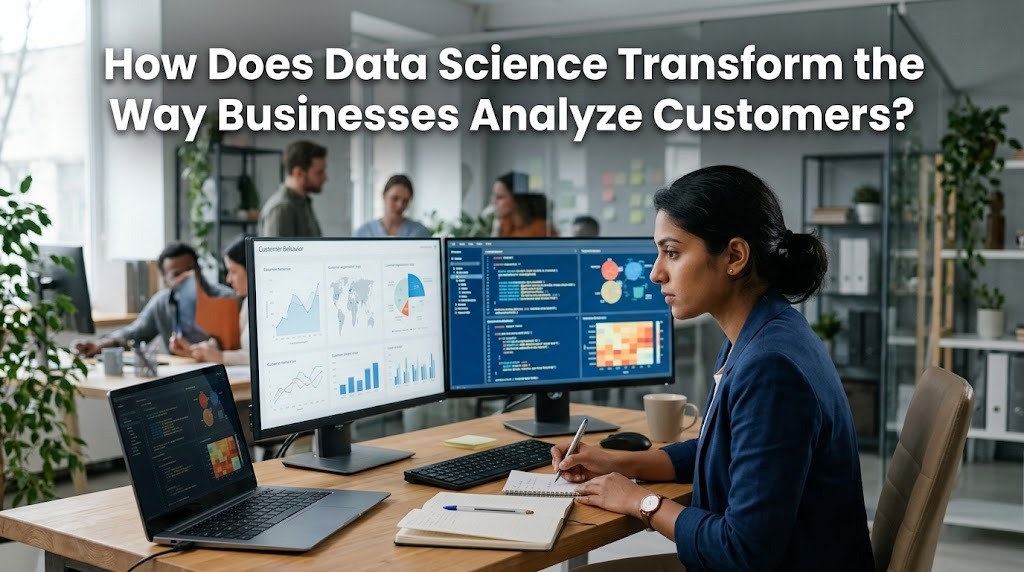
In today's competitive digital economy, understanding customers is essential for business success. Companies need to know what customers want, how they make purchasing decisions, and why they choose certain products or services over others. Traditional methods, such as basic surveys and manual observations, can provide useful information but may not fully explain complex customer behavior. Data science helps businesses analyze large amounts of customer information to discover patterns, understand preferences, and make more informed decisions. By combining data analysis, statistics, and machine learning, companies can improve customer experiences, develop effective marketing strategies, and build stronger relationships with their audiences.
WHAT IS THE ROLE OF DATA SCIENCE IN CUSTOMER ANALYSIS?
Data science is a field that uses statistics, programming, and analytical techniques to extract meaningful insights from data. In customer analysis, it helps businesses understand purchasing habits, product preferences, customer satisfaction, and interactions with digital platforms. Companies can collect information from sales transactions, website visits, customer feedback, loyalty programs, and other relevant sources, provided that the collection and use of this information follow applicable privacy requirements.
The main advantage of data science is its ability to identify patterns that may be difficult to recognize through manual analysis. For example, a retailer may discover that customers frequently purchase certain products together or that demand increases during particular seasons. These findings can help businesses improve product recommendations, organize inventory, and design more relevant promotional campaigns. By transforming raw information into actionable customer insights, data science allows companies to understand their audiences more systematically and respond to their needs.
HOW DOES DATA SCIENCE HELP BUSINESSES UNDERSTAND CUSTOMER BEHAVIOR?
Customer behavior includes the actions and decisions people make when discovering, evaluating, purchasing, and using products or services. Data science helps businesses study these activities by examining transaction histories, browsing patterns, product searches, and responses to marketing campaigns. Through behavioral analysis, companies can identify common purchasing patterns and understand which factors may influence customer decisions. For example, an online store may discover that many customers compare several products before making a purchase or frequently abandon their shopping carts when unexpected costs appear.
These findings allow businesses to investigate potential problems and improve the purchasing experience. A company might provide clearer pricing information, simplify its checkout process, or offer more detailed product descriptions. Data scientists can also use statistical methods to distinguish meaningful patterns from random fluctuations and examine whether a proposed change actually improves results. However, customer behavior can change over time, so businesses should regularly update their analyses and avoid assuming that every customer follows the same pattern. Accurate customer analysis requires reliable data, appropriate methods, and an understanding of the context behind the numbers.
HOW DOES DATA SCIENCE SUPPORT PERSONALIZED MARKETING?
Personalized marketing involves delivering relevant messages, products, or offers based on customer interests and behavior. Data science helps businesses achieve this by analyzing information such as previous purchases, product preferences, and responses to promotional activities. For example, an online marketplace may recommend products related to a customer's previous purchases, while a streaming platform may suggest content based on viewing history. These recommendations can make the customer experience more relevant and help businesses present suitable options.
Machine learning can strengthen personalization by identifying relationships between customer characteristics and product interests. Businesses can also use customer segmentation to divide audiences into groups based on shared characteristics, purchasing behavior, or engagement levels. This approach helps marketing teams develop different campaigns for different audiences rather than sending identical messages to everyone. Nevertheless, personalization must be balanced with customer privacy, transparency, and fairness. Companies should collect only appropriate information, protect sensitive data, and avoid making intrusive assumptions about individuals.
HOW DOES DATA SCIENCE HELP BUSINESSES PREDICT CUSTOMER NEEDS?
Data science enables businesses to estimate future customer behavior by analyzing historical information and identifying recurring patterns. Through predictive analytics, companies can forecast product demand, estimate the likelihood of repeat purchases, and identify customers who may stop using a service. For example, a subscription-based business can examine changes in customer activity to identify signs of declining engagement. It can then investigate the underlying causes and consider appropriate ways to improve the customer experience.
Businesses can also use predictive models to support inventory planning and customer service preparation. If historical data suggests that demand for a product typically increases during a certain period, a retailer can prepare its stock accordingly. However, predictions are estimates rather than guarantees because economic conditions, customer preferences, competitors, and unexpected events can change purchasing behavior. Companies should evaluate model accuracy, monitor changing patterns, and combine analytical predictions with human judgment. Responsible forecasting helps businesses prepare for possible outcomes without treating predictions as certain facts.
WHAT ARE THE BENEFITS AND CHALLENGES OF USING DATA SCIENCE FOR CUSTOMER ANALYSIS?
Data science offers several benefits for businesses, including better decision-making, improved marketing efficiency, stronger customer relationships, and more effective resource allocation. By understanding what customers need, companies can improve products, identify service problems, and direct their marketing budgets toward more relevant audiences. Customer analysis can also help businesses measure satisfaction, evaluate campaign performance, and identify opportunities for innovation. When used effectively, these insights support long-term competitiveness and help organizations respond to changing market conditions.
Despite these advantages, customer analysis also presents challenges. Incomplete, inaccurate, or outdated information can produce misleading conclusions, while biased datasets may cause analytical models to treat certain customer groups unfairly. Businesses must also address data security, consent, and applicable privacy regulations when handling personal information. Another challenge is interpreting analytical results correctly because a statistical relationship does not necessarily prove that one factor causes another. To address these issues, organizations should maintain high data-quality standards, regularly evaluate their models, and establish clear rules for responsible data use. Combining reliable technology with ethical practices is essential for gaining customer insights without compromising trust.
CONCLUSION
Data science transforms the way businesses analyze customers by helping them understand behavior, identify preferences, personalize marketing, and estimate future needs. Through data analysis, customer segmentation, machine learning, and predictive analytics, organizations can turn large amounts of information into insights that support practical business decisions. These capabilities help companies improve customer experiences, develop more relevant products, and use their resources more effectively.
However, successful customer analysis depends on more than collecting large amounts of data. Businesses need accurate information, suitable analytical methods, skilled professionals, and strong privacy protections. They must also recognize the limitations of predictive models and avoid making unsupported assumptions about customers. By applying data science responsibly, companies can build stronger customer relationships and create sustainable business value in an increasingly digital marketplace.
Recent Posts

Bagaimana Sistem SKS pada Program Kuliah... 22.11.2026/46 View

How Does Technology Make Daily Evaluation... 21.11.2026/74 View

Apa Strategi Menghadapi Kesenjangan antara Kompetensi... 21.11.2026/75 View

Mengapa Inventaris Aset Penting bagi Kelancaran... 21.11.2026/72 View

When Should Musicians Join a Record... 21.11.2026/75 View
