

How Does DNA Help Scientists Trace Human Evolution?
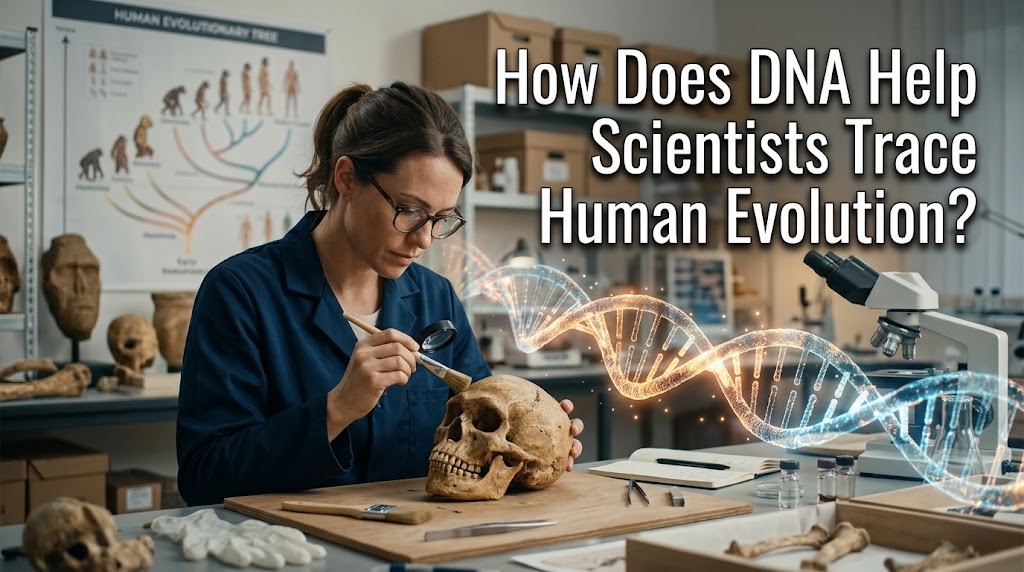
DNA plays an important role in helping scientists understand human evolution and discover how modern humans are related to ancient populations. By examining genetic information, researchers can identify similarities and differences between individuals, populations, and ancient human relatives. These comparisons provide evidence about shared ancestry, migration patterns, and changes that occurred throughout human history.
DNA research has also revealed that human evolution was more complex than scientists once believed. Modern humans share common ancestors with other primates and have inherited genetic material from ancient human groups, including Neanderthals and Denisovans. By combining DNA analysis with fossils and archaeological discoveries, scientists can build a more detailed picture of how humans evolved and spread across the world.
WHAT IS DNA AND WHY IS IT IMPORTANT IN HUMAN EVOLUTION?
DNA, or deoxyribonucleic acid, is the molecule that carries genetic instructions in living organisms. It contains information that influences the development, functioning, and inherited characteristics of humans. Most human DNA is found in the nucleus of cells, while a smaller amount is located in mitochondria, structures that help produce energy.
DNA is valuable for studying human evolution because genetic information is passed from parents to their children. Over many generations, mutations and other genetic changes create differences between populations. Scientists can examine these differences to investigate relationships between groups and estimate when their ancestors may have shared a common population. DNA therefore provides evidence of evolutionary history that cannot always be obtained from physical remains alone.
HOW SCIENTISTS COMPARE DNA BETWEEN POPULATIONS
Scientists study human evolution by comparing DNA sequences from different individuals and populations. They look for genetic similarities, differences, and patterns that may indicate shared ancestry. Populations with many shared genetic variants may have inherited them from common ancestors, although migration and interbreeding can also influence these patterns.
Researchers use statistical methods to interpret genetic data and develop models of population history. These models can help estimate when populations separated, how they migrated, and whether they later mixed with other groups. However, genetic similarities do not always provide an exact date or a complete explanation of historical events. Scientists compare multiple sources of evidence to determine which evolutionary explanations are best supported.
THE ROLE OF ANCIENT DNA IN HUMAN EVOLUTION
Ancient DNA is genetic material recovered from preserved remains such as bones and teeth. It allows scientists to study extinct human populations directly rather than relying only on comparisons with living people. Although ancient DNA often becomes damaged over time, advances in laboratory techniques have made it possible to recover and analyze genetic information from some archaeological discoveries.
One major breakthrough came from research on Neanderthal DNA. Scientists found that many present-day people with ancestry outside Africa carry a small proportion of Neanderthal genetic material. Research has also identified Denisovan ancestry in several modern populations, particularly in parts of Asia and Oceania. These discoveries demonstrate that modern humans sometimes interbred with other human groups during their evolutionary history.
HOW DNA REVEALS HUMAN MIGRATION PATTERNS
Genetic evidence helps researchers reconstruct how human populations moved across different regions. By comparing genetic variations among populations, scientists can identify patterns consistent with migration, population expansion, and periods of isolation. These patterns can be combined with fossil discoveries and archaeological evidence to investigate when humans occupied particular environments.
DNA research supports the conclusion that modern humans evolved in Africa and that populations later spread to other parts of the world. However, human migration did not occur in one simple journey. Different groups moved at different times, and some populations mixed with others after reaching new regions. Genetic evidence helps scientists investigate these movements, although researchers must account for later migrations and population changes when interpreting the results.
HOW MUTATIONS HELP SCIENTISTS TRACE EVOLUTION
Mutations are changes in DNA sequences that can occur during the copying of genetic material or as a result of other biological processes. Many mutations have little or no noticeable effect, while others can influence inherited characteristics. Over generations, mutations contribute to genetic diversity and provide useful markers for studying evolutionary relationships.
Scientists compare these genetic markers to estimate how populations are related. Some mutations accumulate over time, allowing researchers to make approximate estimates of when lineages diverged. These estimates depend on assumptions about mutation rates, population history, and the genetic regions being studied. Mutations therefore help scientists reconstruct evolutionary history, but they do not function as a perfectly precise biological clock.
THE DIFFERENCE BETWEEN MITOCHONDRIAL DNA AND NUCLEAR DNA
Scientists examine different types of DNA because each can reveal different aspects of human ancestry. Nuclear DNA is inherited from both parents and contains genetic information from many ancestral lines. Because it represents contributions from both sides of a family, it provides a broad view of population relationships and ancient interbreeding.
Mitochondrial DNA is found in mitochondria and is usually inherited from the mother. It is useful for tracing maternal lineages across generations. Scientists have used mitochondrial DNA to study the ancestry and movements of human populations, including the maternal lineage commonly associated with the term Mitochondrial Eve. This term refers to the most recent woman from whom all living humans inherited their mitochondrial DNA through an unbroken maternal line. She was not the only woman alive at the time, and she was not the first modern human.
HOW DNA HELPS IDENTIFY COMMON ANCESTORS
Shared genetic variations can help scientists identify relationships between modern humans and ancient populations. When different groups possess genetic features inherited from an earlier population, these similarities can provide evidence of common ancestry. Researchers use genetic comparisons to develop evolutionary family trees, often called phylogenetic trees.
These trees represent possible relationships between populations or genetic lineages. They can show when groups likely shared common ancestors and how their lineages may have separated over time. However, human population history is not always represented accurately by a simple branching tree because different groups sometimes interbred after separating. Scientists therefore use models that account for both shared ancestry and genetic exchange.
THE LIMITATIONS OF DNA RESEARCH
Although DNA provides powerful evidence, it cannot answer every question about human evolution. Ancient genetic material is often poorly preserved, especially in warm and humid environments. Researchers may therefore have limited access to DNA from certain places and periods, creating gaps in the historical record.
Genetic evidence must also be interpreted carefully because different evolutionary processes can produce similar patterns. Migration, natural selection, genetic drift, and interbreeding can all influence the distribution of genetic variants. In addition, estimates of population separation depend on scientific models and the quality of the available data. Combining DNA with fossils, archaeological discoveries, and geological evidence helps scientists develop more reliable conclusions.
WHY DNA IS IMPORTANT FOR UNDERSTANDING HUMAN ORIGINS
DNA research has transformed the study of human origins by revealing relationships that are difficult to determine from physical remains alone. It has helped scientists identify ancient interbreeding, reconstruct population movements, and investigate the shared ancestry of modern humans. Genetic research also provides insights into how inherited characteristics changed as populations adapted to different environments.
Understanding DNA and human evolution helps explain both human diversity and the close relationships among living populations. Although people differ in many inherited characteristics, all modern humans belong to the same species, Homo sapiens. Genetic evidence demonstrates that human history includes repeated movements and interactions between populations rather than a division into completely separate biological groups. These findings continue to improve our understanding of human ancestry.
CONCLUSION
DNA helps scientists trace human evolution by revealing genetic similarities, mutations, common ancestors, migration patterns, and evidence of interbreeding between ancient human groups. Through the study of ancient and modern DNA, researchers have gained important insights into the origins of Homo sapiens and the relationships between modern humans, Neanderthals, and Denisovans.
However, DNA is most useful when combined with other scientific evidence, including fossils and archaeological discoveries. Each source contributes different information about the past and helps researchers evaluate evolutionary explanations. As genetic technology advances, scientists will continue to uncover new details about the complex history of human evolution.
Recent Posts

Bagaimana Sistem SKS pada Program Kuliah... 22.11.2026/51 View

How Does Technology Make Daily Evaluation... 21.11.2026/81 View

Apa Strategi Menghadapi Kesenjangan antara Kompetensi... 21.11.2026/81 View

Mengapa Inventaris Aset Penting bagi Kelancaran... 21.11.2026/77 View

When Should Musicians Join a Record... 21.11.2026/82 View
