

How Does Gedung Sate Reflect Indonesia's Architectural Heritage?
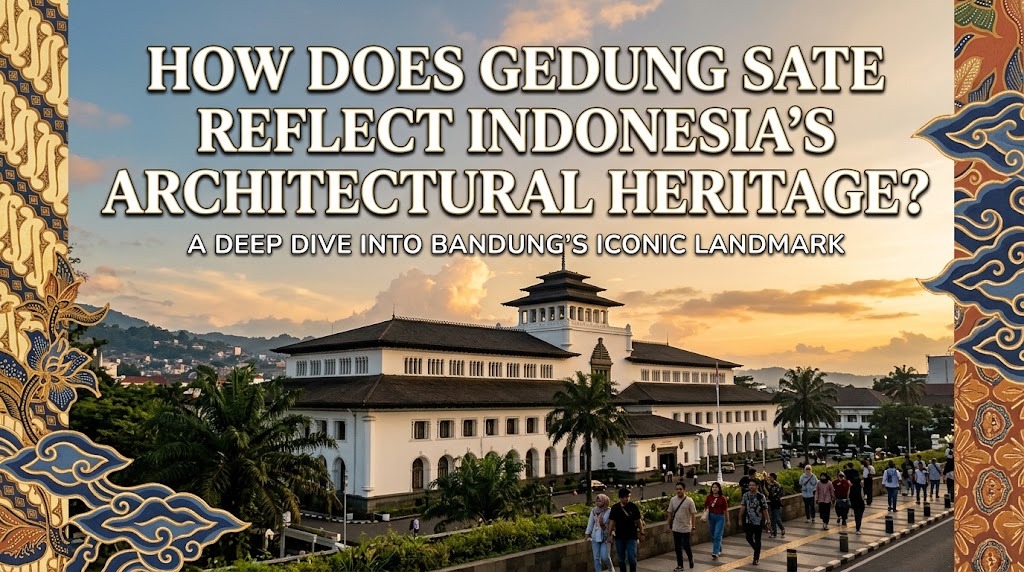
Gedung Sate is one of the most recognizable historic buildings in Indonesia, located in Bandung, West Java. Known for its distinctive central tower and ornamental details, the building has become an important symbol of the city. Its architectural design combines European influences with elements inspired by local traditions, creating a structure that reflects Indonesia's complex architectural history.
Beyond its appearance, Gedung Sate represents the development of government administration during the Dutch colonial period and the evolution of Indonesian architectural identity. Today, the building serves as the office of the Governor of West Java and remains a significant landmark for public administration, education, and cultural tourism.
THE HISTORICAL BACKGROUND OF GEDUNG SATE
Gedung Sate was constructed during the Dutch colonial period as part of a broader plan to develop Bandung as an important administrative center. Construction began in 1920, and the building was completed in 1924. It was originally designed to accommodate the Department of Government Enterprises of the Dutch East Indies, known as the Department of Government Enterprises or Departement van Gouvernementsbedrijven.
The building's construction reflected the growing importance of Bandung in colonial administration and urban development. Architects and planners aimed to create a functional government complex with a distinctive appearance. Over time, the building's role changed alongside Indonesia's political transformation, eventually becoming the headquarters of the West Java provincial government.
THE BLEND OF EUROPEAN AND LOCAL ARCHITECTURAL INFLUENCES
One of the most interesting aspects of Gedung Sate's architecture is its combination of different design traditions. The building incorporates European architectural features associated with classical and Renaissance-inspired styles, including balanced proportions, decorative facades, and carefully arranged windows. These elements reflect the architectural practices used in many government buildings during the colonial era.
At the same time, the design is often recognized for incorporating references to Indonesian and regional architectural traditions. Its broad roof forms and overall composition have been interpreted as reflecting influences from local and Southeast Asian architecture. This combination demonstrates how colonial-era buildings in Indonesia were sometimes adapted to regional environments and aesthetic preferences rather than simply reproducing European designs.
THE MEANING BEHIND THE DISTINCTIVE TOWER
The most recognizable feature of Gedung Sate is its central tower, which gives the building much of its visual identity. At the top of the tower is an ornament resembling a skewer, traditionally associated with the building's popular name, Gedung Sate. The Indonesian word sate refers to a dish of skewered food, and the ornament is commonly described as resembling a skewer with several decorative elements.
The tower helps distinguish Gedung Sate from other historic government buildings in Indonesia. Its vertical form creates a visual focal point, while the surrounding facade maintains a balanced and symmetrical appearance. The combination of the tower, roofline, and decorative details makes the building an example of how architectural features can become closely associated with a city's identity.
GEDUNG SATE AS A SYMBOL OF INDONESIAN HISTORY
Gedung Sate reflects the political and administrative changes that have shaped Indonesia. Although it was built during Dutch colonial rule, its continued use after independence demonstrates how existing buildings can take on new meanings in a changing national context. Rather than remaining solely a reminder of the colonial period, the building became part of Indonesia's modern government administration.
Its significance is also connected to the history of Bandung as a center of government, education, and urban development. The building's continued public role helps preserve its place in the city's historical landscape. Through its architecture and changing functions, Gedung Sate represents the relationship between colonial history and Indonesian national identity.
THE IMPORTANCE OF PRESERVING GEDUNG SATE
Preserving Gedung Sate is important because historic buildings provide physical evidence of architectural methods, materials, and social conditions from earlier periods. The structure helps researchers, students, and visitors understand how government buildings were designed and how urban planning developed in Bandung. Its continued existence also supports public awareness of Indonesia's architectural diversity.
Historic building preservation requires regular maintenance, careful restoration, and respect for the original design. Changes to the structure should be managed carefully so that essential architectural features are not lost. By maintaining Gedung Sate while allowing it to serve its current function, the government can protect a significant heritage landmark and ensure that future generations can continue learning from it.
CONCLUSION
Gedung Sate reflects Indonesia's architectural heritage through its colonial-era origins, combination of European and regional design influences, distinctive central tower, and continuing role in public administration. Completed in 1924, the building represents an important period in Bandung's development and demonstrates how architectural styles can reflect historical and cultural interactions.
Today, Gedung Sate remains both a government building and a recognized historical landmark. Protecting its architecture and historical significance helps preserve the identity of Bandung while contributing to a broader understanding of Indonesia's built heritage. Its story illustrates how a historic structure can retain its original character while gaining new meaning across different periods of national history.
Recent Posts

Bagaimana Sistem SKS pada Program Kuliah... 22.11.2026/51 View

How Does Technology Make Daily Evaluation... 21.11.2026/81 View

Apa Strategi Menghadapi Kesenjangan antara Kompetensi... 21.11.2026/81 View

Mengapa Inventaris Aset Penting bagi Kelancaran... 21.11.2026/77 View

When Should Musicians Join a Record... 21.11.2026/82 View
