

How Does Google Scholar Help Students Find Thesis References?
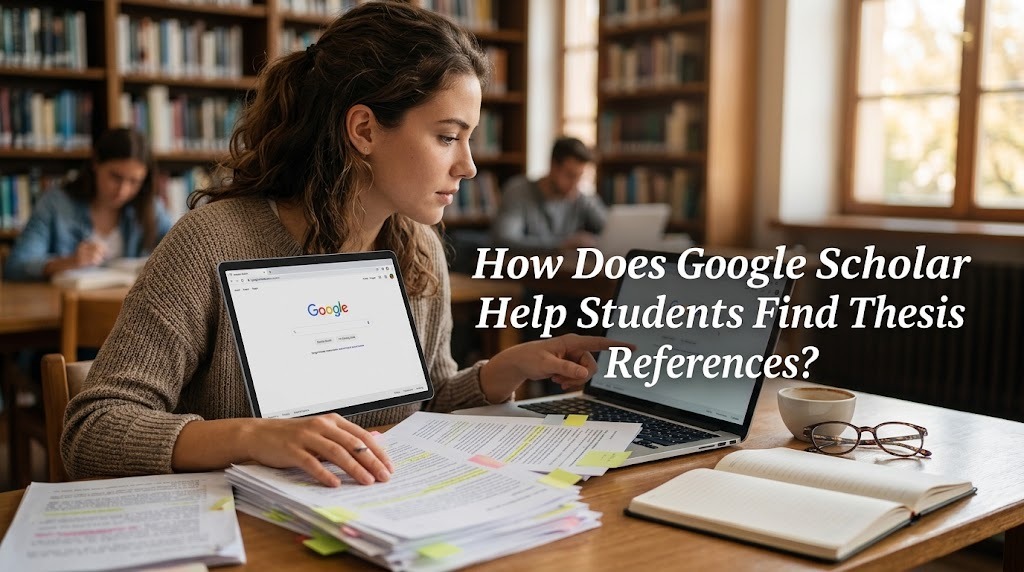
Writing a thesis requires students to use relevant and reliable academic references to support their research. Finding suitable references can sometimes be difficult because students may need to review many publications before discovering studies that match their topic. Google Scholar provides a practical way to search for scholarly literature from different academic fields. With the right search techniques, students can use it to discover previous research, theories, and supporting evidence for their thesis.
SEARCH FOR RELEVANT THESIS TOPICS
Google Scholar allows students to search for academic publications using specific keywords related to their thesis topic. Students can begin by identifying the main concepts, variables, or research problems in their study. For example, a thesis about online learning and student achievement can use combinations such as online learning, student achievement, and higher education. Using several relevant terms can produce more focused search results.
Students should avoid relying on only one search phrase because researchers may use different terminology for similar topics. Trying synonyms and related academic terms can reveal additional articles that might otherwise be missed. Students can also use exact phrases when searching for a particular concept. This approach helps create a broader but still relevant collection of potential thesis references.
FIND PREVIOUS RESEARCH
One of the most useful functions of Google Scholar is helping students discover previous research related to their thesis. Previous studies can show how other researchers have investigated similar problems, which methods they used, and what conclusions they reached. This information can help students understand the current state of research in their chosen field. It can also help identify areas that still require further investigation.
Students can examine the references and citation connections of a useful article to discover additional studies. The Cited by feature can lead to newer research that has referred to an earlier publication. Related articles can also provide alternative studies covering similar subjects. Reviewing these connections can help students develop a stronger understanding of the academic discussion surrounding their thesis topic.
EVALUATE THE QUALITY OF REFERENCES
Finding a publication through Google Scholar does not automatically mean that it is the best reference for a thesis. Students should evaluate the author, journal or publisher, publication date, research methodology, and relevance of each source. They should read the abstract and, when appropriate, the full article to determine whether the research genuinely supports their thesis. Careful evaluation helps prevent weak or unrelated sources from being included.
Students should also compare important information with multiple academic sources. Different studies may produce different findings because they use different samples, locations, methods, or theoretical approaches. Comparing these differences can help students develop a more balanced literature review. It also encourages critical analysis instead of simply accepting the conclusions of one study.
USE RECENT AND FOUNDATIONAL SOURCES
A strong thesis reference list often combines recent research with important foundational studies. Recent publications can provide updated findings, especially for topics influenced by technological, social, or economic changes. Older studies can still be valuable when they introduce theories, concepts, or research methods that remain important. Students should therefore select sources based on their academic value rather than choosing references only according to publication year.
Google Scholar can help students locate publications from different periods of research. Search results can be explored to understand how a particular topic has developed over time. Students can compare older theories with newer findings to identify changes in academic thinking. This process can strengthen the background and literature review sections of a thesis.
ORGANIZE THESIS REFERENCES
After discovering useful publications, students should keep their reference information organized. Important details include the author's name, article title, journal or publication name, year, and other bibliographic information required by the chosen citation style. Google Scholar provides citation information that can serve as a useful starting point for creating references. Students should still verify the generated information because automatic citation data may require correction.
Organizing references from the beginning can make thesis writing more efficient and manageable. Students can group sources according to research variables, theories, methods, or specific sections of the thesis. This makes it easier to locate supporting evidence when writing the literature review and discussion. A well-organized reference collection can also reduce the risk of losing important sources or forgetting citations.
CONCLUSION
Google Scholar can help students find thesis references by providing access to a broad range of academic literature and previous research. Students can use specific keywords, explore related studies, evaluate source quality, and combine recent publications with foundational research. Citation and related-article features can also help expand a reference collection. These functions make Google Scholar a useful starting point for thesis research.
However, students should not select references simply because they appear in search results. Relevance, credibility, research quality, and academic value should guide every reference decision. By searching systematically and organizing sources carefully, students can build a stronger literature review and create a thesis supported by appropriate academic evidence.
Recent Posts

Bagaimana Sistem SKS pada Program Kuliah... 22.11.2026/38 View

How Does Technology Make Daily Evaluation... 21.11.2026/71 View

Apa Strategi Menghadapi Kesenjangan antara Kompetensi... 21.11.2026/73 View

Mengapa Inventaris Aset Penting bagi Kelancaran... 21.11.2026/69 View

When Should Musicians Join a Record... 21.11.2026/73 View
