

How Does Google Scholar Make Academic Information Easier to Access?
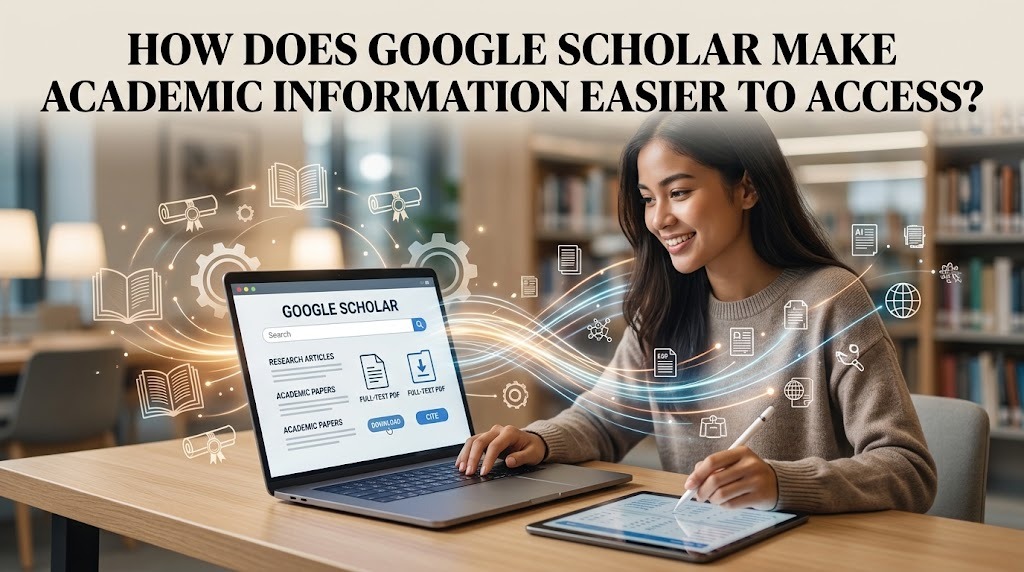
Access to academic information is essential for students, researchers, lecturers, and other learners. Academic work often requires reliable information from journal articles, books, theses, conference papers, and other scholarly publications. Without an effective search tool, finding appropriate literature can take considerable time. Google Scholar helps simplify this process by providing a single platform where users can search for scholarly information from many academic fields.
The platform makes academic searching more convenient by allowing users to search with keywords and explore connected publications. It can also help users identify citation information, related studies, and accessible versions of publications. Although Google Scholar improves access to academic information, users still need to evaluate the quality and relevance of every source before using it.
BRINGS SCHOLARLY INFORMATION TO ONE SEARCH PLATFORM
Google Scholar makes academic information easier to access by allowing users to search across a broad range of scholarly literature from one platform. Instead of manually visiting numerous websites, students can begin their research with a single search. Results may include journal articles, conference papers, theses, dissertations, books, and other academic materials. This broad coverage makes the initial research process more convenient.
The platform covers many academic disciplines, including education, business, technology, science, economics, and social sciences. This means users can search for literature even when their research involves several related fields. However, the availability and type of full text can vary between publications. Users should therefore examine individual results carefully after discovering them through Google Scholar.
MAKES ACADEMIC SEARCHING FASTER
Google Scholar provides a simple search interface that allows users to enter keywords, phrases, or author names. This makes it easier for students to begin searching without learning complicated database systems. More specific keywords can produce more focused results and reduce the number of unrelated publications. Students can adjust their searches when the initial results do not match their research needs.
Search options can also help users narrow down the literature they find. Publication-date filters can be useful when students need recent research, while exact-phrase searches can help locate publications discussing a specific concept. These features reduce the amount of time users need to spend manually reviewing unrelated results. As a result, students can focus more of their time on reading and analyzing useful research.
HELPS USERS DISCOVER RELATED RESEARCH
Google Scholar does more than provide individual search results. Its Cited by feature allows users to discover publications that have cited a particular article. This can help students follow the development of an academic idea and locate newer studies. It is especially useful when a user has already found one publication that closely matches their research topic.
The Related articles feature provides another way to explore similar academic studies. Students can use it to expand their literature search without having to create completely new search terms every time. These connections can help users discover research that might otherwise be difficult to find. However, each publication still needs to be evaluated for relevance and credibility.
PROVIDES ACCESS TO DIFFERENT VERSIONS OF PUBLICATIONS
Google Scholar can sometimes provide links to freely accessible versions of academic publications. These links may lead to institutional repositories, university websites, author pages, or other legitimate locations. For students without access to subscription-based databases, these options can make academic information more accessible.
However, not every publication found on Google Scholar is available for free. Some results may require payment or institutional access to view the complete article. Users should also check whether an accessible document is a journal article, repository version, conference paper, thesis, or preprint. Understanding the document type helps students determine how the source should be used and cited.
SUPPORTS ACADEMIC RESEARCH AND WRITING
Easier access to scholarly information can support different stages of academic research. Students can use Google Scholar to explore research topics, identify previous studies, develop literature reviews, and find evidence for academic arguments. Researchers can also use it to discover publications connected to their fields and follow citation relationships.
The platform can therefore reduce some of the barriers involved in finding academic literature. However, access alone does not guarantee that students will produce high-quality academic work. They still need to read critically, compare studies, evaluate evidence, and cite sources correctly. The value of Google Scholar ultimately depends on how responsibly users apply the information they discover.
EVALUATE INFORMATION BEFORE USING IT
Although Google Scholar makes academic information easier to find, users should not assume that every result is equally reliable. Students need to evaluate the author, publication venue, methodology, publication date, evidence, and relevance of each source. A publication that appears in a search result may still be unsuitable for a particular research question.
Students should also compare information from multiple academic sources. Looking at different studies can help them identify agreements, disagreements, limitations, and emerging findings. This process produces a more balanced understanding of the research topic. Careful evaluation ensures that easier access to information leads to better academic decisions, rather than simply a larger collection of references.
CONCLUSION
Google Scholar makes academic information easier to access by providing a convenient platform for discovering scholarly literature from many disciplines. Keyword searches, publication filters, citation links, related articles, and access links can help students find useful research more efficiently. These features can save time and support students throughout different stages of academic research and writing.
Nevertheless, Google Scholar should be viewed as a research discovery tool, not an automatic guarantee of source quality. Users must still evaluate the credibility, relevance, methodology, and evidence of each publication before using it. When used strategically and responsibly, Google Scholar can make academic information more accessible and help students develop stronger research and academic writing.
Recent Posts

Bagaimana Sistem SKS pada Program Kuliah... 22.11.2026/40 View

How Does Technology Make Daily Evaluation... 21.11.2026/71 View

Apa Strategi Menghadapi Kesenjangan antara Kompetensi... 21.11.2026/73 View

Mengapa Inventaris Aset Penting bagi Kelancaran... 21.11.2026/69 View

When Should Musicians Join a Record... 21.11.2026/73 View
