

How Does Industry 5.0 Combine Advanced Technology with Human Capabilities?
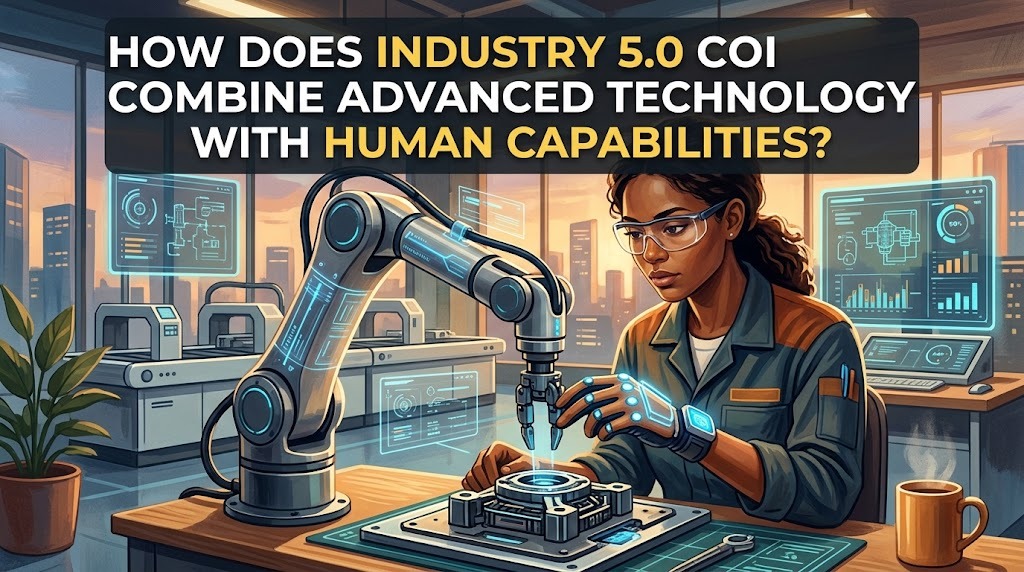
Industry 5.0 represents a modern approach to industrial development that combines advanced technology with human creativity, judgment, and problem-solving abilities. While Industry 4.0 focuses heavily on automation, connected devices, and data-driven systems, Industry 5.0 places greater emphasis on collaboration between people and machines. Technologies such as artificial intelligence, robotics, and intelligent manufacturing systems help workers perform tasks more effectively. However, human skills remain essential for making decisions, developing ideas, and responding to complex situations. This approach aims to create industries that are not only productive but also sustainable, resilient, and centered on human needs.
UNDERSTANDING THE CONCEPT OF INDUSTRY 5.0
Industry 5.0 is an industrial development concept that emphasizes cooperation between advanced technology and human capabilities. It builds on the digital infrastructure developed through Industry 4.0, including automation, artificial intelligence, and connected industrial systems. Instead of viewing technology only as a way to replace human labor, Industry 5.0 encourages businesses to use technology to support workers and improve the value of their contributions. This approach recognizes that machines can process information quickly, while humans bring creativity, empathy, ethical judgment, and contextual understanding.
The concept also emphasizes three important priorities: human-centricity, sustainability, and resilience. Human-centricity means designing technology around people's needs, safety, and well-being. Sustainability involves reducing environmental impacts and using resources more responsibly. Resilience means developing industrial systems that can adapt to disruptions, such as supply chain problems or sudden changes in demand. Together, these priorities encourage businesses to pursue technological progress while considering its effects on workers, communities, and the environment.
THE ROLE OF ARTIFICIAL INTELLIGENCE AND ROBOTICS
Artificial intelligence (AI) is one of the technologies that supports Industry 5.0. AI systems can analyze large amounts of data, recognize patterns, and provide recommendations that help workers make informed decisions. In manufacturing, AI can assist with quality inspection, production planning, and predictive maintenance. These applications help employees identify potential problems and improve operational efficiency without requiring them to perform every analytical task manually.
Robotics also plays an important role by helping people complete repetitive, physically demanding, or potentially dangerous activities. Collaborative robots, often called cobots, are designed to work alongside humans in certain environments when appropriate safety measures are in place. For example, a cobot may help position components while a worker performs detailed assembly or quality checks. This combination allows machines to contribute speed and precision while humans provide judgment and flexibility. Nevertheless, effective human-machine collaboration requires proper training, workplace safety procedures, and regular evaluation of system performance.
HUMAN CREATIVITY AND DECISION-MAKING IN MODERN INDUSTRY
Although advanced technology can automate many activities, human creativity and critical thinking remain important in industrial development. Machines can analyze data and generate possible solutions, but people must evaluate whether those solutions are appropriate for specific business objectives and social conditions. Workers can identify customer needs, develop new product concepts, and solve problems that require experience or an understanding of human behavior. These capabilities help businesses innovate beyond routine production tasks.
Human decision-making is also essential when situations involve ethical considerations, uncertainty, or competing priorities. For example, an AI system may recommend a production schedule based on efficiency, but managers must also consider worker safety, environmental requirements, and delivery commitments. Designers and engineers can use digital tools to test ideas while relying on human insight to determine which solutions offer the greatest practical value. Technology-assisted decision-making therefore works best when automated recommendations are combined with professional expertise, accountability, and careful evaluation.
THE BENEFITS OF HUMAN-MACHINE COLLABORATION
One major benefit of Industry 5.0 is the potential to improve productivity while making work more adaptable. Machines can handle repetitive tasks, allowing employees to focus on supervision, problem-solving, customer needs, and creative activities. This division of responsibilities may reduce certain physical demands and improve consistency in production. When implemented effectively, collaboration between humans and technology can also help businesses respond more quickly to changes in customer preferences.
Industry 5.0 can also support personalized products and services. Advanced manufacturing systems can adjust production according to individual requirements, while human workers contribute design expertise and an understanding of customer expectations. In addition, intelligent monitoring systems can help businesses identify waste, improve energy use, and manage resources more efficiently. However, these benefits depend on suitable technology, effective management, and appropriate worker training. Businesses must assess whether new systems genuinely improve outcomes rather than adopting technology simply because it is advanced.
THE CHALLENGES OF IMPLEMENTING INDUSTRY 5.0
Despite its potential, Industry 5.0 presents several challenges for businesses. Implementing AI systems, collaborative robots, and connected equipment can require significant investment in infrastructure, software, maintenance, and cybersecurity. Smaller companies may find these costs difficult to manage, particularly when they lack technical specialists. Integrating new technology with existing systems can also create operational difficulties if the equipment and software are not compatible.
Another challenge is preparing workers for changing job responsibilities. Employees may need to learn how to operate intelligent equipment, interpret data, and collaborate safely with automated systems. Businesses must also protect sensitive information and ensure that AI-supported decisions are transparent, reliable, and appropriately supervised. Reskilling and upskilling can help workers adapt, while clear workplace policies can address safety, privacy, and accountability. Governments, educational institutions, and industries can support this transition through vocational training, research, and access to digital infrastructure.
THE FUTURE OF INDUSTRY 5.0 AND HUMAN-CENTERED INNOVATION
The future of Industry 5.0 will depend on how effectively industries combine technological innovation with human needs. AI, robotics, connected sensors, and advanced analytics are likely to become increasingly integrated into production and service operations. At the same time, businesses will need workers who can interpret information, make responsible decisions, and contribute ideas that machines cannot fully replace. Digital literacy, adaptability, communication, and critical thinking will therefore remain valuable skills across many occupations.
Industry 5.0 may also encourage businesses to consider environmental and social impacts when developing new technologies. For example, manufacturers can use intelligent systems to reduce material waste, improve energy efficiency, and respond more flexibly to supply chain disruptions. However, achieving these outcomes requires deliberate planning rather than technology alone. Organizations should involve workers in implementation decisions, evaluate the effects of automation, and establish measurable sustainability goals. By prioritizing human-centered innovation, industries can pursue economic performance while supporting worker well-being and long-term resilience.
KESIMPULAN
Industry 5.0 combines advanced technology with human capabilities by encouraging collaboration between AI systems, robotics, and skilled workers. Machines contribute speed, precision, and data-processing power, while humans provide creativity, critical thinking, empathy, and ethical judgment. This approach emphasizes human-centricity, sustainability, and resilience to help industries create more meaningful and adaptable ways of working. However, successful implementation requires investment, employee training, cybersecurity, and responsible management. By placing people at the center of technological development, Industry 5.0 can support industrial progress that benefits businesses, workers, and society.
Recent Posts

Bagaimana Sistem SKS pada Program Kuliah... 22.11.2026/51 View

How Does Technology Make Daily Evaluation... 21.11.2026/81 View

Apa Strategi Menghadapi Kesenjangan antara Kompetensi... 21.11.2026/81 View

Mengapa Inventaris Aset Penting bagi Kelancaran... 21.11.2026/77 View

When Should Musicians Join a Record... 21.11.2026/82 View
