

How Does Kinesthetic Learning Support the Learning Process?
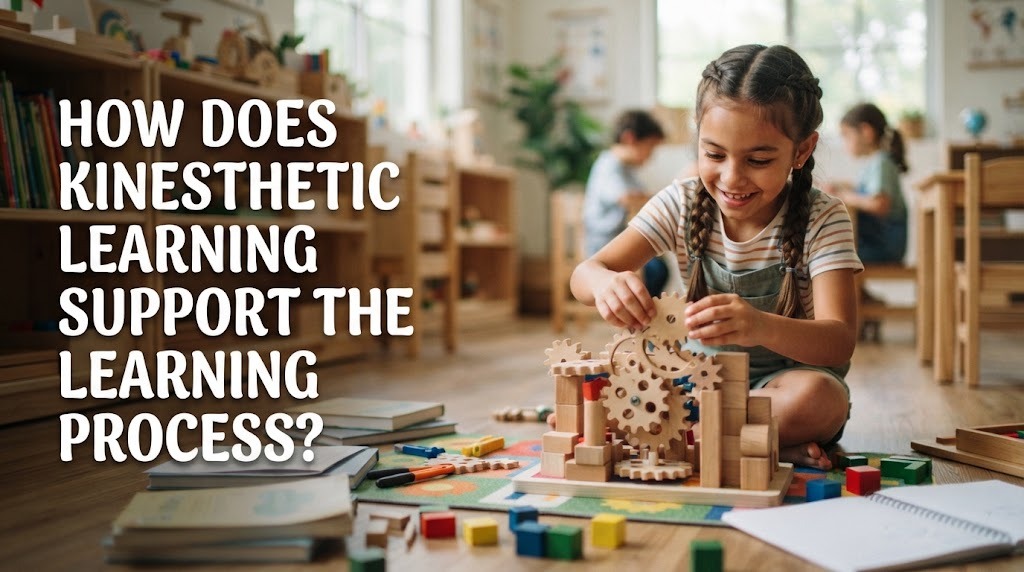
Kinesthetic learning is an approach that involves physical movement, practical activities, and direct experience during the learning process. Instead of only listening to explanations or reading textbooks, students are encouraged to interact with objects, perform tasks, conduct experiments, and practice skills directly. This approach can make lessons more active and meaningful because students experience concepts instead of only receiving information. Kinesthetic activities can be useful in many subjects, especially when students need to understand procedures, solve problems, or develop practical skills. However, effective learning does not require students to use only one learning approach, and combining methods can provide broader learning experiences.
WHAT IS KINESTHETIC LEARNING?
Kinesthetic learning refers to learning activities that involve physical action and direct participation. Students may learn by building models, conducting experiments, practicing procedures, creating projects, or participating in simulations. The main idea is to connect knowledge with action and experience. This can be especially useful when a lesson involves processes or skills that are easier to understand through practice.
Kinesthetic activities can take place inside or outside the classroom. For example, science students can conduct a simple experiment, while language students can practice communication through role play. Students studying technology can learn by using software or creating a project instead of only reading instructions. These activities allow students to actively engage with the subject and receive direct experience.
HOW DOES KINESTHETIC LEARNING SUPPORT UNDERSTANDING?
Kinesthetic learning can support understanding by allowing students to connect abstract concepts with concrete experiences. Some academic concepts can be difficult to understand when they are explained only through words or written descriptions. Practical activities give students an opportunity to see how information works in a real situation. This can help make complex ideas easier to discuss, analyze, and apply.
For example, a student learning about physics may understand motion more clearly after performing an experiment rather than only reading formulas. Similarly, students learning business can understand certain concepts by developing a simple business project or simulation. Through these activities, students can observe results and connect them with theoretical concepts. The combination of explanation and practice can create a more complete learning experience.
HOW CAN KINESTHETIC ACTIVITIES INCREASE STUDENT ENGAGEMENT?
Kinesthetic activities can make students more actively involved in lessons because they require participation rather than passive observation. Students may need to move, create something, solve a practical problem, or work with classmates. This can make classroom activities feel more interactive and provide opportunities for students to contribute. Active participation can also encourage students to ask questions when they encounter difficulties.
Practical activities can be particularly useful for lessons that require problem solving and decision making. Students can test an idea, observe what happens, and make adjustments based on the results. Mistakes can become opportunities to understand why a particular approach does not work. This creates a learning environment where students can learn through both successful and unsuccessful attempts.
HOW DOES KINESTHETIC LEARNING DEVELOP PRACTICAL SKILLS?
One of the main strengths of kinesthetic activities is their connection to practical skill development. Students do not simply learn what a procedure is; they have an opportunity to practice how to perform it. Repeated practice can help students become more familiar with the steps involved in a particular task. This is important for subjects and programs that require hands-on competence.
For example, students in vocational education may practice operating equipment, creating products, or completing technical procedures. University students can also develop practical skills through laboratory work, internships, field projects, presentations, and simulations. These experiences can help students connect academic knowledge with real-world applications. As a result, learning can become more relevant to situations outside the classroom.
HOW DOES KINESTHETIC LEARNING SUPPORT MEMORY?
Practical experiences can create multiple connections between information and action. When students perform an activity, they may use observation, movement, problem solving, and communication at the same time. These experiences can provide additional ways to recall what they have learned. However, physical activity alone does not guarantee better memory, so it should be combined with effective study and review techniques.
Students can strengthen their understanding by reviewing the concepts after completing a practical activity. For example, after conducting an experiment, they can write a summary, explain the results, and answer related questions. This combination of doing, reflecting, and recalling can reinforce the connection between experience and knowledge. Active recall and spaced review can also be used alongside practical learning.
WHAT ARE EXAMPLES OF KINESTHETIC LEARNING ACTIVITIES?
There are many ways to incorporate kinesthetic learning into education. Students can participate in experiments, role plays, simulations, group projects, educational games, demonstrations, field activities, and model-building exercises. They can also practice skills through laboratory work, presentations, workshops, or project-based assignments. The activity should be connected to a clear learning objective rather than simply involving movement.
For example, history students can recreate a historical situation through a role play, while geography students can create a physical map or model. Biology students can conduct observations or laboratory activities, while business students can simulate a marketing or sales situation. Students studying languages can practice conversations through structured activities. These examples show that kinesthetic learning can be adapted to different subjects and educational levels.
WHAT ARE THE LIMITATIONS OF KINESTHETIC LEARNING?
Kinesthetic learning is not suitable as the only method for every lesson or every student. Some concepts require reading, listening, discussion, visual representation, or quiet individual study. Practical activities can also require additional time, equipment, classroom space, and teacher preparation. If an activity is not connected to the learning objective, students may focus more on the activity itself than on the knowledge they are expected to gain.
For this reason, kinesthetic learning works best as part of a broader instructional approach. Teachers can combine practical activities with explanations, reading, visual resources, reflection, and assessment. Students can also choose different study techniques based on the subject and task. A flexible approach allows learners to benefit from hands-on experiences without treating kinesthetic learning as a fixed requirement.
CONCLUSION
Kinesthetic learning supports the learning process by giving students opportunities to learn through action, practice, and direct experience. It can help connect theoretical concepts with real situations, increase active participation, and develop practical skills. Hands-on activities may also provide meaningful experiences that students can use when reviewing and recalling information. However, kinesthetic learning should not be considered the only effective way to learn. Combining practical activities with reading, explanation, discussion, reflection, and active recall can create a more flexible and effective learning process.
KEYWORDS
- Kinesthetic Learning
- Learning Process
- Hands On
Recent Posts

Bagaimana Sistem SKS pada Program Kuliah... 22.11.2026/21 View

How Does Technology Make Daily Evaluation... 21.11.2026/63 View

Apa Strategi Menghadapi Kesenjangan antara Kompetensi... 21.11.2026/65 View

Mengapa Inventaris Aset Penting bagi Kelancaran... 21.11.2026/62 View

When Should Musicians Join a Record... 21.11.2026/59 View
