

How Does Logical Intelligence Help People Make Better Decisions?
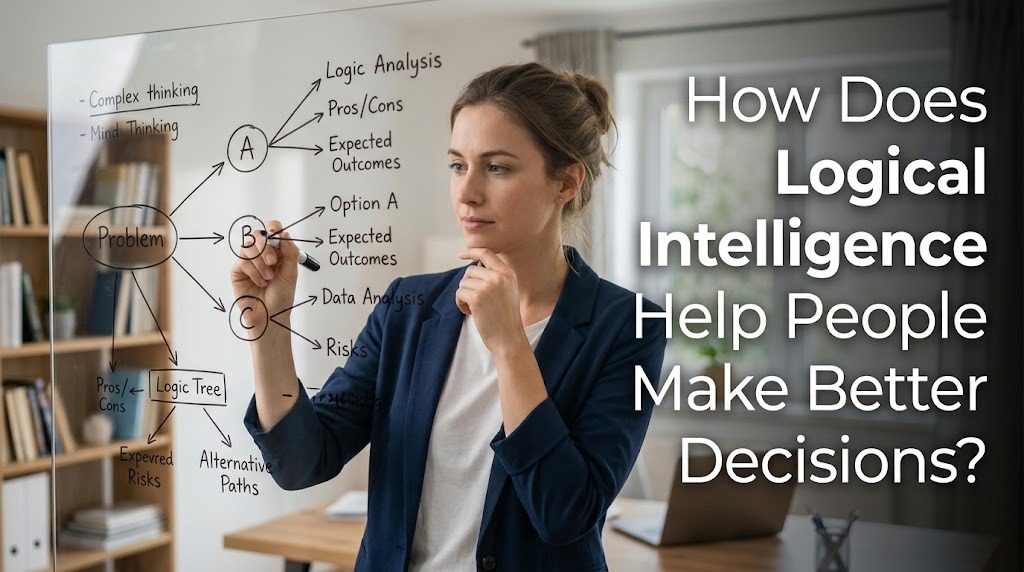
Making decisions is part of everyday life. People make decisions when choosing what to study, managing money, solving problems, or planning future activities. Logical intelligence can help individuals make decisions by encouraging them to examine information, compare options, and consider possible consequences. Instead of relying only on emotions or assumptions, people can use reasoning to understand a situation more clearly. This ability can be useful for students, professionals, and anyone who needs to make thoughtful choices.
UNDERSTANDING LOGICAL INTELLIGENCE
Logical intelligence is the ability to use reasoning, identify patterns, analyze information, and understand relationships between different ideas. It helps people organize information before reaching a conclusion. Someone who uses logical thinking usually considers facts and evidence before deciding what action should be taken. This process can reduce confusion when a situation involves several choices or possible outcomes.
Logical intelligence is not only related to mathematics. It can be applied to education, business, technology, communication, and everyday activities. For example, a student may use logical reasoning to decide how to manage several assignments with different deadlines. A person may also use it when comparing products, planning expenses, or evaluating information online. These examples show that logical intelligence can support practical decision making in many situations.
HOW LOGICAL THINKING IMPROVES DECISION MAKING
Logical thinking helps people make better decisions by encouraging them to examine a situation step by step. Before choosing an option, a person can identify the problem, collect relevant information, and compare the available alternatives. This structured process makes it easier to understand the advantages and disadvantages of each choice. It also reduces the risk of making a decision based only on incomplete information.
Another important benefit is the ability to identify relationships between actions and consequences. A decision may create both short-term and long-term effects, so considering these possibilities can provide a clearer picture of the situation. Logical reasoning encourages people to ask what might happen after a particular choice is made. By considering possible outcomes, individuals can make decisions that are more carefully planned.
THE ROLE OF INFORMATION AND EVIDENCE
Good decisions often depend on the quality of the information being considered. Logical intelligence helps individuals distinguish between relevant and irrelevant information. People can compare different sources and examine whether a claim is supported by facts, evidence, or reasonable explanations. This is especially important in the digital era because people can encounter large amounts of information through websites and social media.
Logical reasoning also encourages people to avoid accepting information immediately. They can ask where the information comes from, whether it is consistent with other evidence, and whether there may be another explanation. Evaluating information before making a decision can help individuals avoid conclusions based on rumors or unsupported assumptions. This habit is useful both in academic environments and in everyday life.
LOGICAL INTELLIGENCE AND PROBLEM SOLVING
Decision making and problem solving are closely connected. When people face a problem, they first need to understand what is causing it before deciding how to respond. Logical intelligence helps them break complex problems into smaller parts and examine each part systematically. This can make difficult situations easier to understand and can provide several possible solutions.
After identifying possible solutions, logical thinking can help individuals compare them. They can consider factors such as time, resources, risks, benefits, and possible consequences. A person can then select an option based on the available information rather than making a random choice. Reviewing the result afterward is also useful because it allows individuals to learn from their decisions and improve their approach in the future.
WAYS TO DEVELOP BETTER LOGICAL DECISION MAKING
Logical decision making can be developed through regular practice. Students can practice by solving puzzles, analyzing case studies, comparing different options, and explaining why they choose a particular answer. Writing down the advantages, disadvantages, risks, and possible results of different choices can also help organize thoughts. These activities encourage people to examine decisions from more than one perspective.
Another useful habit is learning from previous decisions. When an outcome does not match expectations, individuals can review the information they used and consider whether another approach would have produced a different result. This does not mean every decision must have a perfect outcome. Instead, reflection helps people improve their reasoning skills over time. With consistent practice, logical thinking can become a natural part of the decision-making process.
CONCLUSION
Logical intelligence helps people make better decisions by providing a structured way to analyze information and evaluate choices. It encourages individuals to consider evidence, compare alternatives, understand possible consequences, and solve problems systematically. These abilities can reduce decisions based only on assumptions or incomplete information. Logical intelligence is therefore useful in education, work, and everyday situations.
Developing this ability does not require complicated methods. Practicing problem solving, evaluating information, comparing alternatives, and reflecting on previous decisions can gradually strengthen logical reasoning. When people combine logical thinking with accurate information and careful consideration, they can approach important choices with greater clarity and responsibility.
Recent Posts

Bagaimana Sistem SKS pada Program Kuliah... 22.11.2026/12 View

How Does Technology Make Daily Evaluation... 21.11.2026/63 View

Apa Strategi Menghadapi Kesenjangan antara Kompetensi... 21.11.2026/64 View

Mengapa Inventaris Aset Penting bagi Kelancaran... 21.11.2026/61 View

When Should Musicians Join a Record... 21.11.2026/59 View
