

How Does Logical Intelligence Help Students Face Academic Challenges?
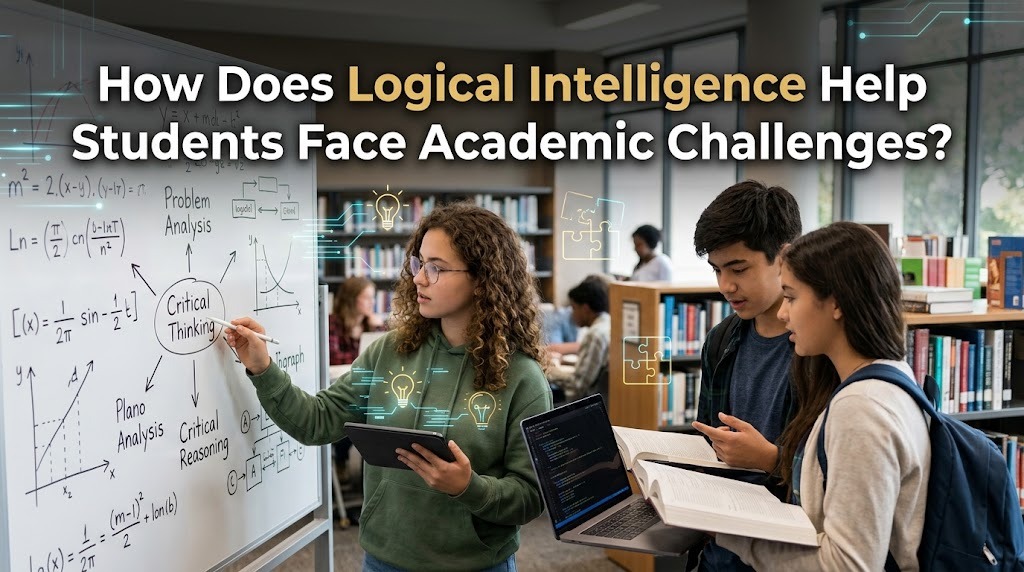
Students often face different academic challenges during their education. Difficult assignments, complex subjects, limited study time, and unfamiliar topics can make the learning process more demanding. Logical intelligence can help students approach these challenges by encouraging them to analyze information and find solutions systematically. Instead of feeling overwhelmed by a difficult task, students can break it into smaller and more manageable parts. This approach can make academic challenges easier to understand and handle.
UNDERSTANDING LOGICAL INTELLIGENCE
Logical intelligence is the ability to reason, analyze information, recognize patterns, and understand relationships between different ideas. It helps students determine how different pieces of information are connected and what conclusions can reasonably be drawn from them. This ability is useful in subjects such as mathematics and science, but it can also support language, business, technology, and social studies. Logical intelligence allows students to approach learning tasks with a more organized way of thinking.
Logical intelligence is not simply about getting correct answers quickly. It also involves understanding the process behind a solution. When students know why an answer is correct, they are more likely to apply the same reasoning to a different problem. This can help them become more independent learners. With regular practice, logical reasoning can become a useful habit when facing academic difficulties.
BREAKING COMPLEX TASKS INTO SMALLER STEPS
One common academic challenge is dealing with assignments that seem complicated or contain many requirements. Logical intelligence can help students divide these assignments into smaller steps. Breaking a large task into manageable parts makes it easier to identify what needs to be completed first. Students can then create a sequence that allows them to work more systematically.
For example, when preparing a research assignment, students may need to choose a topic, collect information, organize evidence, write the content, and review the final work. Looking at these activities as separate steps can make the assignment feel more manageable. Logical organization can also help students identify connections between tasks and avoid skipping important requirements. This method can be applied to many types of academic work.
IMPROVING PROBLEM SOLVING SKILLS
Academic challenges often require students to solve problems rather than simply remember information. Logical intelligence helps students identify the main problem, examine the available information, and consider possible solutions. Problem solving becomes more systematic when students understand each step of the process. They can compare different approaches and determine which one is most appropriate based on the information available.
Logical thinking also encourages students to check their work after reaching a solution. If an answer does not seem reasonable, they can return to earlier steps and look for possible mistakes. Learning from errors is an important part of academic development because mistakes can show which concepts still need to be understood. This process can gradually improve students' ability to handle difficult questions.
MANAGING INFORMATION AND STUDY PRIORITIES
Students often need to manage large amounts of information while studying. Logical intelligence can help them identify which information is important and how different concepts are related. Organizing information into categories, sequences, or connected ideas can make learning more structured. Students may use notes, diagrams, mind maps, or other organizational methods to understand complex material.
Logical thinking can also support better study priorities. When students have several assignments or exams, they can consider deadlines, difficulty, and available study time before creating a plan. This helps them determine which task requires attention first. Prioritizing responsibilities based on clear factors can reduce confusion and help students use their time more effectively.
DEVELOPING LOGICAL INTELLIGENCE FOR ACADEMIC SUCCESS
Logical intelligence can be developed through regular academic activities and everyday practice. Students can solve puzzles, analyze case studies, practice mathematics, learn basic coding, and answer questions that require reasoning. Explaining why an answer is correct is another useful exercise because it encourages students to understand the reasoning process. Reading and comparing information from reliable sources can also strengthen analytical skills.
Students should also practice asking questions when they encounter unfamiliar information. Questions such as why something happens, how two ideas are connected, and what evidence supports a conclusion can encourage deeper thinking. Teachers can support this process by giving students opportunities to discuss their reasoning instead of focusing only on final answers. Consistent practice can gradually strengthen logical thinking and academic confidence.
CONCLUSION
Logical intelligence can help students face academic challenges by providing a structured way to understand problems and develop solutions. It helps students break complex assignments into smaller steps, organize information, manage priorities, and evaluate their answers. These abilities can make difficult academic tasks more manageable and encourage students to become more independent learners. Logical thinking can also help students learn from mistakes and improve their problem-solving approach.
Developing logical intelligence does not require complicated methods. Regular practice through problem solving, information analysis, planning, and reflection can gradually strengthen this ability. When students combine logical reasoning with discipline and effective study habits, they can build useful skills for handling academic challenges. These skills can also remain valuable when students enter higher education and the professional world.
Recent Posts

Bagaimana Sistem SKS pada Program Kuliah... 22.11.2026/21 View

How Does Technology Make Daily Evaluation... 21.11.2026/63 View

Apa Strategi Menghadapi Kesenjangan antara Kompetensi... 21.11.2026/65 View

Mengapa Inventaris Aset Penting bagi Kelancaran... 21.11.2026/62 View

When Should Musicians Join a Record... 21.11.2026/59 View
