

How Does Logical Intelligence Help Students Solve Problems Effectively?
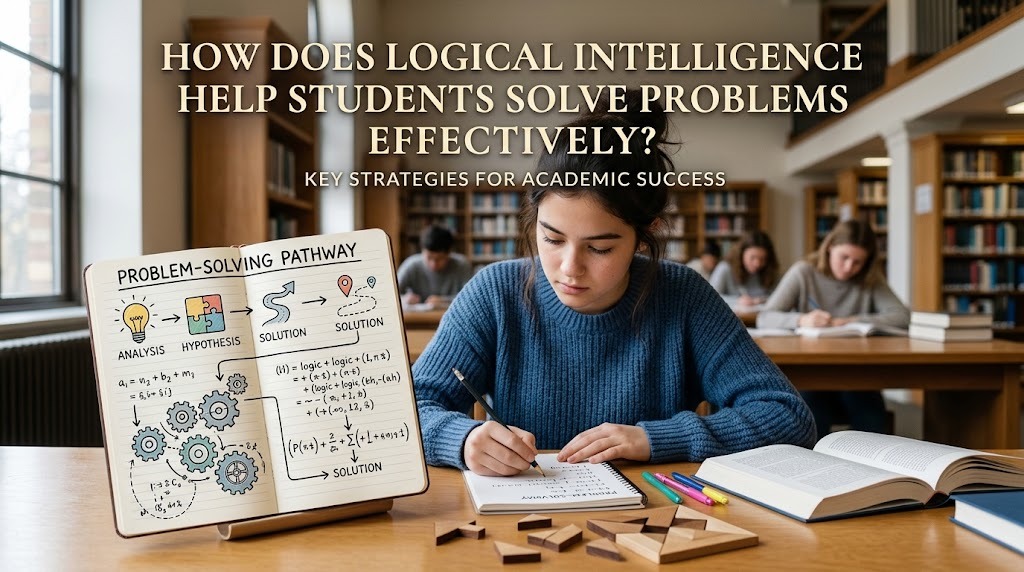
Logical intelligence is the ability to think in an organized way, recognize patterns, understand relationships, and use reasoning to reach a conclusion. For students, this ability is useful because learning often involves questions, challenges, and situations that require careful thinking. Logical intelligence is not only related to mathematics but also supports learning in science, language, technology, and everyday activities. Students can strengthen it through practice and meaningful learning experiences.
UNDERSTANDING LOGICAL INTELLIGENCE
Logical intelligence refers to the ability to use reasoning, identify patterns, compare information, and understand cause and effect. Students with this ability can approach a problem by examining the available information before deciding what to do. They tend to break complicated situations into smaller parts so the problem becomes easier to understand. This process helps students avoid making conclusions based only on assumptions.
Logical intelligence also involves analytical thinking and systematic reasoning. A student may use these skills when solving a mathematics problem, analyzing information from a lesson, or determining why a particular situation happens. It does not mean that someone must always have perfect answers. Instead, the important part is learning how to use evidence and logical steps when searching for solutions.
BREAKING PROBLEMS INTO SMALLER PARTS
One important way logical intelligence helps students is by allowing them to divide complex problems into smaller and more manageable parts. A difficult assignment may seem confusing when viewed as one large task. By identifying the main question, available information, and required steps, students can create a clearer path toward the solution. This approach can make problem solving more structured and less overwhelming.
For example, when facing a difficult academic question, students can first determine what is being asked. They can then identify relevant information and remove details that are not needed. After that, they can choose an appropriate method and check whether the result makes sense. These steps encourage students to solve problems systematically rather than guessing.
IMPROVING ANALYTICAL AND CRITICAL THINKING
Logical intelligence is closely connected with analytical thinking, because both require students to examine information carefully. Students can learn to compare different ideas, identify important details, and recognize relationships between pieces of information. This ability is useful when they need to understand complicated subjects or evaluate different possible answers. It also helps them become more careful when interpreting information.
Logical reasoning can also support critical thinking skills. Instead of immediately accepting every statement as true, students can ask whether there is enough evidence to support it. They can consider different explanations and examine whether the information is consistent. As a result, logical intelligence encourages students to become more thoughtful learners who make conclusions based on reasoning.
SUPPORTING BETTER DECISION MAKING
Students make many decisions during their academic life, such as choosing how to complete an assignment, managing study time, or selecting an appropriate solution to a problem. Logical intelligence helps students evaluate available choices before making a decision. They can consider the advantages, disadvantages, consequences, and information related to each option. This makes their decisions more deliberate and less dependent on impulsive reactions.
Good decision making does not mean that students will always choose the perfect option. Instead, logical thinking helps them understand why a particular choice may be more suitable in a certain situation. Students can review the information they have, consider possible outcomes, and select an approach that fits their goal. This habit can also be useful beyond school because decision making is an important part of everyday life.
DEVELOPING LOGICAL INTELLIGENCE THROUGH LEARNING
Logical intelligence can be developed through regular practice and challenging activities. Students can work on puzzles, mathematics problems, strategy games, coding exercises, research tasks, and activities that require them to identify patterns. Group discussions can also be useful when students are encouraged to explain how they reached an answer. The goal is not simply to find the correct answer but to understand the reasoning behind it.
Teachers and parents can support this development by giving students opportunities to ask questions, analyze situations, and explain their reasoning. Students can also practice by reviewing mistakes and identifying which part of their reasoning needs improvement. Over time, these activities can make logical thinking more natural. Consistent practice is important because reasoning skills generally become stronger when students frequently use them.
CONCLUSION
Logical intelligence helps students solve problems effectively by improving their ability to organize information, recognize patterns, analyze situations, and make reasoned decisions. It allows students to break complicated problems into smaller steps and evaluate possible solutions more carefully. This ability also supports critical thinking, analytical skills, and independent learning. Logical intelligence can be strengthened through academic exercises, puzzles, technology, strategy-based activities, and everyday problem solving. By practicing these skills consistently, students can become more confident and systematic when facing different academic challenges.
Recent Posts

Bagaimana Sistem SKS pada Program Kuliah... 22.11.2026/12 View

How Does Technology Make Daily Evaluation... 21.11.2026/63 View

Apa Strategi Menghadapi Kesenjangan antara Kompetensi... 21.11.2026/64 View

Mengapa Inventaris Aset Penting bagi Kelancaran... 21.11.2026/61 View

When Should Musicians Join a Record... 21.11.2026/59 View
