

How Does Logical Intelligence Support Success in the Workplace?
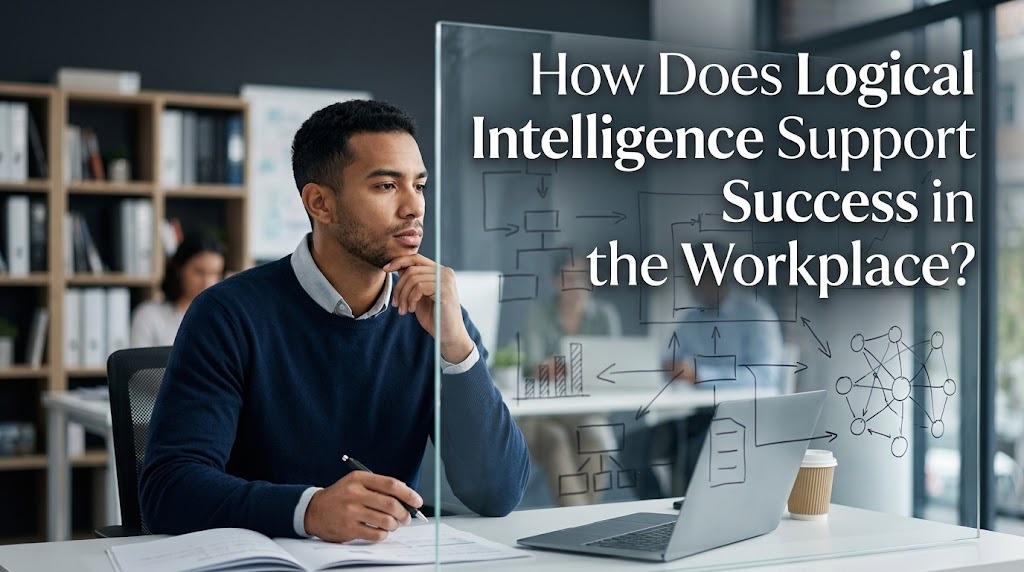
The workplace requires people to handle different tasks, solve problems, communicate ideas, and make decisions. Employees may encounter unexpected situations that require them to think carefully before taking action. Logical intelligence can help workers analyze information and choose reasonable solutions based on available evidence. This ability can support employees when they need to complete tasks efficiently and respond to changing situations. Although logical intelligence is only one part of professional development, it can be valuable in many types of jobs.
UNDERSTANDING LOGICAL INTELLIGENCE AT WORK
Logical intelligence is the ability to analyze information, recognize patterns, understand relationships, and use reasoning to solve problems. In the workplace, employees can apply these skills when organizing tasks, evaluating information, or identifying the causes of a problem. Logical thinking helps people approach situations systematically instead of making decisions without considering relevant information. It can therefore support both individual responsibilities and teamwork.
Logical intelligence can be useful in many professional fields. Employees in business, marketing, technology, finance, education, and administration may all need to analyze information and make decisions. For example, a marketing employee may examine campaign data to understand customer responses. A technology employee may analyze an error and determine possible causes. These activities require different forms of logical reasoning.
SUPPORTING EFFECTIVE PROBLEM SOLVING
Problems are a normal part of professional life. Employees may encounter technical issues, customer concerns, scheduling difficulties, or unexpected changes in a project. Logical intelligence helps employees identify the main problem and examine possible causes before choosing a solution. This can make problem solving more organized and reduce unnecessary trial and error.
Logical thinking also helps employees compare several possible solutions. They can consider factors such as available resources, time, risks, and expected results. After choosing a solution, they can evaluate whether it actually solves the problem. Reviewing the results can help employees learn from mistakes and improve future decisions.
IMPROVING DECISION MAKING
Employees often need to make decisions based on available information. Logical intelligence can help them compare alternatives and consider the possible consequences of each choice. Evidence-based decision making can be useful when employees need to determine priorities or select an appropriate course of action. This approach does not eliminate uncertainty, but it provides a structured way to evaluate choices.
Logical reasoning can also help employees avoid making decisions based only on assumptions. They can check the information they have and identify what additional information may be needed. For example, a manager may review project data before deciding how to allocate resources. Careful analysis can make workplace decisions more transparent and easier to explain.
SUPPORTING PRODUCTIVITY AND ORGANIZATION
Logical intelligence can contribute to workplace productivity by helping employees organize tasks efficiently. When employees understand which tasks are connected and which activities should be completed first, they can create a clearer workflow. Prioritizing tasks based on deadlines and importance can help employees manage their responsibilities. Logical thinking can also help them identify unnecessary steps in a process.
Organization becomes particularly important when employees handle multiple responsibilities at the same time. They may need to divide a large project into smaller tasks and monitor progress toward a specific goal. Systematic planning can reduce confusion and make complex work more manageable. This approach can also help employees recognize potential problems before they become larger issues.
DEVELOPING LOGICAL INTELLIGENCE FOR CAREER GROWTH
Logical intelligence can be strengthened through continuous practice and learning. Employees can improve their reasoning skills by analyzing workplace situations, solving problems, reviewing data, and learning from feedback. Asking questions and understanding the reasons behind a process can also encourage deeper thinking. These habits can help employees become more capable of handling unfamiliar situations.
Technology can provide additional opportunities to develop logical skills. Learning basic data analysis, coding, spreadsheets, or digital problem-solving tools can encourage employees to work with information systematically. Employees can also practice by reviewing completed projects and identifying what worked well and what could be improved. Continuous learning allows logical thinking to develop alongside professional skills.
CONCLUSION
Logical intelligence can support workplace success by helping employees analyze information, solve problems, make decisions, and organize tasks. These abilities are useful across many professional fields because employees regularly encounter situations that require reasoning and careful evaluation. Logical thinking can also help workers understand complex tasks and respond to problems systematically. However, professional success also depends on other abilities such as communication, teamwork, adaptability, and technical knowledge.
Developing logical intelligence can be part of long-term career development. Problem solving, data analysis, planning, reflection, and continuous learning can provide practical opportunities to strengthen reasoning skills. By combining logical thinking with other professional abilities, employees can build a more effective approach to workplace challenges and responsibilities.
Recent Posts

Bagaimana Sistem SKS pada Program Kuliah... 22.11.2026/21 View

How Does Technology Make Daily Evaluation... 21.11.2026/63 View

Apa Strategi Menghadapi Kesenjangan antara Kompetensi... 21.11.2026/65 View

Mengapa Inventaris Aset Penting bagi Kelancaran... 21.11.2026/62 View

When Should Musicians Join a Record... 21.11.2026/59 View
