

How Does Mind Mapping Help Students Organize Information?
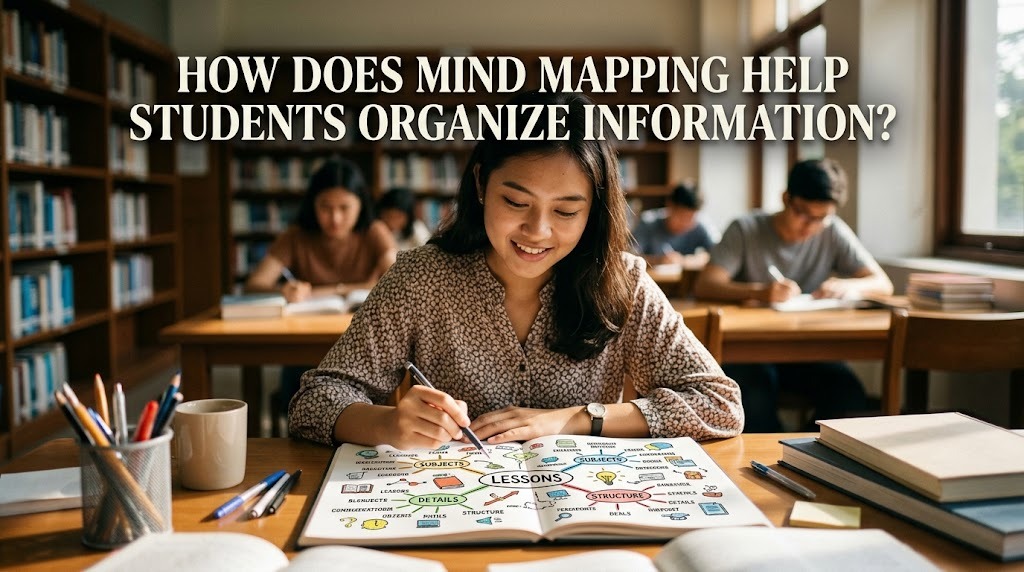
Students often receive information from textbooks, lectures, assignments, discussions, and digital resources. When there is too much information, students may have difficulty deciding which ideas are important and how they are connected. Mind mapping provides a visual method for arranging information into a clear and structured format. It allows students to group related concepts and place supporting details under the appropriate topic. This can make learning materials easier to understand, review, and remember.
WHAT IS MIND MAPPING FOR ORGANIZING INFORMATION?
Mind mapping is a visual technique that organizes information around a central topic. The main topic is placed in the center, while related ideas are connected through branches. Smaller branches can then contain supporting details, examples, definitions, or explanations. This creates a structure that shows the relationship between different pieces of information. Instead of keeping ideas in separate notes, students can see them as part of one connected topic.
Mind mapping can be used for many types of learning activities. Students can create a map when reading a chapter, listening to a lecture, planning an assignment, or reviewing for an exam. The process requires them to select important information and decide where each idea belongs. This encourages active organization of knowledge rather than simply copying information. As a result, students can develop a clearer understanding of the subject they are studying.
HOW DO MAIN BRANCHES ORGANIZE INFORMATION?
Main branches help students divide a large topic into important categories. Each branch can represent a major concept related to the central topic. Students can then add smaller branches to explain each category in greater detail. This hierarchical structure makes it easier to see which ideas are broad and which ones provide supporting information.
For example, if the central topic is Digital Marketing, students can create branches for social media, content marketing, SEO, advertising, and analytics. Each branch can contain relevant terms, strategies, and examples. This organization prevents different concepts from becoming mixed together. It also provides a clear overview of the subject that students can understand at a glance.
HOW DO KEYWORDS HELP STUDENTS ORGANIZE INFORMATION?
Keywords allow students to represent important information using short and meaningful terms. Instead of writing complete paragraphs, students can choose words that summarize the main idea. These keywords can then be connected to related concepts through branches. This makes the mind map less crowded and easier to read.
Selecting keywords also encourages students to determine which information is most important. They need to understand the material before deciding which words should be included. This process can help separate essential concepts from unnecessary details. When keywords are properly organized, students can use them as reminders when explaining the topic in their own words.
HOW DOES MIND MAPPING SHOW CONNECTIONS BETWEEN IDEAS?
One of the main strengths of mind mapping is its ability to show relationships between different ideas. Students can connect concepts using branches, lines, or arrows when there is a meaningful relationship between them. These connections can represent causes, effects, examples, processes, or related categories. Seeing these relationships can make complicated information easier to understand.
For example, students studying business management may connect planning with organizing, leadership, and evaluation. They can also add arrows to show how one stage influences another. This helps students understand the subject as a system instead of a collection of unrelated facts. Clear connections can support deeper understanding of learning materials.
HOW CAN STUDENTS USE MIND MAPS FOR STUDY AND ASSIGNMENTS?
Mind maps can be useful for planning assignments and organizing study materials. Before writing an essay, students can place the assignment topic in the center and create branches for arguments, examples, evidence, and conclusions. This provides a basic structure that can later be developed into paragraphs. Students can also rearrange branches when they decide that a different order would make the assignment clearer.
For studying, students can use completed mind maps as quick reference materials. They can review the central topic first and then move through each branch while explaining the concepts from memory. If they discover information that is missing or incorrect, they can update the map. This makes the mind map a flexible tool that can change as students develop and improve their understanding.
CONCLUSION
Mind mapping helps students organize information by arranging a central topic, main branches, supporting details, and meaningful connections in one visual structure. It helps students separate major ideas from smaller details and recognize relationships between concepts. The use of keywords and organized branches also makes large amounts of information easier to review. Students can use mind maps for studying, assignments, summaries, and exam preparation. When used consistently, mind mapping can become an effective study strategy for clearer and more organized learning.
Recent Posts

Bagaimana Sistem SKS pada Program Kuliah... 22.11.2026/28 View

How Does Technology Make Daily Evaluation... 21.11.2026/65 View

Apa Strategi Menghadapi Kesenjangan antara Kompetensi... 21.11.2026/65 View

Mengapa Inventaris Aset Penting bagi Kelancaran... 21.11.2026/62 View

When Should Musicians Join a Record... 21.11.2026/63 View
