

How Does Mind Mapping Help Students Summarize Learning Materials?
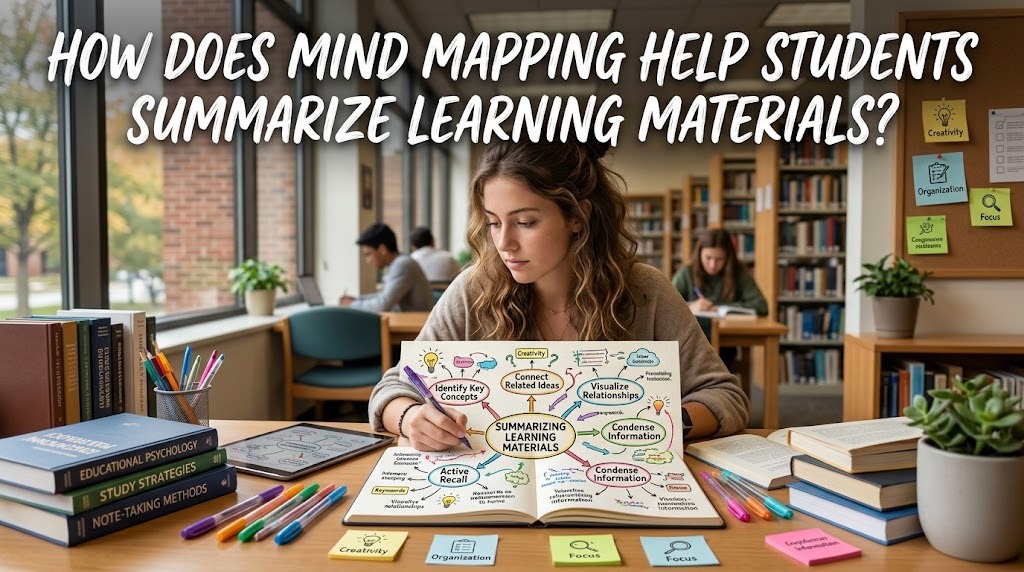
Students often need to understand and review large amounts of information from textbooks, lectures, and other learning resources. Writing everything in long paragraphs can make important points difficult to identify. Mind mapping offers a visual way to summarize information by organizing the main topic and its supporting ideas. Students can use keywords, branches, and simple visual elements to represent the most important parts of a lesson. This approach can make learning materials shorter, clearer, and easier to review.
WHAT IS MIND MAPPING FOR SUMMARIZING LEARNING MATERIALS?
Mind mapping is a visual note-taking method that organizes information around a central topic. The central topic represents the subject being studied, while branches contain important ideas related to it. Students can add smaller branches for definitions, examples, explanations, or other supporting details. This structure allows a large amount of information to be represented in a compact format. As a result, students can create a summary without copying every sentence from their learning materials.
When used for summarizing, mind mapping requires students to identify the most important information. They need to decide which concepts are essential and which details are less important. This makes the summarizing process more active because students must process the material before adding it to the map. A good mind map should represent the main meaning of the topic without becoming overloaded with unnecessary information.
HOW DOES MIND MAPPING IDENTIFY MAIN IDEAS?
One of the most useful features of mind mapping is its ability to separate main ideas from supporting details. Students can place the main concept in the center and use major branches for the most important points. Smaller branches can then provide additional explanations or examples. This hierarchy makes it easier to recognize the structure of the original material.
For example, when summarizing a lesson about digital marketing, students could place Digital Marketing in the center. Main branches could include content marketing, social media, SEO, advertising, and analytics. Each branch could contain only the most important keywords and concepts. This creates a concise overview that allows students to understand the main structure of the lesson without reading every detail again.
HOW DO KEYWORDS MAKE SUMMARIES MORE CONCISE?
Keywords are essential when students use mind mapping to summarize learning materials. Instead of writing complete sentences, students select words that represent important concepts. This reduces the amount of text while preserving the main meaning of the information. Keywords can also help students quickly recognize what each branch represents.
Choosing the right keywords requires students to understand the information before summarizing it. Simply copying words from a textbook may not produce a useful summary. Students should select terms that can remind them of the larger explanation behind each idea. When the keywords are connected through branches, they can provide a quick visual overview of the entire topic.
HOW CAN VISUAL ELEMENTS IMPROVE A SUMMARY?
Mind maps can use colors, symbols, icons, and simple images to distinguish different types of information. For example, students can use one visual element for definitions and another for examples or important concepts. These elements can make the summary easier to scan and help students recognize different categories quickly. However, visual elements should remain simple and relevant to the topic.
The purpose of these elements is not to make the mind map highly decorative. Instead, they should help students understand and organize information more effectively. A clear mind map with simple visual elements can be more useful than a complicated design. Students should prioritize readability and meaningful connections when creating their summaries.
HOW CAN STUDENTS USE MIND MAPS FOR REVIEW?
After completing a mind map, students can use it as a study guide for reviewing learning materials. They can look at the central topic and try to explain each branch without returning to the original textbook. If they cannot explain a particular branch, they can review that section again. This allows students to identify areas where their understanding may still need improvement.
Mind maps can also support active recall during study sessions. Students can cover some keywords and try to remember the missing information based on the surrounding branches. Before an exam, the completed map can provide a quick overview of important concepts. This makes revision more organized while helping students focus on the information that matters most.
CONCLUSION
Mind mapping helps students summarize learning materials by organizing important information into a clear visual structure. The central topic provides the main focus, while branches and keywords represent important concepts and supporting details. Visual elements can further separate categories and make summaries easier to review. The process also encourages students to identify essential information instead of simply copying long explanations. When combined with active recall and regular review, mind mapping can become an effective study strategy for understanding and summarizing learning materials.
Recent Posts

Bagaimana Sistem SKS pada Program Kuliah... 22.11.2026/27 View

How Does Technology Make Daily Evaluation... 21.11.2026/65 View

Apa Strategi Menghadapi Kesenjangan antara Kompetensi... 21.11.2026/65 View

Mengapa Inventaris Aset Penting bagi Kelancaran... 21.11.2026/62 View

When Should Musicians Join a Record... 21.11.2026/63 View
