

How Does Modern Technology Help Scientists Study Human Evolution?
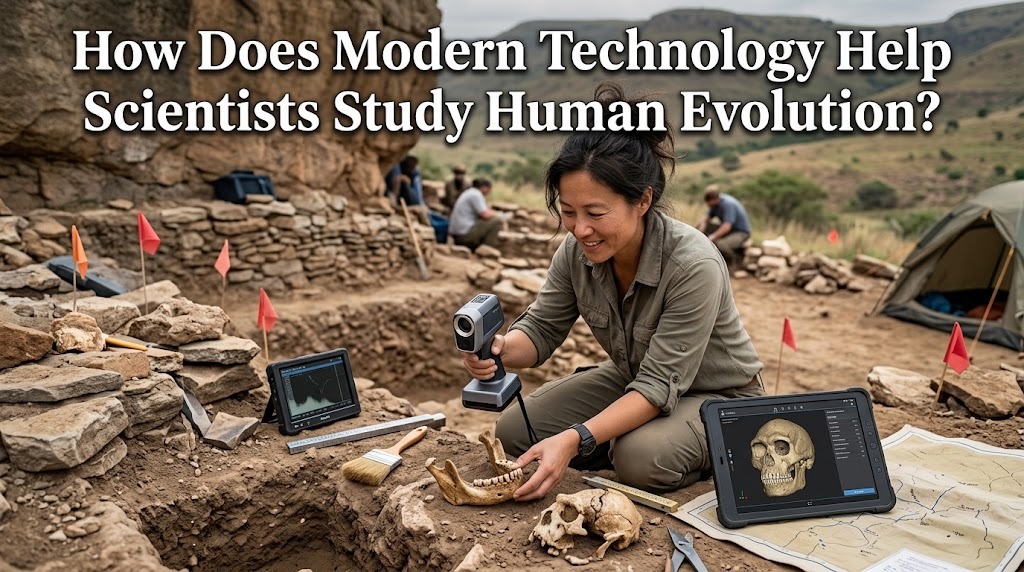
Modern technology has transformed how scientists study human evolution by providing more accurate ways to examine fossils, analyze ancient DNA, and reconstruct the lives of early humans. In the past, researchers mainly relied on fossil discoveries, stone tools, and comparisons of skeletal structures to understand human origins. Today, advanced technologies allow scientists to investigate evidence at microscopic and genetic levels without always damaging valuable archaeological remains. These methods help researchers identify relationships between ancient human populations, understand how humans adapted to different environments, and reconstruct important events in evolutionary history. By combining technological innovations with traditional scientific methods, researchers can develop a more detailed understanding of how modern humans evolved.
HOW DNA ANALYSIS REVEALS HUMAN EVOLUTION
DNA analysis is one of the most important technologies used to study human evolution. Scientists can examine genetic material from modern humans and, when preservation allows, from ancient human remains. By comparing DNA sequences, researchers can identify genetic similarities and differences between populations and estimate when certain groups shared common ancestors. Ancient DNA has also provided evidence that modern humans interbred with other human groups, including Neanderthals and Denisovans. These findings show that human evolution involved interactions between different populations rather than a simple, uninterrupted line of development.
However, ancient DNA is often difficult to recover because genetic material breaks down over time. Heat, moisture, microorganisms, and contamination can damage or destroy DNA in archaeological remains. Scientists therefore use specialized laboratory procedures to reduce contamination and verify whether genetic findings are reliable. When sufficient evidence is available, genetic analysis can help reconstruct population movements, relationships, and adaptations. This technology has significantly expanded scientific knowledge about human origins and prehistoric population history.
HOW 3D SCANNING HELPS ANALYZE FOSSILS
Three-dimensional scanning allows scientists to create detailed digital models of fossils and skeletal remains. These models can reveal the shape, size, and surface features of bones without requiring researchers to handle fragile specimens repeatedly. Scientists can examine skulls, teeth, and other anatomical structures from different angles and compare them with remains from other human species. This makes it easier to identify physical similarities and differences that may provide clues about evolutionary relationships. Digital models can also be shared between research institutions, allowing specialists in different countries to examine the same evidence.
Three-dimensional technology is particularly useful when fossils are incomplete or damaged. Researchers can sometimes use digital reconstruction methods to estimate the original shape of missing or distorted sections, although these reconstructions must be interpreted carefully. Scientists can also measure anatomical features more consistently and test different explanations of how ancient humans moved or developed. These methods help improve comparisons between fossil specimens and modern human anatomy. Nevertheless, digital models cannot replace the original fossils or eliminate uncertainty when the available evidence is limited.
THE ROLE OF RADIOCARBON DATING AND OTHER DATING METHODS
Dating technologies help scientists determine when ancient human remains, tools, and archaeological materials existed. Radiocarbon dating measures the remaining carbon-14 in once-living materials to estimate their age. Under suitable conditions, it is useful for dating organic materials up to approximately 50,000 years old, although the practical range depends on preservation and measurement conditions. This method helps researchers establish the timing of relatively recent events in human prehistory. It can also show whether archaeological objects and human remains found at the same site may belong to the same period.
For much older fossils and archaeological sites, scientists use other dating techniques. These include potassium-argon and argon-argon dating for certain volcanic materials, as well as uranium-series dating for appropriate mineral deposits and fossil contexts. Researchers often combine several methods to improve the reliability of an estimated age. Dating results must also be interpreted alongside geological evidence and the conditions in which the materials were discovered. By establishing more reliable timelines, these technologies help scientists understand when important evolutionary changes occurred.
HOW ARTIFICIAL INTELLIGENCE SUPPORTS HUMAN EVOLUTION RESEARCH
Artificial intelligence and machine learning can help researchers analyze large amounts of archaeological, genetic, and anatomical data. These systems can identify patterns in datasets that would be difficult to examine manually, including similarities among fossil measurements or relationships between genetic variations. For example, computational models can assist scientists in comparing skull shapes or classifying stone tools according to their physical characteristics. Such analysis can help researchers develop new questions and identify evidence that deserves closer investigation. AI therefore serves as a supporting tool rather than a replacement for scientific reasoning.
However, AI-generated results depend on the quality of the data and the methods used to train or develop a model. Incomplete fossil records, small datasets, or inaccurate assumptions can produce misleading conclusions. Scientists must evaluate computational findings against physical evidence, established methods, and independent research. AI cannot reliably determine an ancient human species or evolutionary relationship simply by producing a convincing prediction. When used carefully, these technologies can make evolutionary research more efficient and help scientists investigate complex questions.
HOW CT SCANS REVEAL ANCIENT HUMAN ANATOMY
Computed tomography, commonly known as CT scanning, produces detailed images of internal structures by combining multiple X-ray measurements. Scientists use this technology to examine fossils without cutting them open or physically separating delicate structures. CT scans can reveal the internal anatomy of skulls, the structure of teeth, and features hidden beneath the surface of ancient bones. These observations may provide information about growth, development, and anatomical differences between human species. They are particularly valuable when fossils contain important structures that cannot be examined directly.
CT scanning can also produce digital data that researchers use to create three-dimensional reconstructions. For example, scientists may study the internal structure of the skull to investigate aspects of braincase development or examine tooth structures to learn about growth patterns. Such findings can help clarify how different anatomical characteristics changed during human evolution. However, scientists must be careful not to assume that a single anatomical feature reveals an individual's complete behavior or intelligence. CT scanning is most useful when its results are combined with other fossil, genetic, and archaeological evidence.
HOW ARCHAEOLOGICAL TECHNOLOGY DISCOVERS ANCIENT HUMAN SITES
Modern archaeological technologies help scientists locate and investigate sites where early humans once lived. Satellite imagery, geographic information systems, and remote sensing can reveal landscape features that may indicate ancient settlements or activity areas. Ground-penetrating radar can help detect certain buried structures and changes beneath the surface without immediately excavating the ground. These tools allow researchers to identify promising locations and plan archaeological investigations more effectively. They can also reduce unnecessary excavation, helping protect important archaeological sites.
Once a site has been identified, researchers use precise recording methods, digital mapping, and specialized excavation equipment to document discoveries. Photogrammetry, which creates three-dimensional models from overlapping photographs, can preserve detailed records of fossils, tools, and their surrounding locations. The position of an artifact is important because it helps researchers understand how it relates to other objects and geological layers. Careful documentation allows future researchers to revisit the evidence and evaluate earlier interpretations. These technologies make archaeological research more systematic and help preserve information that could otherwise be lost during excavation.
WHY COMBINING TECHNOLOGIES IMPROVES HUMAN EVOLUTION RESEARCH
No single technology can explain the entire history of human evolution. DNA analysis can reveal genetic relationships, while fossils provide evidence of physical anatomy and archaeological objects offer clues about past activities. Dating techniques help establish when these discoveries occurred, and digital tools allow researchers to compare evidence across different sites. When independent methods support the same explanation, scientists can develop stronger conclusions about evolutionary events. Combining technologies also helps reveal disagreements that may require further investigation.
For example, researchers studying an ancient human fossil may use CT scanning to examine its anatomy, dating methods to estimate its age, and genetic analysis if suitable DNA survives. Archaeological evidence from the surrounding site may provide additional information about the environment and activities of the population. Each method answers different questions, and their results must be interpreted together rather than treated as interchangeable. Some discoveries cannot be tested with every technology because fossils may be too old, damaged, or poorly preserved. By integrating available evidence and acknowledging uncertainty, scientists can build more reliable explanations of human evolutionary history.
CONCLUSION
Modern technology helps scientists study human evolution by making it possible to analyze ancient DNA, examine fossils in three dimensions, date archaeological materials, and investigate buried sites more accurately. Artificial intelligence and advanced computing also help researchers identify patterns in large datasets and compare evidence from different sources. These methods have improved scientific understanding of human ancestry, anatomical changes, migration, and interactions between ancient populations. However, technology does not remove every limitation, because evidence can be incomplete, damaged, or difficult to interpret. By combining modern tools with careful scientific analysis, researchers continue to uncover new information about how humans evolved and how modern populations are connected to their ancient ancestors.
Recent Posts

Bagaimana Sistem SKS pada Program Kuliah... 22.11.2026/51 View

How Does Technology Make Daily Evaluation... 21.11.2026/81 View

Apa Strategi Menghadapi Kesenjangan antara Kompetensi... 21.11.2026/81 View

Mengapa Inventaris Aset Penting bagi Kelancaran... 21.11.2026/77 View

When Should Musicians Join a Record... 21.11.2026/82 View
