

How Does Musical Intelligence Support Brain Development?
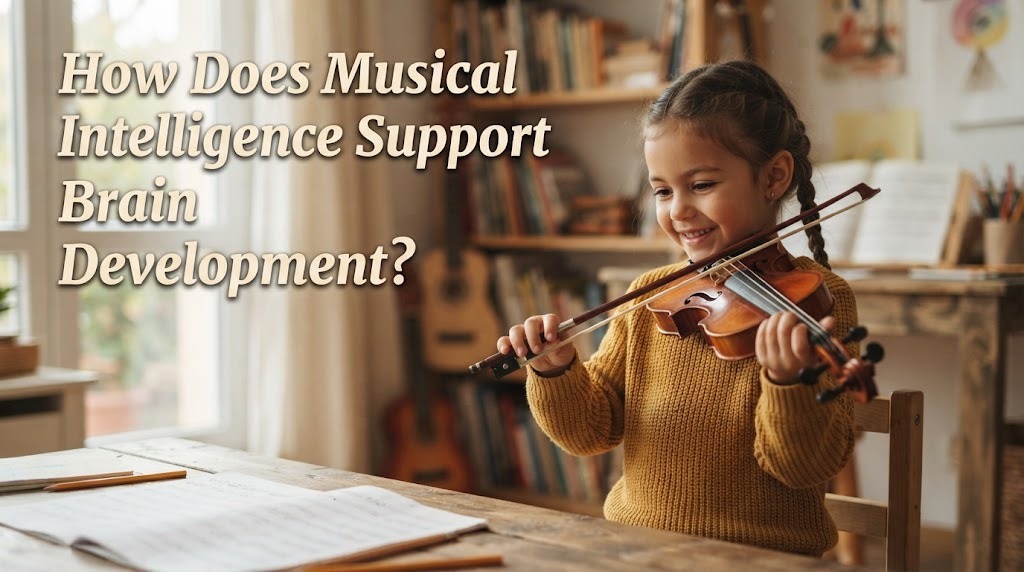
Musical intelligence is the ability to recognize, understand, and create musical patterns, including sounds, rhythms, melodies, and tones. It is one of the abilities described in Howard Gardner’s theory of multiple intelligences. Musical activities, such as singing, playing instruments, and listening carefully to music, engage several brain processes at the same time. These activities can involve hearing, movement, attention, memory, and emotional responses.
Musical intelligence can support brain development by providing opportunities to practice these different skills. Learning music may help strengthen certain abilities related to sound processing, coordination, and memory. However, its effects vary depending on factors such as age, practice, individual differences, and the type of musical activity. Understanding these connections helps explain why music can be a valuable part of education and personal development.
IMPROVING MEMORY AND INFORMATION PROCESSING
Musical activities engage brain systems involved in learning and memory. When people learn a song, they need to remember its melody, rhythm, lyrics, and sequence. Repeated practice helps them retrieve and organize this information more efficiently. These experiences can support musical memory and provide opportunities to practice attention and information processing.
Music can also help people remember certain types of information when words are connected to a melody or rhythm. For example, children may learn the alphabet through a song because the melody provides additional cues for recalling the sequence. However, this benefit does not mean that music automatically improves every type of memory. The effectiveness of musical learning depends on the task and whether the activity helps the learner understand the information.
DEVELOPING ATTENTION AND CONCENTRATION
Musical activities require attention to different elements of sound, including rhythm, pitch, tempo, and changes in melody. When learning to play an instrument, a person may need to follow musical notation, listen to sounds, and control movements at the same time. These demands provide opportunities to practice focusing on relevant information and noticing mistakes. Regular musical practice can therefore help develop skills related to attention within musical tasks.
Some attention skills may also be useful in other situations, such as classroom learning or completing structured activities. However, research does not establish that musical training consistently improves every aspect of general attention for everyone. The benefits depend on the individual and the type of training involved. Music should therefore be viewed as one possible way to practice attention rather than a guaranteed method for improving concentration in all situations.
SUPPORTING LANGUAGE AND SOUND RECOGNITION
The brain uses complex processes to recognize speech sounds, understand words, and interpret spoken language. Musical activities also involve recognizing patterns in sound, distinguishing differences in pitch, and identifying changes in timing. Because music and language share some sound-processing mechanisms, musical training may support certain skills related to listening and speech perception. This connection is especially relevant when children are learning to recognize sounds and develop language abilities.
For example, singing songs with clear pronunciation can expose children to repeated sound patterns and familiar words. Activities that involve clapping to syllables or identifying differences between sounds may also support phonological awareness, an important skill in early reading development. Nevertheless, music does not replace direct language instruction, reading practice, or conversation. Its greatest educational value comes when it complements other learning experiences.
STRENGTHENING COORDINATION BETWEEN THE BRAIN AND BODY
Playing a musical instrument involves more than hearing sounds. A musician may need to read notes, remember a sequence, control finger movements, and listen to the result simultaneously. These actions require coordination between sensory, motor, and cognitive processes. Repeated practice can improve instrument-specific motor skills and the coordination needed to perform musical tasks.
For example, learning the piano requires coordinating both hands while following a musical sequence. Playing the drums involves controlling movements according to a steady rhythm, while singing may require coordinating breathing, vocal control, and listening. Such activities provide structured opportunities to practice timing and movement. Although these skills can improve through musical training, they do not necessarily transfer directly to every physical or cognitive ability.
ENCOURAGING CREATIVITY AND PROBLEM SOLVING
Music offers opportunities for the brain to explore patterns, generate ideas, and make decisions. When composing a melody, students may experiment with different rhythms, choose suitable notes, and adjust their work when the result does not match their intentions. These activities involve planning, evaluation, and creative thinking. They can encourage learners to approach challenges through experimentation rather than relying on a single solution.
Musical improvisation can also require people to respond to sounds in real time. They may need to recognize a musical pattern, predict what could come next, and adapt their performance. These experiences can provide opportunities to practice flexible thinking within a musical context. However, musical creativity does not automatically guarantee stronger problem-solving skills in every academic subject, so broader benefits should be understood with care.
SUPPORTING EMOTIONAL DEVELOPMENT AND SOCIAL CONNECTIONS
Music can influence emotional experiences because the brain processes musical sounds alongside systems involved in emotion, motivation, and reward. Listening to familiar music may create feelings of comfort, excitement, or relaxation, depending on the person and the situation. Singing or playing music can also provide a way to express feelings that may be difficult to communicate through words. These experiences can contribute to emotional awareness and engagement.
Group musical activities offer additional opportunities for social development. When students sing in a choir or play in an ensemble, they must listen to one another, coordinate their actions, and work toward a shared goal. These activities can encourage cooperation, patience, and communication. However, emotional responses to music differ between individuals, and musical participation should remain flexible enough to accommodate different preferences and abilities.
HOW TO DEVELOP MUSICAL INTELLIGENCE FOR BRAIN DEVELOPMENT
Musical intelligence can be developed through regular practice and enjoyable musical experiences. Children can begin with simple activities such as singing songs, clapping to rhythms, identifying different sounds, or moving to music. Older learners can explore an instrument, practice reading musical notation, or experiment with composing short melodies. These activities should be appropriate for each person's age, interests, and current abilities.
Consistency is more important than trying to master difficult musical skills immediately. Short, regular practice sessions can help learners become familiar with rhythms, melodies, and musical techniques over time. Listening actively to different types of music can also encourage people to notice patterns and differences in sound. For children, supportive guidance and opportunities to explore music without excessive pressure can help maintain motivation.
Musical activities should also be balanced with other experiences that support healthy brain development, including sufficient sleep, physical activity, social interaction, reading, and varied learning opportunities. Music is not a substitute for these essential parts of development. Instead, it can become a meaningful addition to a balanced learning environment.
CONCLUSION
Musical intelligence can support brain development by engaging processes related to memory, attention, sound recognition, movement, creativity, and emotional expression. Learning music provides opportunities to practice these abilities through repeated listening, singing, playing instruments, and working with others. Musical training may also support certain language and listening skills, although the extent of these benefits varies between individuals.
Music does not automatically make every person more intelligent or improve all cognitive abilities. Its effects depend on the activities involved, the amount of practice, and individual circumstances. By including enjoyable and appropriate musical experiences in everyday life, children and adults can develop musical abilities while practicing a range of skills that contribute to learning and personal growth.
Recent Posts

Bagaimana Sistem SKS pada Program Kuliah... 22.11.2026/27 View

How Does Technology Make Daily Evaluation... 21.11.2026/65 View

Apa Strategi Menghadapi Kesenjangan antara Kompetensi... 21.11.2026/65 View

Mengapa Inventaris Aset Penting bagi Kelancaran... 21.11.2026/62 View

When Should Musicians Join a Record... 21.11.2026/63 View
