

How Does Numeracy Literacy Improve the Quality of Education?
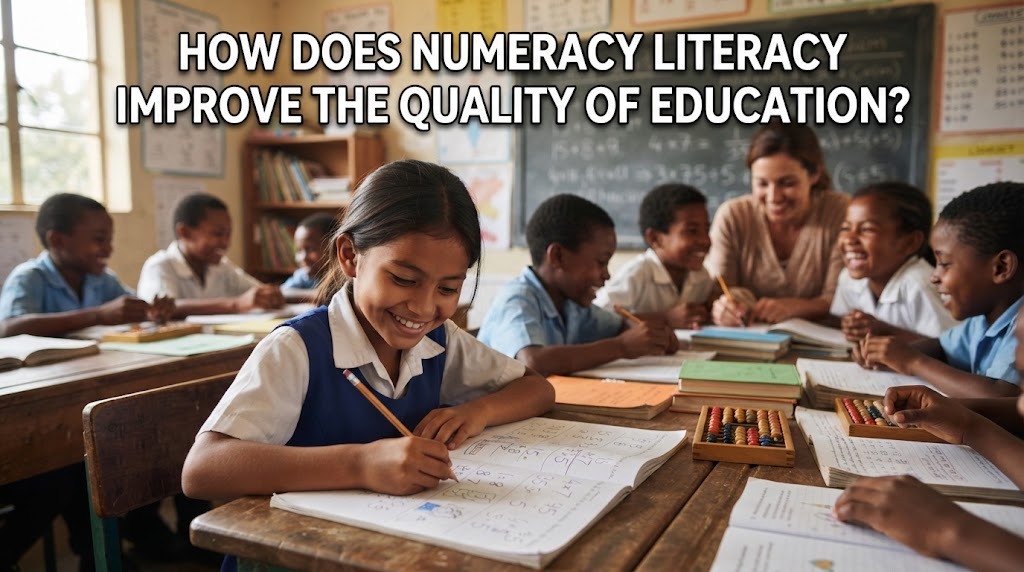
Numeracy literacy plays an important role in improving the quality of education because it helps students understand, interpret, and use mathematical information in everyday life. It is not only about learning numbers or solving mathematical problems but also about developing logical thinking, decision-making, and problem-solving skills. In modern education, students need these abilities to understand lessons, analyze information, and face real-world challenges. By developing numeracy literacy, schools can create more effective learning experiences and prepare students for future academic and professional opportunities.
WHAT IS NUMERACY LITERACY?
Numeracy literacy is the ability to understand and use mathematical concepts in different situations. It includes basic skills such as counting, measuring, calculating, interpreting data, and understanding patterns. Students with good numeracy literacy can apply mathematical knowledge to practical situations rather than simply memorizing formulas. For example, they can calculate expenses, compare prices, read graphs, and understand information presented through percentages.
Numeracy literacy also involves critical thinking and the ability to make decisions based on numerical information. These skills are important because mathematics is connected to many subjects, including science, economics, geography, and technology. When students understand how numbers work in real situations, they become more confident in learning and applying knowledge. Therefore, numeracy literacy is an essential foundation for meaningful education.
WHY IS NUMERACY LITERACY IMPORTANT IN EDUCATION?
Numeracy literacy is important because it helps students develop a deeper understanding of academic subjects. Mathematics is not limited to the classroom, as numerical information appears in many areas of learning. Students need to understand measurements in science, statistics in social studies, and calculations in economics. Without sufficient numeracy skills, they may struggle to understand important concepts and complete academic tasks effectively.
Furthermore, numeracy literacy encourages students to think logically and solve problems independently. Instead of relying only on memorized answers, they learn to identify problems, analyze available information, and select suitable solutions. This process improves their ability to learn actively and understand lessons more clearly. As a result, numeracy literacy contributes to better academic performance and overall educational development.
HOW DOES NUMERACY LITERACY IMPROVE STUDENTS' CRITICAL THINKING?
Numeracy literacy strengthens critical thinking by teaching students how to analyze information and evaluate different possibilities. When solving mathematical problems, students must understand the situation, identify relevant data, and choose an appropriate method. These activities train them to think carefully before making conclusions. Over time, they become more capable of examining information rather than accepting every result without questioning it.
In addition, numeracy literacy helps students recognize patterns, compare evidence, and identify errors in calculations or data interpretation. For example, students can use graphs to understand changes in population or compare statistics from different sources. These experiences improve their reasoning abilities and encourage independent learning. Critical thinking developed through numeracy literacy can also support students when facing challenges outside the classroom.
HOW DOES NUMERACY LITERACY SUPPORT BETTER LEARNING OUTCOMES?
Numeracy literacy supports better learning outcomes by helping students understand lessons more effectively. Students who have strong numerical skills can follow instructions involving calculations, measurements, tables, and statistical information. This makes it easier for them to connect different concepts and complete assignments accurately. When students understand the basic mathematical ideas behind a lesson, they are more likely to participate actively in classroom activities.
Teachers can also use numeracy-based learning activities to make lessons more practical and interesting. For example, students can collect data, calculate results, create charts, and discuss their findings through group projects. These activities allow them to learn through direct experience instead of depending entirely on textbooks. Consequently, numeracy literacy can improve understanding, learning motivation, and students' confidence in their academic abilities.
WHAT IS THE ROLE OF TEACHERS IN DEVELOPING NUMERACY LITERACY?
Teachers have an important responsibility in developing numeracy literacy because they guide students in understanding and applying mathematical concepts. They can introduce numerical activities through real-life examples, such as calculating shopping expenses, measuring classroom objects, or interpreting simple statistics. These approaches help students understand that mathematics is useful in everyday situations. Teachers should also provide clear explanations and opportunities for students to practice different problem-solving methods.
Another important role is creating a supportive learning environment where students feel comfortable asking questions and making mistakes. Teachers can use interactive discussions, educational games, group assignments, and digital learning tools to improve engagement. They should also identify students who experience difficulties and provide additional guidance based on their learning needs. With consistent support, students can gradually develop stronger numerical understanding and confidence.
HOW CAN SCHOOLS IMPROVE NUMERACY LITERACY?
Schools can improve numeracy literacy by integrating mathematical thinking into different subjects and classroom activities. Instead of teaching numeracy only during mathematics lessons, schools can encourage students to interpret data in science, calculate budgets in economics, and understand measurements in practical projects. This approach helps students recognize the connection between mathematics and real-world experiences. It also makes learning more relevant and meaningful.
Schools should also provide appropriate learning resources, teacher training, and regular assessments. Educational technology, interactive exercises, and practical learning materials can help students understand difficult concepts more easily. Regular assessments allow teachers to identify learning gaps and adjust their teaching strategies. By working together, school leaders, teachers, students, and parents can build a learning environment that supports continuous improvement in numeracy skills.
WHAT ARE THE BENEFITS OF NUMERACY LITERACY FOR FUTURE CAREERS?
Numeracy literacy provides valuable skills that students can use when entering higher education and the professional world. Many careers require the ability to understand numbers, analyze information, manage budgets, and make decisions based on data. Fields such as business, engineering, healthcare, finance, technology, and education all involve numerical reasoning. Students who develop these abilities during school can become better prepared to face future academic and professional responsibilities.
Beyond career preparation, numeracy literacy also supports financial awareness and responsible decision-making. Individuals need numerical skills to manage personal expenses, understand savings, compare financial options, and evaluate information. These abilities help people become more independent and confident in everyday life. Therefore, improving numeracy literacy is not only an investment in academic achievement but also an important step toward lifelong learning.
CONCLUSION
Numeracy literacy improves the quality of education by strengthening students' mathematical understanding, critical thinking, problem-solving abilities, and academic performance. It helps students connect classroom knowledge with real-life situations while preparing them for higher education and future careers. Teachers and schools play an essential role by providing practical learning activities, supportive teaching methods, and appropriate educational resources.
Developing numeracy literacy should become a shared priority because education is not only about memorizing information but also about applying knowledge effectively. When students can understand and use numerical information confidently, they become more independent learners and better prepared to face modern challenges. Ultimately, stronger numeracy literacy contributes to more meaningful, inclusive, and higher-quality education.
Recent Posts

Bagaimana Sistem SKS pada Program Kuliah... 22.11.2026/31 View

How Does Technology Make Daily Evaluation... 21.11.2026/67 View

Apa Strategi Menghadapi Kesenjangan antara Kompetensi... 21.11.2026/66 View

Mengapa Inventaris Aset Penting bagi Kelancaran... 21.11.2026/64 View

When Should Musicians Join a Record... 21.11.2026/65 View
