

How Does Numerical Practice Improve Calculation Speed?
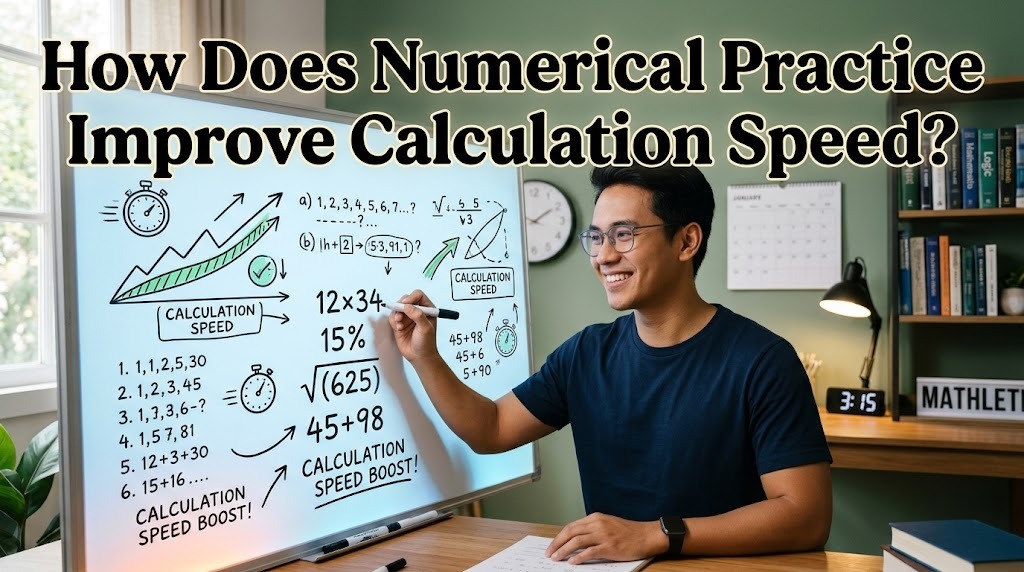
Calculation speed is an important skill in numerical reasoning tests, especially when candidates must solve multiple questions within a limited time. These assessments often involve percentages, ratios, averages, number sequences, and data interpretation. Candidates need to understand numerical information and complete calculations accurately without spending too much time on individual questions.
Regular numerical practice can help develop faster and more efficient calculation skills. By solving different types of problems repeatedly, candidates become more familiar with mathematical operations, recognize patterns more quickly, and learn to choose suitable methods. However, improving calculation speed does not simply mean working faster. It also requires maintaining accuracy and understanding the reasoning behind each solution.
BUILDING FAMILIARITY WITH MATHEMATICAL OPERATIONS
One way numerical practice improves calculation speed is by making basic mathematical operations more familiar. Repeatedly working with addition, subtraction, multiplication, and division helps candidates become more comfortable handling numerical information.
When these operations become familiar, candidates spend less time thinking about basic calculations. They can focus more attention on understanding the question and selecting the appropriate solution method.
Consistent practice also helps reduce hesitation when dealing with larger numbers or calculations involving several steps. As a result, candidates can complete routine mathematical operations more efficiently.
RECOGNIZING NUMERICAL PATTERNS FASTER
Numerical reasoning questions frequently involve patterns and relationships between numbers. Candidates may need to identify sequences, determine differences, or recognize multiplication and division rules.
Regular practice helps candidates become familiar with common numerical patterns. For example, they may learn to recognize sequences involving constant addition, multiplication, alternating operations, or differences that increase gradually.
This familiarity reduces the time needed to analyze each problem. Instead of testing every possible operation, candidates can identify promising patterns and verify whether they match the sequence.
IMPROVING MENTAL CALCULATION SKILLS
Mental calculation allows candidates to solve certain problems without writing down every mathematical step. This ability can save time during numerical assessments, particularly when questions involve simple operations or familiar number relationships.
Through regular practice, candidates can improve their ability to calculate percentages, estimate values, and perform basic arithmetic mentally. They also become more comfortable breaking complicated numbers into smaller parts.
For example, calculating 15% of 200 can be simplified by finding 10% and 5% separately. Practicing methods like this helps candidates develop efficient approaches without sacrificing accuracy.
DEVELOPING MORE EFFICIENT SOLVING METHODS
Not every numerical problem requires a long calculation. Some questions can be solved through estimation, simplification, or alternative mathematical methods.
Numerical practice helps candidates discover which approaches are suitable for different problem types. They can learn to simplify fractions, compare ratios, or use percentage relationships instead of performing unnecessary calculations.
Choosing an efficient method can reduce the number of steps required to reach an answer. However, candidates should still make sure that the method is mathematically valid and appropriate for the question.
REDUCING CALCULATION ERRORS
Calculation speed is closely connected to accuracy. Candidates who frequently make mistakes may need to repeat calculations, which takes additional time and can affect their overall performance.
Regular practice helps candidates understand where errors commonly occur. They can become more careful when handling decimal numbers, negative values, percentages, and multi-step calculations.
Reviewing incorrect answers is particularly important. By identifying the cause of each mistake, candidates can improve their calculation habits and avoid repeating the same errors in future assessments.
STRENGTHENING NUMBER SENSE
Number sense refers to the ability to understand numerical values, relationships, and mathematical quantities. It helps individuals recognize whether an answer is reasonable without relying entirely on detailed calculations.
Through consistent practice, candidates can become more familiar with numerical relationships. They may recognize approximate values, compare quantities, and identify whether a result is unusually high or low.
Strong number sense also supports estimation. Instead of calculating every detail immediately, candidates can sometimes estimate the expected result and use it to evaluate possible answers.
INCREASING CONFIDENCE WHEN SOLVING QUESTIONS
Lack of confidence can cause candidates to hesitate, repeatedly check simple calculations, or avoid attempting unfamiliar questions. These habits can reduce the amount of time available during an assessment.
Numerical practice provides opportunities to become familiar with different question formats. As candidates gain experience, they may feel more comfortable selecting calculation methods and working through challenging problems.
Confidence should still be supported by mathematical understanding. Candidates need to verify their reasoning rather than selecting answers based only on familiarity or intuition.
IMPROVING TIME MANAGEMENT DURING TESTS
Numerical assessments often have time limits, so candidates must distribute their attention effectively. Spending too long on one difficult calculation can leave insufficient time for other questions.
Practicing with a timer helps candidates understand how long different question types usually take. They can learn to recognize easier questions, prioritize problems they can solve confidently, and return to more difficult ones when time allows.
This approach encourages a better balance between speed and accuracy. Candidates also become more aware of their working pace and can adjust their strategy during practice sessions.
PRACTICAL WAYS TO IMPROVE CALCULATION SPEED
Improving calculation speed requires a consistent routine rather than occasional practice. Candidates should focus on developing basic arithmetic skills, understanding mathematical concepts, and applying efficient methods.
Several practical strategies can support this process:
- Practice Daily: Spend a short amount of time solving arithmetic and numerical reasoning questions.
- Use a Timer: Complete practice exercises within a set period to develop a consistent working pace.
- Review Mistakes: Identify incorrect steps and understand why the calculations failed.
- Learn Shortcuts: Practice valid methods for simplifying fractions, calculating percentages, and estimating values.
- Try Different Questions: Work with sequences, ratios, averages, graphs, and tables to build flexibility.
- Measure Progress: Compare completion time and accuracy across practice sessions.
- Maintain Accuracy: Avoid rushing calculations simply to finish questions more quickly.
Candidates should gradually increase the difficulty of their exercises as their skills improve. Starting with basic calculations and moving toward multi-step problems can help create a stronger foundation.
CONCLUSION
Numerical practice improves calculation speed by strengthening familiarity with mathematical operations, developing mental calculation skills, and helping candidates recognize numerical patterns. It also encourages more efficient problem-solving methods, reduces repeated errors, and builds confidence when working under time pressure.
However, speed should not become the only goal. Candidates need to maintain accuracy while learning how to solve problems efficiently. With consistent practice, careful evaluation, and effective time management, they can develop stronger numerical reasoning skills and improve their performance in numerical assessments.
Recent Posts

Bagaimana Sistem SKS pada Program Kuliah... 22.11.2026/40 View

How Does Technology Make Daily Evaluation... 21.11.2026/71 View

Apa Strategi Menghadapi Kesenjangan antara Kompetensi... 21.11.2026/73 View

Mengapa Inventaris Aset Penting bagi Kelancaran... 21.11.2026/69 View

When Should Musicians Join a Record... 21.11.2026/73 View
