

How Does Poor Lighting Affect Robotic Color Recognition?
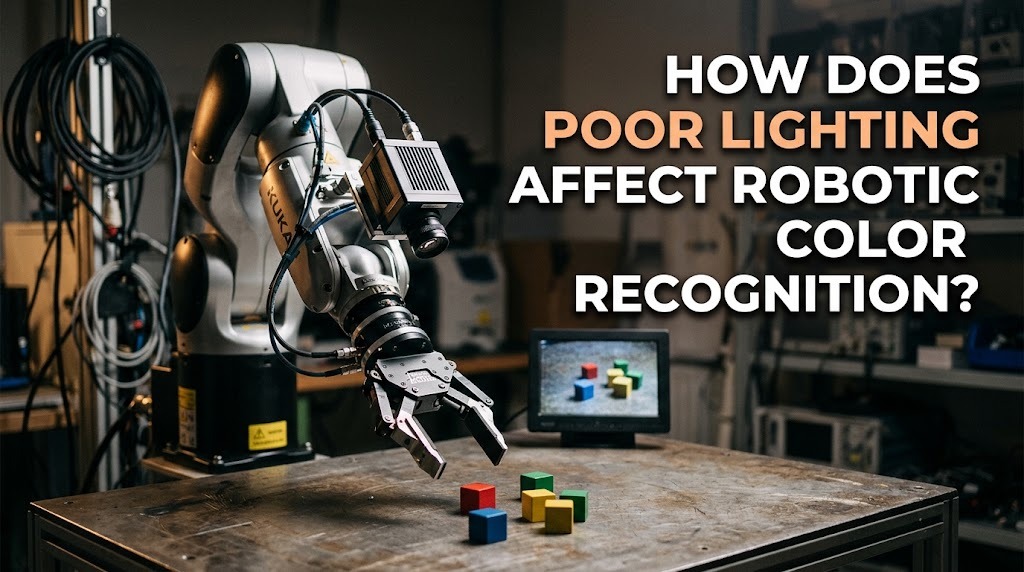
Robots often rely on computer vision to identify objects, sort products, and navigate their surroundings. One important capability is color recognition, which allows robots to distinguish objects based on their visual characteristics. However, lighting conditions can significantly affect how accurately a robot detects colors. Poor lighting may cause colors to appear different from their actual appearance, leading to classification errors and unreliable decisions. Understanding these effects helps engineers develop more dependable robotic vision systems.
HOW ROBOTS RECOGNIZE COLORS
Robots typically recognize colors using cameras and image-processing algorithms. A camera captures light reflected from an object's surface and converts it into digital pixel values. Software then analyzes these values using color representations such as RGB or HSV to distinguish different colors. Some systems also use machine learning to classify objects based on their visual features. The accuracy of this process depends on camera quality, sensor calibration, image-processing methods, and the lighting environment.
THE EFFECT OF LOW LIGHT INTENSITY
Insufficient lighting reduces the amount of light reaching a camera sensor. As a result, images may appear dark, details can become difficult to distinguish, and sensor noise may increase. These conditions make it harder for a robot to separate similar colors, such as dark blue and black. A robot sorting products on a conveyor belt may therefore assign an object to the wrong category. Increasing illumination or adjusting camera exposure can help, although excessive exposure adjustments may introduce other image-quality problems.
COLOR DISTORTION CAUSED BY LIGHT SOURCES
Different light sources produce different color temperatures and spectral distributions. For example, warm lighting can make white surfaces appear yellowish, while some artificial lights may emphasize particular wavelengths. These changes can alter the camera's recorded color values even when the object itself remains unchanged. Without proper white balance and color calibration, a robot may interpret the same object differently under different lighting conditions. Consistent illumination helps reduce these variations and improves recognition reliability.
SHADOWS AND UNEVEN ILLUMINATION
Shadows occur when objects block light from reaching certain areas of a scene. They can create dark regions across an object's surface, making one part appear to have a different color from another. Uneven illumination may also produce bright reflections or glare that hide the original surface color. These effects can confuse image-processing algorithms and reduce the accuracy of object classification. Diffused lighting, carefully positioned light sources, and shadow-resistant image-processing techniques can help address these problems.
HOW POOR LIGHTING INCREASES RECOGNITION ERRORS
Color recognition systems often compare pixel values with predefined thresholds or patterns learned from training images. When lighting changes, the recorded values may move outside the expected range, causing incorrect classifications. For example, a robot designed to identify ripe red fruit might struggle when the fruit is partially shaded or illuminated by colored light. These errors can affect automated inspection, agricultural harvesting, packaging, and material sorting. Reliable performance requires systems that can handle realistic variations in brightness and color.
METHODS TO IMPROVE ROBOTIC COLOR RECOGNITION
Engineers can improve color recognition by controlling illumination and optimizing the vision system. Diffused LED lighting can provide consistent brightness, while camera calibration helps maintain accurate color measurements. White-balance correction and color normalization can reduce the effects of different light sources. More advanced systems may use machine learning models trained on images captured under varied lighting conditions. Combining color information with shape, texture, depth, or other sensor data can further improve object identification when color alone is insufficient.
THE ROLE OF ARTIFICIAL INTELLIGENCE
Artificial intelligence can help robots recognize colors under changing environmental conditions. Machine learning models trained with diverse examples may learn to distinguish meaningful color features despite moderate changes in brightness, shadows, and exposure. Image-enhancement algorithms can also improve visibility before classification. However, AI cannot fully compensate for missing visual information, severe glare, or extremely poor image quality. Reliable results still depend on suitable sensors, adequate lighting, representative training data, and regular system testing.
APPLICATIONS IN INDUSTRIAL AND SERVICE ROBOTS
Accurate color recognition is useful in many robotic applications. In manufacturing, robots can inspect painted surfaces, identify colored components, and detect product defects. In agriculture, robots may use color information to estimate fruit ripeness or distinguish plants from surrounding objects. Warehouse robots can also sort packages or items based on color-coded labels. In each application, poor lighting can reduce efficiency and cause incorrect decisions, making environmental control and robust vision algorithms important parts of system design.
CONCLUSION
Poor lighting affects robotic color recognition by reducing image brightness, changing recorded color values, and introducing shadows or glare. These problems can lead to incorrect object classification and lower automation accuracy. Consistent illumination, camera calibration, image processing, and AI-based recognition can help reduce errors. By designing vision systems for realistic lighting conditions, engineers can improve the reliability of robots in industrial, agricultural, and everyday environments.
Recent Posts

Bagaimana Sistem SKS pada Program Kuliah... 22.11.2026/49 View

How Does Technology Make Daily Evaluation... 21.11.2026/77 View

Apa Strategi Menghadapi Kesenjangan antara Kompetensi... 21.11.2026/78 View

Mengapa Inventaris Aset Penting bagi Kelancaran... 21.11.2026/74 View

When Should Musicians Join a Record... 21.11.2026/79 View
