

How Does Population Density Affect Job Availability?
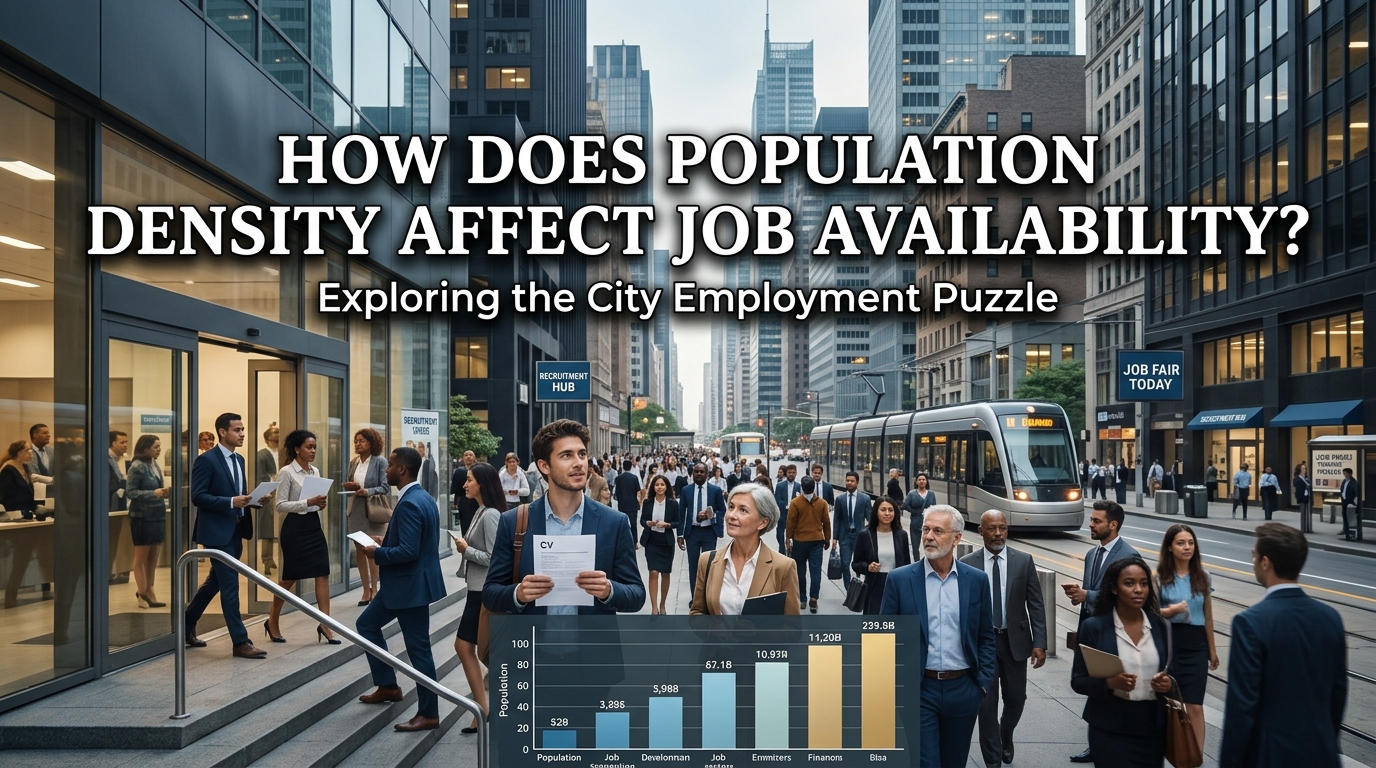
Population density plays an important role in shaping employment opportunities in different regions. Areas with large populations often have more workers, consumers, businesses, and economic activities. This can encourage companies to establish operations, expand their services, and create additional jobs. However, a high population density does not always guarantee that everyone can find employment because the number of available jobs may not grow as quickly as the workforce.
The relationship between population density and job availability depends on several factors, including economic development, business investment, education, infrastructure, and labor market conditions. Densely populated cities may offer a wider range of employment opportunities, while less populated regions may have fewer vacancies but also less competition. Understanding this relationship helps governments, businesses, and job seekers make better decisions about employment and regional development.
UNDERSTANDING THE RELATIONSHIP BETWEEN POPULATION DENSITY AND JOB AVAILABILITY
Population density refers to the number of people living within a specific unit of land area, usually measured in people per square kilometer. Meanwhile, job availability describes the number and variety of employment opportunities accessible to people in a particular region. These two factors are connected because population concentration influences the supply of workers, consumer demand, and business activities.
In densely populated areas, companies often have access to a larger labor force and a broader customer base. This can encourage businesses to open new branches, establish factories, and expand commercial services. As economic activities increase, the demand for workers may also rise. However, if the number of job seekers grows faster than employment opportunities, competition for available positions can become more intense.
WHY HIGH POPULATION DENSITY CAN INCREASE JOB OPPORTUNITIES
High population density can encourage economic growth by creating a large market for products and services. Businesses are often attracted to areas where many potential customers live because they have greater opportunities to sell their products. As a result, densely populated cities tend to support various industries, including retail, transportation, healthcare, education, hospitality, and finance. The expansion of these industries can generate employment opportunities for people with different skills and educational backgrounds.
Another advantage is the concentration of business networks and economic resources. Large cities often have better access to transportation, communication facilities, suppliers, and financial institutions. These conditions can make it easier for companies to operate and expand their businesses. Furthermore, business expansion and investment can create both direct employment, such as office and factory positions, and indirect employment through suppliers, logistics providers, and other supporting services.
HOW HIGH POPULATION DENSITY INCREASES JOB COMPETITION
Although densely populated areas may offer more employment opportunities, they also attract a large number of job seekers. When many people compete for the same positions, companies can become more selective during recruitment. Applicants may need stronger qualifications, relevant work experience, and specialized skills to stand out from other candidates. This situation is particularly common in major cities where attractive jobs receive applications from people across different regions.
High competition can also create challenges for new graduates and workers with limited experience. Some applicants may struggle to secure permanent employment and accept temporary, informal, or lower-paid jobs instead. In certain industries, the number of available workers may exceed the demand for labor, contributing to unemployment or underemployment. Therefore, a larger labor force does not automatically mean better employment conditions.
THE IMPACT OF POPULATION DENSITY ON DIFFERENT INDUSTRIES
Population density affects industries differently depending on their products, services, and labor requirements. In densely populated cities, the retail, food, healthcare, education, and transportation sectors often experience higher demand because they serve large numbers of residents. For example, supermarkets, restaurants, hospitals, schools, and delivery companies may need additional employees to handle increasing customer demand. This creates opportunities for workers with different levels of education and professional experience.
Meanwhile, industries such as manufacturing, construction, and technology may expand in densely populated areas when infrastructure, investment, and skilled workers are available. However, not every industry benefits equally from population concentration. Some businesses require large amounts of land, lower operating costs, or access to specific natural resources, making less densely populated regions more attractive. Consequently, job availability depends not only on population density but also on the economic characteristics of each region.
THE DIFFERENCE BETWEEN URBAN AND RURAL EMPLOYMENT OPPORTUNITIES
Urban areas generally provide a wider variety of employment opportunities because they have more businesses, industries, and commercial activities. Residents may find jobs in finance, information technology, education, healthcare, tourism, manufacturing, and professional services. Cities also tend to have more training institutions and professional networks that help workers develop their careers. However, urban employment markets can be highly competitive, and the cost of living may reduce the financial benefits of higher salaries.
In contrast, rural areas often have employment opportunities concentrated in agriculture, fisheries, forestry, local trade, and small businesses. Although job options may be more limited, some rural occupations offer opportunities that are closely connected to local resources and community needs. Rural regions can also create new employment through tourism, food processing, renewable energy, and digital businesses. Developing rural economies is important because it can reduce excessive migration to major cities and create a more balanced distribution of employment opportunities.
FACTORS THAT DETERMINE JOB AVAILABILITY IN DENSELY POPULATED AREAS
Several factors influence whether high population density leads to more employment opportunities. One of the most important is economic growth. Regions with expanding industries, increasing business investment, and strong consumer demand are generally more capable of creating new jobs. However, areas with weak economic activity may struggle to provide sufficient employment even when they have large populations.
Another important factor is the quality of education and workforce skills. Employers need workers whose qualifications match the requirements of available positions. If the labor force lacks relevant technical knowledge or professional abilities, companies may experience difficulties finding suitable employees despite a large number of applicants. Infrastructure, government policies, technological development, and access to business financing also influence employment growth. These factors determine how effectively a region can turn its population into a productive workforce.
HOW GOVERNMENTS CAN IMPROVE JOB AVAILABILITY
Governments can improve job availability by encouraging investment and supporting the development of different economic sectors. Providing business incentives, improving transportation infrastructure, and simplifying certain business procedures can attract companies and encourage existing businesses to expand. Governments can also support small and medium-sized enterprises because these businesses play an important role in creating employment opportunities. A stronger business environment can help absorb a growing labor force.
In addition, education and vocational training are essential for preparing workers to meet changing labor market demands. Governments can cooperate with educational institutions and companies to provide practical training, internships, and professional certification programs. Supporting entrepreneurship and digital skills development can also help people access new employment opportunities. Furthermore, promoting investment in smaller cities and rural regions can distribute jobs more evenly and reduce excessive competition in major metropolitan areas.
CONCLUSION
Population density affects job availability by influencing the size of the labor force, consumer demand, business development, and economic activities. Densely populated areas often offer more diverse employment opportunities because businesses can access larger markets and more workers. However, they may also experience intense job competition when the number of applicants increases faster than the number of available positions.
The impact of population density on employment depends on economic growth, workforce skills, infrastructure, business investment, and government policies. To create a balanced labor market, governments need to encourage regional development, improve education, support businesses, and provide relevant vocational training. With effective planning, population concentration can become an economic advantage that supports job creation and improves people's living standards.
Recent Posts

Bagaimana Sistem SKS pada Program Kuliah... 22.11.2026/33 View

How Does Technology Make Daily Evaluation... 21.11.2026/67 View

Apa Strategi Menghadapi Kesenjangan antara Kompetensi... 21.11.2026/67 View

Mengapa Inventaris Aset Penting bagi Kelancaran... 21.11.2026/65 View

When Should Musicians Join a Record... 21.11.2026/66 View
