

How Does Scientific Literacy Help People Face Modern Challenges?
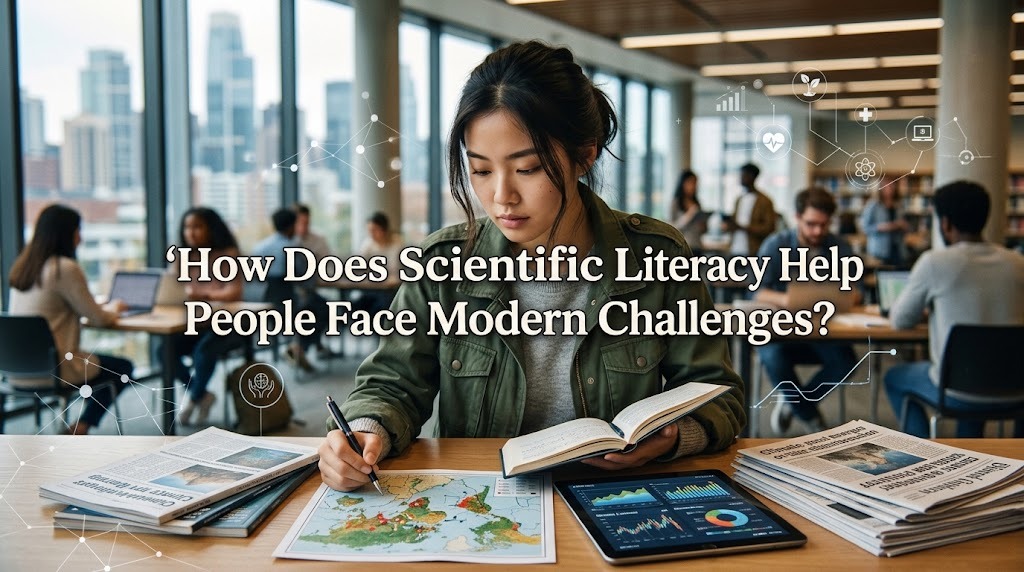
UNDERSTANDING SCIENTIFIC LITERACY IN MODERN LIFE
Scientific literacy is the ability to understand scientific concepts, evaluate evidence, and apply scientific knowledge to real situations. In modern life, people are surrounded by information about technology, health, climate, energy, and the environment. Scientific literacy helps people understand these topics more carefully and recognize the difference between reliable information and unsupported claims. It also encourages people to ask questions before accepting information as true. These abilities are increasingly important as modern challenges become more complex.
Scientific literacy is not simply about memorizing facts from science lessons. It involves reasoning, evaluating evidence, interpreting information, and making informed judgments. People can use these skills when they encounter new technologies, environmental problems, or scientific discussions in the media. A strong understanding of science can make it easier to respond thoughtfully to changes in society. It also helps people recognize when additional information is needed before reaching a conclusion.
DEALING WITH RAPID TECHNOLOGICAL DEVELOPMENT
Technology continues to influence education, communication, transportation, workplaces, and everyday activities. Scientific literacy helps people understand the basic principles, benefits, and limitations behind many technological developments. This understanding can make it easier to consider how a technology works and what factors should be considered before using it. People can also recognize that technology can provide useful solutions while still having limitations or potential challenges. Such knowledge supports responsible use of technological innovations.
Modern technologies can also introduce unfamiliar scientific concepts. For example, people may encounter discussions about artificial intelligence, renewable energy, biotechnology, or digital systems. Scientific literacy does not require everyone to become an expert in these fields, but it provides a foundation for understanding important information about them. By asking questions and examining evidence, people can develop a clearer understanding of technological developments. This can help them adapt to changes while avoiding unsupported assumptions.
UNDERSTANDING HEALTH AND ENVIRONMENTAL ISSUES
Modern society faces many issues involving public health and environmental changes. People may encounter information about nutrition, infectious diseases, pollution, climate, water resources, and energy consumption. Scientific literacy helps them understand the evidence behind explanations and recommendations related to these topics. It also allows people to recognize that scientific information may contain uncertainty and can develop as new research becomes available. This encourages more careful interpretation of important information.
Environmental challenges often involve several connected factors. Scientific literacy can help people understand concepts related to climate change, ecosystems, biodiversity, pollution, and natural resources. By learning how scientific evidence is collected and interpreted, people can better understand why environmental problems occur and how different factors influence them. This knowledge can support informed discussions about environmental issues. It can also encourage people to consider the consequences of everyday actions on the surrounding environment.
FACING MISINFORMATION IN THE DIGITAL ERA
The rapid spread of information online creates another important challenge. Social media and digital platforms allow scientific claims to reach large audiences very quickly, but not all online information is accurate or supported by evidence. Scientific literacy helps people evaluate the source, evidence, context, and reasoning behind a claim. They can compare information with credible scientific sources before deciding whether it should be trusted or shared. This habit can reduce the influence of misleading scientific information.
Critical evaluation is especially important when information uses scientific language to appear convincing. A claim may include numbers, charts, or references without providing enough context to support its conclusion. People with stronger critical thinking and information evaluation skills can examine whether the evidence is relevant and sufficient. They can also recognize when a statement represents an opinion rather than a scientific finding. These abilities are valuable when navigating large amounts of digital information.
DEVELOPING PROBLEM SOLVING AND ADAPTABILITY
Modern challenges often require people to understand problems and consider possible solutions. Scientific literacy supports problem solving by encouraging people to define a problem, gather relevant information, analyze evidence, and consider possible explanations. These steps can help people approach unfamiliar situations in a more systematic way. Scientific thinking can also encourage people to test ideas and learn from results. This makes scientific literacy useful when facing changing conditions.
Adaptability is another important skill in a rapidly changing world. New discoveries and technologies can change how people study, work, communicate, and solve problems. Scientific literacy encourages people to remain open to new evidence and willing to update their understanding when reliable information changes. This does not mean accepting every new claim without examination. Instead, it means using evidence and reasoning to respond appropriately to new developments.
CONCLUSION
Scientific literacy helps people face modern challenges by improving their ability to understand scientific information, evaluate evidence, and apply knowledge to real situations. It can support people when dealing with technological development, health issues, environmental changes, and digital misinformation. Scientific literacy also strengthens critical thinking, problem solving, and the ability to adapt when new evidence or technologies emerge. These skills allow people to approach complex issues with greater understanding and care. Therefore, developing scientific literacy is an important part of preparing individuals to participate responsibly in modern society.
Recent Posts

Bagaimana Sistem SKS pada Program Kuliah... 22.11.2026/33 View

How Does Technology Make Daily Evaluation... 21.11.2026/67 View

Apa Strategi Menghadapi Kesenjangan antara Kompetensi... 21.11.2026/67 View

Mengapa Inventaris Aset Penting bagi Kelancaran... 21.11.2026/65 View

When Should Musicians Join a Record... 21.11.2026/66 View
