

How Does Scientific Literacy Help Students Understand Scientific Information?
WHAT IS SCIENTIFIC LITERACY?
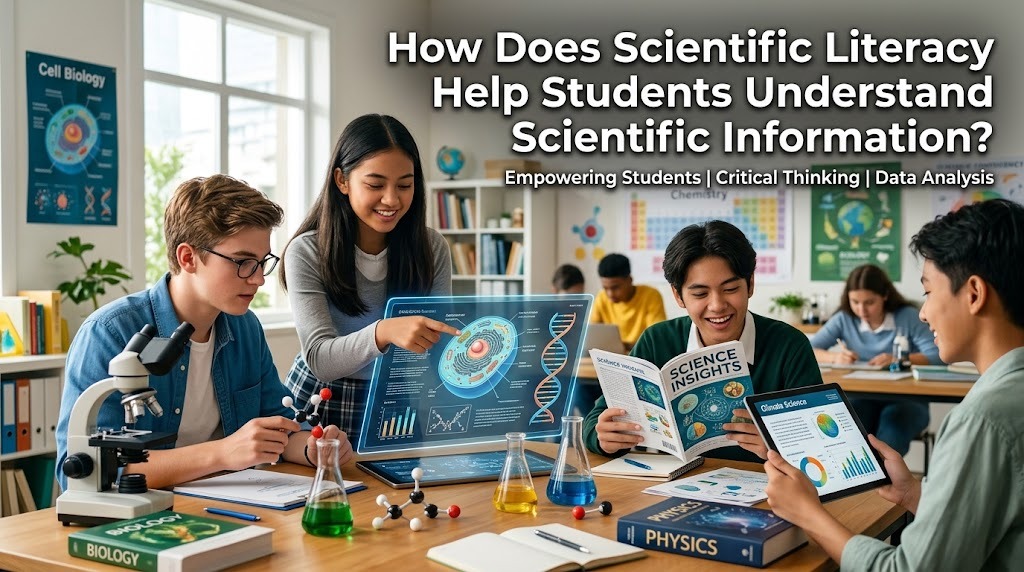
Scientific literacy is the ability to understand, evaluate, and use scientific information in daily life. It helps students recognize how science works and how scientific knowledge is developed through observation, evidence, testing, and reasoning. Scientific literacy is not only about memorizing scientific facts but also about understanding how those facts can be applied to real situations. Students with good scientific literacy can ask relevant questions and look for reliable evidence before accepting information. This ability is increasingly important because students encounter scientific content through books, websites, social media, videos, and other digital platforms.
Scientific literacy also helps students understand that scientific knowledge can develop when new evidence becomes available. They can learn to distinguish between information supported by evidence and claims based mainly on personal opinions. As a result, students become more careful when reading or sharing information about health, technology, the environment, and other scientific topics.
HOW SCIENTIFIC LITERACY HELPS STUDENTS READ SCIENTIFIC INFORMATION
Students regularly encounter scientific information in textbooks, online articles, news reports, educational videos, and social media. Scientific literacy helps them identify the main idea, understand scientific terms, and connect information with relevant concepts. Students can also examine whether a statement is supported by appropriate data or evidence. Instead of accepting every claim immediately, they learn to consider where the information comes from and how it was produced. This process makes their understanding of scientific information more accurate.
Another important benefit is the ability to interpret different forms of information. Scientific information may be presented through graphs, tables, diagrams, statistics, or written explanations. Students need to understand what these forms of information show and avoid drawing conclusions that are not supported by the available evidence. By practicing these skills, students can become more confident when studying scientific subjects and evaluating information independently.
EVALUATING THE RELIABILITY OF SCIENTIFIC INFORMATION
The internet provides students with access to a huge amount of information, but not all of it is reliable. Scientific literacy gives students tools to evaluate information critically before believing or using it. They can examine the source, the evidence presented, the date of publication, and whether the claims are consistent with established scientific knowledge. Students can also compare information from several trustworthy sources instead of relying on a single webpage or social media post. These habits can reduce the risk of misunderstanding scientific issues.
Students should also recognize the difference between scientific evidence and unsupported claims. For example, a social media post may present a health claim without explaining how the conclusion was reached. A scientifically literate student can ask whether the claim is supported by credible research and whether important context has been omitted. This approach encourages students to make conclusions based on evidence rather than popularity or emotional reactions.
DEVELOPING CRITICAL THINKING THROUGH SCIENTIFIC LITERACY
Scientific literacy is closely connected to critical thinking because students need to analyze information before reaching a conclusion. When studying a scientific issue, they can identify a question, examine relevant evidence, consider possible explanations, and evaluate the strength of different arguments. These steps encourage students to think logically rather than simply accept information from others. Scientific literacy also helps students understand that different explanations should be compared using evidence. This makes learning more active and meaningful.
Critical thinking becomes especially useful when students face conflicting information. Two sources may discuss the same scientific topic but provide different interpretations or conclusions. Students with stronger scientific literacy can examine the evidence and reasoning behind each claim. They can also recognize uncertainty when the available evidence is limited. This ability helps them develop more balanced and reasonable conclusions.
APPLYING SCIENTIFIC INFORMATION IN EVERYDAY LIFE
Scientific literacy is useful beyond the classroom because students encounter scientific information in many everyday situations. They may need to understand information about nutrition, health, environmental issues, technology, weather, or energy. Scientific literacy helps them connect scientific concepts with practical decisions and understand why certain recommendations are supported by evidence. For instance, students can evaluate information about healthy habits by considering credible scientific sources rather than relying only on popular online content. This makes scientific knowledge more relevant to their daily lives.
Scientific literacy can also help students respond to modern technological changes. New technologies often involve scientific concepts that may be difficult to understand without basic scientific knowledge. By developing the ability to interpret evidence and ask appropriate questions, students can better understand the benefits and limitations of new technologies. They can also become more responsible when using and sharing scientific information with other people.
CONCLUSION
Scientific literacy helps students understand scientific information by developing their ability to read, analyze, evaluate, and apply evidence-based knowledge. It allows students to distinguish reliable information from unsupported claims and understand scientific information presented through different formats. Strong scientific literacy also supports critical thinking, logical reasoning, and informed decision making. These skills are valuable both in education and in everyday life, especially when students face large amounts of information online. Therefore, developing scientific literacy can help students become more careful, informed, and responsible users of scientific information.
Recent Posts

Bagaimana Sistem SKS pada Program Kuliah... 22.11.2026/33 View

How Does Technology Make Daily Evaluation... 21.11.2026/67 View

Apa Strategi Menghadapi Kesenjangan antara Kompetensi... 21.11.2026/67 View

Mengapa Inventaris Aset Penting bagi Kelancaran... 21.11.2026/65 View

When Should Musicians Join a Record... 21.11.2026/66 View
