

How Does Sunlight Create a Double Rainbow?
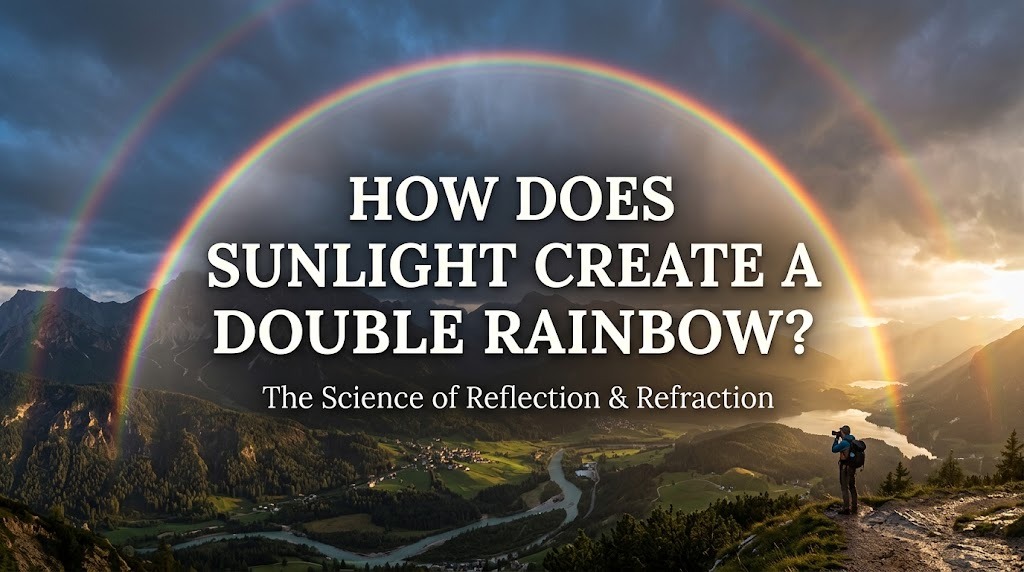
A double rainbow is a natural optical phenomenon that occurs when sunlight interacts with water droplets in the atmosphere and produces two colorful arcs. The primary rainbow is usually brighter, while the secondary rainbow appears outside it with a wider shape and a reversed color sequence. Although this sight may seem extraordinary, it can be explained through the physical behavior of light as it travels through water.
Sunlight creates a double rainbow through three important processes: refraction, dispersion, and internal reflection. These processes determine how light bends, separates into colors, and emerges from water droplets at specific angles. When sunlight follows two different paths inside the droplets, both the primary and secondary rainbows can become visible to an observer.
SUNLIGHT CONTAINS A SPECTRUM OF COLORS
Sunlight often appears white because the different wavelengths of visible light reach our eyes together. However, this light contains a spectrum of colors, including red, orange, yellow, green, blue, and violet. Each color corresponds to a different wavelength, and these wavelengths behave slightly differently when they pass through water.
When sunlight reaches water droplets suspended in the atmosphere, the light can enter the droplets and change direction. Because different wavelengths bend by different amounts, the colors begin to separate. This process, known as dispersion, is essential to rainbow formation. Without the separation of wavelengths, the visible rainbow would not display its familiar range of colors.
HOW REFRACTION BENDS SUNLIGHT INSIDE WATER DROPLETS
Refraction occurs when light changes direction as it passes from one medium into another. When sunlight enters a raindrop from the air, it slows down and bends because water has a different refractive index from air. The direction of the light changes again when it leaves the droplet and returns to the air.
The amount of bending depends on the wavelength of the light and the refractive properties of the water. As a result, red light and violet light emerge at slightly different angles. These differences help create the ordered colors of a rainbow rather than a random mixture of light. Refraction therefore works together with dispersion to determine the appearance and position of the colored arcs.
THE ROLE OF INTERNAL REFLECTION IN CREATING TWO ARCS
Inside a water droplet, sunlight can reflect from the inner surface before exiting. For the primary rainbow, light generally undergoes one internal reflection. After entering the droplet, refracting, and separating into colors, the light reflects internally and then exits toward the observer at an appropriate angle.
The secondary rainbow forms when light undergoes two internal reflections before leaving the droplet. This additional reflection changes the direction in which the light emerges and reduces the amount of light reaching the observer along that path. Because both paths can occur in the same collection of droplets, the two arcs may appear simultaneously. The different reflection paths are the main reason a double rainbow has two distinct arcs.
WHY THE PRIMARY AND SECONDARY RAINBOWS LOOK DIFFERENT
The primary rainbow generally appears brighter because its light undergoes fewer internal reflections. Its colors follow the familiar sequence, with red on the outer edge and violet on the inner edge. The secondary rainbow forms at a larger angular distance from the point directly opposite the Sun and is usually wider and fainter.
The secondary rainbow also has a reversed color order. Violet appears on its outer edge, while red appears on its inner edge. This reversal results from the different path that sunlight takes through the droplets before reaching the observer. The extra reflection also reduces the light intensity, making the secondary arc more difficult to see against a bright background.
THE CONDITIONS NEEDED FOR SUNLIGHT TO CREATE A DOUBLE RAINBOW
Sunlight alone cannot create a double rainbow without suitable water droplets and viewing conditions. Rain, lingering moisture after a shower, waterfalls, and fountains can provide droplets that interact with sunlight. The observer generally needs to face the part of the sky opposite the Sun, with the Sun behind them.
The Sun is often relatively low in the sky when rainbows are visible, which makes morning and late-afternoon conditions favorable. A darker background can help reveal the fainter secondary arc, while a bright sky may make it difficult to distinguish. The distribution of droplets, the strength of sunlight, and the observer's position all influence whether both arcs become visible. These factors explain why a double rainbow may appear clearly in one situation but remain absent or faint in another.
CONCLUSION
Sunlight creates a double rainbow when it enters water droplets, bends through refraction, separates into colors through dispersion, and reflects internally before emerging. The primary rainbow forms through one internal reflection, while the secondary rainbow forms through two. These different optical paths produce two arcs with distinct positions, brightness levels, and color sequences.
The secondary rainbow is generally wider, fainter, and displays its colors in reverse order compared with the primary arc. Both rainbows can appear together when sunlight, water droplets, and the observer's viewing angle align under suitable atmospheric conditions. This phenomenon illustrates how the basic principles of physics explain the colorful patterns that sometimes appear in the sky.
Recent Posts

Bagaimana Sistem SKS pada Program Kuliah... 22.11.2026/54 View

How Does Technology Make Daily Evaluation... 21.11.2026/83 View

Apa Strategi Menghadapi Kesenjangan antara Kompetensi... 21.11.2026/82 View

Mengapa Inventaris Aset Penting bagi Kelancaran... 21.11.2026/78 View

When Should Musicians Join a Record... 21.11.2026/84 View
