

How Does the Learning Environment Affect Student Learning Styles?
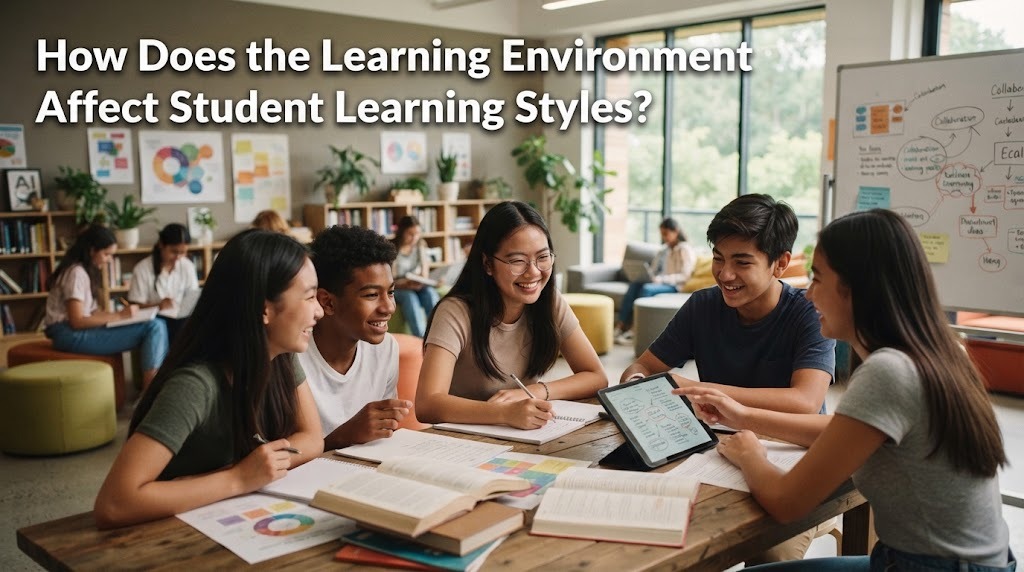
The learning environment plays an important role in how students study and interact with learning materials. A quiet room, a collaborative classroom, or a practical learning space can create different experiences for students. Because students have different preferences and needs, the same environment may not work equally well for everyone.
A suitable learning environment can support concentration, participation, and motivation. It can also encourage students to use different learning strategies, such as reading, listening, discussing, observing, or practicing. However, learning styles should not be viewed as fixed categories because students can adapt their learning methods depending on the situation.
HOW THE LEARNING ENVIRONMENT INFLUENCES LEARNING
The environment can affect how easily students focus on academic tasks. Noise, poor lighting, uncomfortable furniture, or frequent interruptions may make it harder to concentrate. In contrast, an organized and comfortable space can make students feel more prepared to study.
The environment also affects the type of learning activities students can perform. A classroom with presentation equipment may support visual learning activities, while a discussion area can encourage communication and collaboration. A laboratory or workshop can provide opportunities for practical learning and direct experience.
QUIET SPACES CAN SUPPORT FOCUSED LEARNING
Some students concentrate better in quiet environments where there are few distractions. Libraries, study rooms, or quiet areas can be useful for reading, writing, reviewing notes, and completing individual assignments. These spaces can make it easier for students to maintain attention for longer periods.
However, quiet spaces are not necessarily ideal for every activity. Students who need discussion or verbal practice may benefit more from an environment where communication is allowed. Choosing the right space should therefore depend on the task and the student's current learning needs.
SOCIAL ENVIRONMENTS ENCOURAGE COLLABORATIVE LEARNING
A social learning environment allows students to communicate and exchange ideas with others. Group discussions, peer teaching, presentations, and collaborative projects can help students understand topics from different perspectives. These activities can be particularly useful when the learning objective involves communication or problem-solving.
Working with others can also increase participation and motivation. Students can ask questions, receive feedback, and explain concepts to their classmates. However, group learning should remain organized because excessive conversation or unrelated activities can reduce concentration.
VISUAL ENVIRONMENTS SUPPORT VISUAL INFORMATION
Visual elements can make learning materials easier to organize and understand. Charts, diagrams, presentations, illustrations, and written keywords can help students identify important information and relationships between concepts. A well-organized classroom or digital learning platform can also make information easier to find.
Students can create their own visual environment while studying. They may use mind maps, color-coded notes, diagrams, or simple summaries to organize information. These techniques can support understanding without requiring students to depend entirely on visual learning.
PRACTICAL ENVIRONMENTS SUPPORT ACTIVE LEARNING
Some subjects require students to learn by doing rather than only reading or listening. Laboratories, workshops, simulations, field activities, and project-based classrooms provide opportunities to apply concepts directly. These environments can help students connect theoretical knowledge with real situations.
Practical learning can also improve engagement because students participate directly in the learning process. They may perform experiments, solve problems, create products, or practice specific skills. However, practical activities are most effective when students also understand the concepts behind what they are doing.
DIGITAL LEARNING ENVIRONMENTS PROVIDE FLEXIBILITY
Technology has created learning environments that students can access from different locations. Online classrooms, educational videos, digital books, interactive platforms, and discussion forums provide multiple ways to access information. Students can choose materials that match the type of task they need to complete.
Digital environments also allow students to combine different learning methods. For example, they can watch an explanation, read supporting material, take digital notes, and complete online exercises. At the same time, excessive notifications, social media, or unrelated websites can become distractions, so students need to manage their digital environment carefully.
COMFORT AND ORGANIZATION MATTER
Physical comfort can influence how long students can study effectively. Appropriate lighting, good air circulation, a suitable chair, and an organized desk can reduce unnecessary discomfort. When basic physical needs are managed, students may find it easier to focus on academic tasks.
Organization is also important in digital and physical spaces. Students should prepare the materials they need before studying and remove unnecessary distractions. A simple and organized environment can make it easier to begin tasks and maintain a consistent study routine.
HOW TO CHOOSE THE RIGHT LEARNING ENVIRONMENT
Students can choose a learning environment based on the type of activity they plan to complete. Reading and individual assignments may be easier in a quiet space, while group projects may require a collaborative environment. Practical tasks may need a laboratory, workshop, or other suitable facility.
Students can also experiment with different environments and observe the results. They can consider their concentration, understanding, motivation, and ability to complete tasks. This process can help them discover which environments support their learning needs without assuming that one environment will always be the best.
CONCLUSION
The learning environment can influence how students concentrate, participate, communicate, and use different learning strategies. Quiet spaces can support individual study, social environments can encourage collaboration, visual spaces can organize information, and practical environments can support learning through experience.
However, students should not feel limited to one learning style or environment. Different subjects and tasks may require different approaches. By adjusting the environment, reducing distractions, and combining suitable learning methods, students can create a learning experience that is more comfortable and effective.
Recent Posts

Bagaimana Sistem SKS pada Program Kuliah... 22.11.2026/21 View

How Does Technology Make Daily Evaluation... 21.11.2026/64 View

Apa Strategi Menghadapi Kesenjangan antara Kompetensi... 21.11.2026/65 View

Mengapa Inventaris Aset Penting bagi Kelancaran... 21.11.2026/62 View

When Should Musicians Join a Record... 21.11.2026/60 View
